Singapore shares fall as local banks end mixed; STI down 0.1%
Hongkong Land leads gainers on the blue-chip index
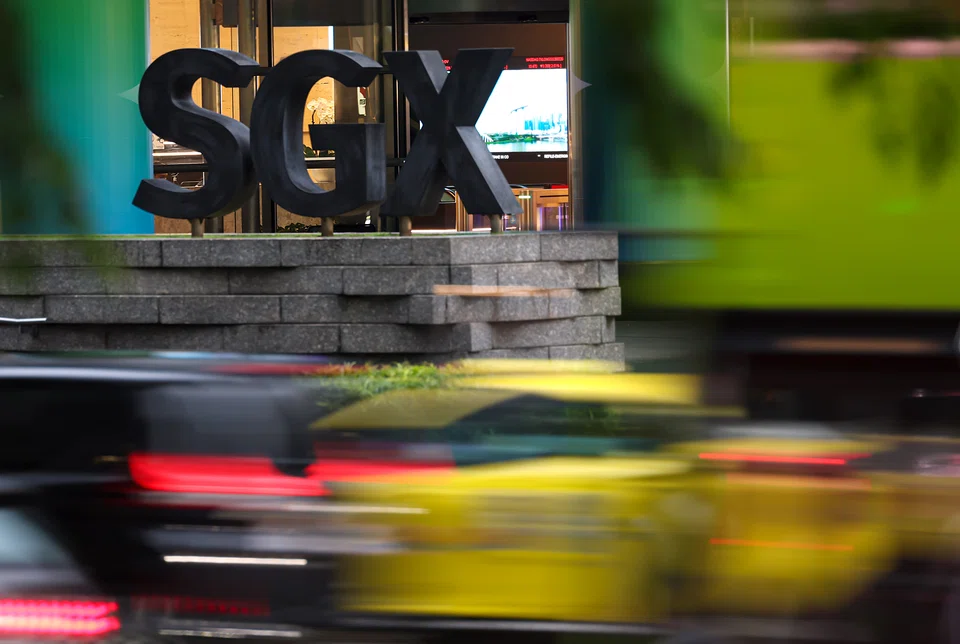
[SINGAPORE] Singapore stocks ended lower on Wednesday (Sep 16). The benchmark Straits Times Index (STI) lost 0.1 per cent or 3.23 points to finish at 5,635.41.
Hongkong Land led the gainers on Singapore’s blue-chip index, rising 1.1 per cent or US$0.09 to US$8.37.
The worst performer among STI constituents was DFI Retail Group , which fell 3.1 per cent or US$0.11 to US$3.45.
The three local banks ended mixed. DBS rose 0.1 per cent or S$0.05 to S$76.80, and OCBC was up 0.6 per cent or S$0.18 at S$31.18, while UOB finished 0.3 per cent or S$0.12 lower at S$41.21.
Within the iEdge Singapore Next 50 Index, First Resources was the top gainer, rising 4.8 per cent or S$0.23 to S$5.06, while UOB Kay Hian was the biggest loser, falling 2 per cent or S$0.08 to S$3.86.
Across the broader market, gainers beat losers 270 to 246, after 1.2 billion securities worth S$1.7 billion changed hands.
Oceanus was the most actively traded stock, with 133.5 million shares changing hands. DBS was the most actively traded stock in terms of value, with 2.8 million shares worth S$217.8 million traded.
Key regional indices were positive. Hong Kong’s Hang Seng Index gained 0.2 per cent, Japan’s Nikkei 225 rose 0.7 per cent and South Korea’s Kospi was up 1.4 per cent.
This comes as the US Federal Reserve is poised for an interest rate hike for the first time in more than three years.
SEE ALSO


Nigel Green, CEO of financial advisory deVere Group, said that the Fed faces a decision that could rattle markets either way, and a hold may be the riskier path.
“A hold today wouldn’t remove what’s building underneath this market. It would only push the moment of reckoning further out, and delay tends to make the eventual response more aggressive, not less,” he added.
This article was written with the assistance of AI and reviewed by a reporter
Decoding Asia newsletter: your guide to navigating Asia in a new global order. Sign up here to get Decoding Asia newsletter. Delivered to your inbox. Free.
Share with us your feedback on BT's products and services