Singapore shares fall as local banks end mixed; STI down 0.1%
DFI Retail Group leads gainers on the blue-chip index
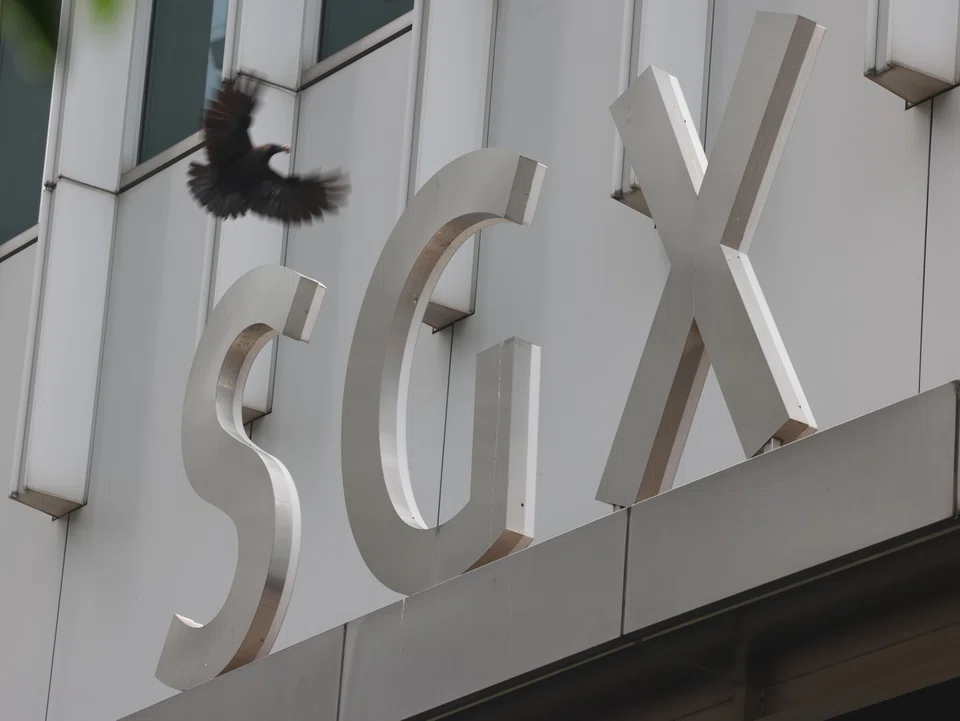
[SINGAPORE] Singapore stocks ended lower on Monday (Oct 19). The benchmark Straits Times Index (STI) lost 0.1 per cent or 3.53 points to finish at 5,412.
DFI Retail Group led the gainers on Singapore’s blue-chip index, rising 1.8 per cent or US$0.06 to US$3.35.
The worst performer among STI constituents was Hongkong Land , which fell 2.1 per cent or US$0.17 to US$8.08.
The three local banks ended mixed on Monday. DBS rose 0.5 per cent or S$0.34 to S$74.45 and UOB was up 0.1 per cent or S$0.03 at S$41.64, while OCBC finished 0.3 per cent or S$0.08 lower at S$28.92.
Within the iEdge Singapore Next 50 Index, UltraGreen.ai was the top gainer, rising 11.6 per cent or US$0.055 to US$0.53, while UOB Kay Hian was the biggest decliner, falling 4.2 per cent or S$0.13 to S$2.98.
Across the broader market, losers beat gainers 276 to 178, after 908.6 million securities worth S$1.6 billion changed hands.
Salt Investments was the most actively traded stock with 124.4 million shares changing hands. DBS was the most actively traded stock in terms of value, with 4.2 million shares worth S$313.2 million traded.
Key regional indices were mixed. Japan’s Nikkei 225 lost 0.6 per cent and the FTSE Bursa Malaysia KLCI was down 0.7 per cent. South Korea’s Kospi rose 1.8 per cent.
Barclays said that upcoming technology earnings would be a key test for markets, with investors likely to seek reassurance about returns on artificial intelligence investment and the pace of spending.

In a report on Monday, the bank said it had turned neutral on equities following last week’s sell-off linked to concerns over AI spending.
While underlying fundamentals had not materially changed in Barclay’s view, it remained concerned that markets had yet to stabilise and selling pressure could persist.
This article was written with the assistance of AI and reviewed by a reporter
Decoding Asia newsletter: your guide to navigating Asia in a new global order. Sign up here to get Decoding Asia newsletter. Delivered to your inbox. Free.
Share with us your feedback on BT's products and services