

SK Hynix, Samsung lead South Korea’s Kospi higher as Asian chip stocks gain
The advances follow a 1.3% rise for the Philadelphia Semiconductor Index on Sep 8
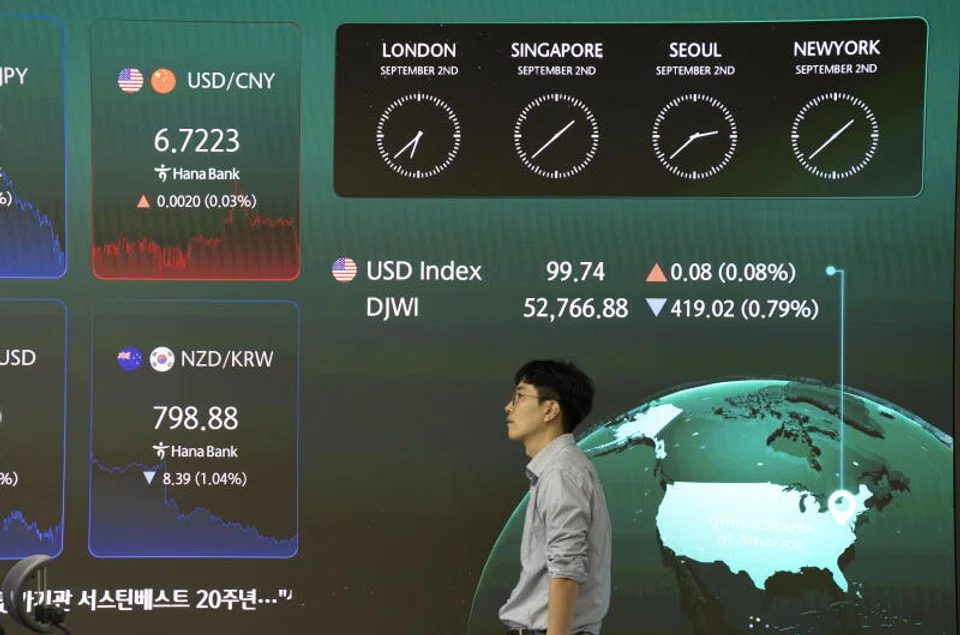
ASIAN chip stocks extended their recent gains on sustained investor interest in the artificial intelligence trade. Escalating hostilities in the Middle East pushed Brent crude towards US$100 a barrel.
South Korea’s Kospi climbed 1.3 per cent, led higher by the nation’s two giant chipmakers, SK Hynix and Samsung Electronics.
The advance came after the Philadelphia Semiconductor Index, or SOX, rose 1.3 per cent on Tuesday (Sep 8).
The broad MSCI Asia Pacific Index gained 0.4 per cent, with the information technology sector making the biggest contribution. US stock futures also rose, while European ones declined.
Among the main market moves, the S&P 500 futures were little changed as at 6.50 am London time while the Nasdaq 100 futures rose 0.2 per cent.
Brent jumped as much as 1.8 per cent to US$99.68 a barrel after the US struck Iranian tankers near the vital crude export hub of Kharg Island, stoking fears of deeper disruptions in the Strait of Hormuz.
The global crude benchmark is up more than 60 per cent in 2026 so far and is closing in on the US$100-a-barrel mark for the first time since July.
Renewed attacks on energy infrastructure stemming from the war between Iran and the US risk keeping oil prices elevated and complicating the outlook for inflation and interest rates.
Investors will be watching to see whether the latest escalation further disrupts supplies, with Friday’s US consumer price index data set to provide the next major test of expectations for a US Federal Reserve rate increase at its Sep 15 to 16 meeting.

Asian semiconductor manufacturers extended their rally on optimism that they will be among the biggest beneficiaries of the rollout of AI technology worldwide.
South Korea’s Kospi has surged 67 per cent in 2026 so far, making it the world’s best-performing major stock index.
“The demand for AI is robust, and it doesn’t matter if the Fed hikes or not,” said Jung In Yun, chief executive officer at Fibonacci Asset Management Global in Singapore.
“The earnings prospect is overwhelming the rate hike fear.”
Oil was also boosted after Teheran responded to the US strikes by firing missiles at Jordan and warning ships in the Persian Gulf.
All tanker crews near piers in Kuwait and Bahrain should “immediately abandon their vessels, whether at anchor or docked, as they will be targeted”, Iran’s state television reported, citing the Islamic Revolutionary Guard Corps.
For oil prices, “the path of least resistance is a strong and steady grind higher”, said Darrell Fletcher, managing director for commodities at Bannockburn Capital Markets.
“The fundamental picture for products remains bullish, with global inventories and reserves deteriorating. In the typical pattern, the US and Iran continue their counterattacks and warnings.”
Elsewhere, the yen strengthened for a third day after US Treasury Secretary Scott Bessent challenged traders to counter his efforts to strengthen Japan’s currency, saying when he makes market calls these days he is effectively doing so with inside information.
The yen advanced 0.4 per cent to 153.40 per US dollar, while Bloomberg’s gauge of the greenback slipped 0.1 per cent.
Treasuries edged lower, with the yield on the US 10-year note climbing one basis point to 4.8 per cent. Gold gained 0.9 per cent to US$4,393 an ounce as the weakening US dollar offset concern that inflation will quicken.
In trade news, the US moved to ban some Canadian alcoholic beverages, dairy products and motorcycles, according to officials.
Meanwhile, the EU and Canada are pursuing a broader partnership spanning trade and security as they seek to counterbalance the global influence of the US and China.
After a stronger-than-forecast US payroll report last week, attention is turning to Friday’s inflation data for clues about future Fed policy.
Economists expect CPI to have risen 0.4 per cent in August, accelerating from a month earlier partly because of higher petrol costs.
Excluding volatile food and energy components, core CPI is projected to have increased a more moderate 0.2 per cent, according to the median estimate in a Bloomberg survey.
That would bring the annual measure of underlying inflation down to 2.4 per cent, the smallest year-over-year increase since 2021.
“Brace for a turbulent week, with inflation data set to swing market expectations for a Fed hold or hike next week – with knock-on effects on wider asset markets,” Evercore ISI strategist Krishna Guha wrote in a Tuesday note. BLOOMBERG
Decoding Asia newsletter: your guide to navigating Asia in a new global order. Sign up here to get Decoding Asia newsletter. Delivered to your inbox. Free.
Share with us your feedback on BT's products and services
TRENDING NOW

Once staunchly pro-China, Malaysian Chinese businesses are now distancing themselves from Beijing

Looking beyond looming CEO succession, should UOB potentially pursue a transformative merger?

Could stablecoins be the future of money?

Grab CEO’s wife Chloe Tong on life with Anthony Tan and finding her purpose

