

SMU launches capital markets initiative; chairman Piyush Gupta says market growth takes sustained reforms
The Singapore Capital Markets Initiative will also foster collaboration among ecosystem players

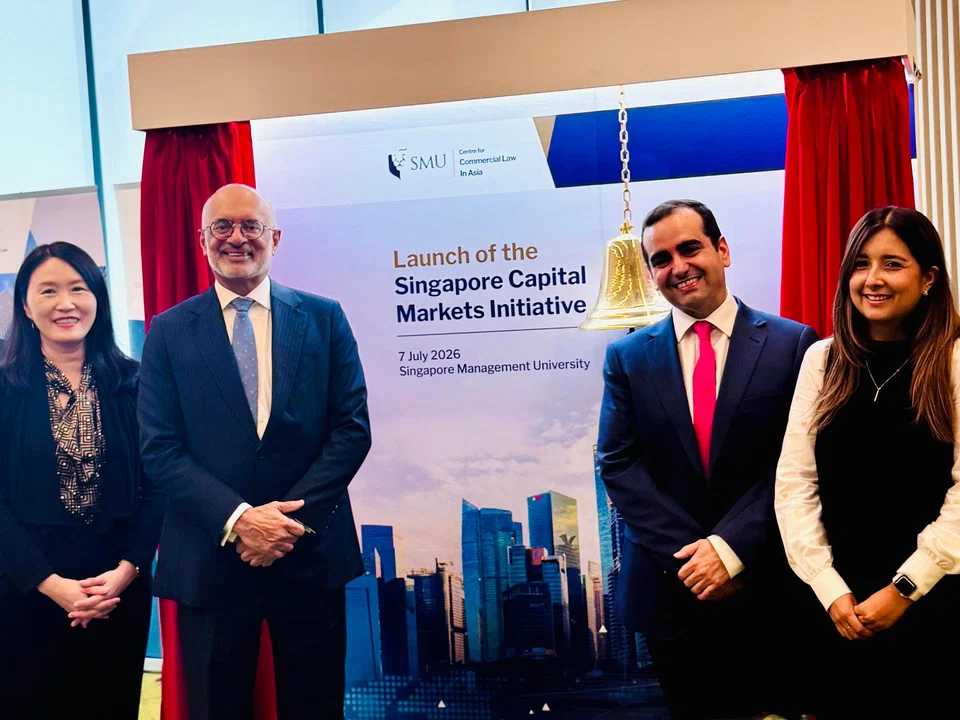
[SINGAPORE] Stronger capital markets do not emerge by accident. They require thoughtful regulation, sound institutions, evidence-based policymaking and continuous dialogue, said Piyush Gupta, chairman of Singapore Management University (SMU) and former CEO of DBS.
Speaking at the launch of the Singapore Capital Markets Initiative (SCMI) on Tuesday (Jul 7), he pointed to Singapore as an example of how sustained policy efforts can strengthen capital markets.
The Republic’s initial public offering market raised more than S$2 billion in 2025, while net institutional inflows extended for a ninth consecutive month following the first set of Equities Market Review Group initiatives. Trading turnover in small and mid-cap stocks also rose sharply.
Gupta said: “The lesson is it takes small steps – a steady step to activate growth and momentum in the market. Therefore, a lot of times we sit back and say this is marginal, but actually, the collective of these marginal actions is often quite meaningful.”
SCMI, launched under the Centre for Commercial Law in Asia at the SMU Yong Pung How School of Law, aims to advance research on capital markets while fostering collaboration among academics, regulators, policymakers, investors and industry leaders.
Its inaugural conference was co-organised with the Organisation for Economic Co-operation and Development (OECD) and the European Corporate Governance Institute (ECGI).
The initiative will serve as a global platform for policy dialogue and thought leadership at the intersection of law and finance by conducting policy-oriented and industry-relevant research.
Its research agenda will include equity and debt capital markets, venture capital and private equity, and private credit and alternative finance.
The launch of SCMI comes at a time when global capital markets are undergoing significant structural change. IPO activity has declined sharply in many economies, while private equity, venture capital and private credit are “reshaping corporate financing”, said SMU.


The new initiative will be led by Professor Aurelio Gurrea-Martinez, together with Professor Dan Puchniak and Assistant Professor Nydia Remolina from the law faculty.
Prof Gurrea-Martinez said: “As capital markets and corporate financing continue to evolve, the need for rigorous research at the intersection of law and finance has never been greater, particularly in Asia, which is now home to more than 55 per cent of the world’s listed companies and more than half of global venture capital activity.”
Sustaining momentum
Gupta said the bigger opportunity for Singapore and the region lies further ahead.
“It is not only to win the established game of listings and trading, in which larger centres are already deeply entrenched, but to help define the next generation of markets,” he said.
Achieving this, he noted, would require addressing several critical questions, including how to sustain momentum in Asian capital markets, improve liquidity and valuations and attract long-term capital.
“These are not questions that any single institution can answer alone,” Gupta said. “They require rigorous research, interdisciplinary thinking, evidence-based policymaking and collaboration.”
He added that this spirit of collaboration underpins the partnership among SMU, OECD and ECGI, and is the driving force behind the launch of SCMI.
“There has never been a more important time and moment for academic and policy engagement on these issues,” he added.
Gupta also noted that future economic growth will increasingly depend on Asia’s ability to finance innovation, while continued innovation will, in turn, rely on the efficient allocation of capital.
One of the region’s longstanding ambitions, he pointed out, has been to create a unified Asean capital market – although progress has been slow.
He recalled joining the Asean Capital Markets Committee in 2007 and working alongside capital markets regulators and central banks in the region for a few years to advance the initiative. Nearly two decades later, however, progress has remained limited.
However, Gupta believes technology can now help to accelerate integration by reducing existing barriers.
“The linkages may be achieved not by reviving old trading links, but by building shared technology-enabled infrastructure in the years ahead across Asia,” he said.
The broader theme of capital market development continued in a panel discussion on reforms across Asia, where panellists discussed fostering changes in capital markets.
Asked about the significance of Singapore’s recent reforms in expanding its capital market ecosystem, Tan Boon Gin, chief executive of Singapore Exchange Regulation (SGX RegCo), said one of the biggest lessons was the importance of taking a holistic approach rather than implementing piecemeal changes.
Recapping Singapore’s efforts, he said reforms have been introduced on both the regulatory and enterprise fronts such as shifting towards a more disclosure-based regime and launching the Global Listing Board, which facilitates dual listings on SGX and Nasdaq using a single prospectus.
“It is a holistic overhaul and the advantage is that changes can reinforce (and) complement each other,” he added.
Corporate governance
Tan also noted that Singapore’s S$6.5 billion Equity Market Development Programme is expected to strengthen market discipline by encouraging active stock selection.
“Market discipline is one way in which we can improve corporate governance, improve the behaviour of companies and this will, in turn, reinforce the efforts on the regulatory side,” he added.
Elsewhere in Asia, South Korea is pursuing a similar objective through corporate governance reforms.
Fellow panellist Chung Joon Hyug, commissioner at the Korean Securities and Futures Commission and associate professor of law at Seoul National University, said the behaviour of boards at listed companies in South Korea is already changing, following amendments to the country’s corporate law in July 2025.
The changes require directors to owe a duty of loyalty not only to the company but also to its shareholders.
Prof Chung described the reforms as “dynamic”, noting that around 90 per cent of Korean listed companies have controlling shareholders.
He sees a mere change in language having a much bigger impact than expected because it “makes independent directors concerned about the decision and the impact of shareholders”.
Decoding Asia newsletter: your guide to navigating Asia in a new global order. Sign up here to get Decoding Asia newsletter. Delivered to your inbox. Free.
Copyright SPH Media. All rights reserved.
TRENDING NOW

Britain’s mansion tax shows the difficulty of targeting wealth

Once staunchly pro-China, Malaysian Chinese businesses are now distancing themselves from Beijing

The only common thing in S-E Asia is that we all eat rice: Cisco’s Asean president

Singapore data centre operator DayOne opts for US IPO at likely US$20 billion valuation

