

Singapore could see more IPOs in 2026 after public listing rebound last year
More than 30 companies have begun preparatory work for listings, evenly split between the SGX mainboard and Catalist


[SINGAPORE] The outlook for Singapore’s initial public offering (IPO) market is gearing up to be promising in 2026, supported by ongoing market reforms and a growing pipeline of listing candidates, industry observers noted.
“The 2026 pipeline is shaping up to be one of the most encouraging in recent years,” said Ong Hwee Li, chief executive officer at investment banking company SAC Capital.
Assuming there is no major economic shock, he remains positive on the market in 2026 and beyond.
He noted that the reform agenda is well under way with the first tranche of the Monetary Authority of Singapore’s S$5 billion Equity Market Development Programme (EQDP) funds having been deployed. This has contributed to “a healthy pipeline of companies progressing through their listing preparations”.
“Based on what we observe on the ground, it is reasonable to expect around 15 to 20 IPOs across both the mainboard and Catalist,” Ong said. He added that the final number will ultimately depend on market conditions.
As Singapore’s equity ecosystem continues to strengthen through EQDP capital, tax incentives and improved research coverage, Ong said, more companies are expected to seriously consider listing in Singapore.
Market observers are also increasingly optimistic about both the scale and sector mix of listings in 2026.
More small to mid-cap listings
Glenn Thum, research manager at Phillip Securities Research, expects the IPO pipeline for 2026 to be stronger than for 2025.
The Singapore Exchange (SGX) recorded 15 IPOs, one reverse takeover and two secondary listings in 2025. Names that came to market include pure-play data centre real estate investment trust (Reit) NTT DC Reit, co-living business Coliwoo, semiconductor optics company MetaOptics and surgery technology firm UltraGreen.ai.
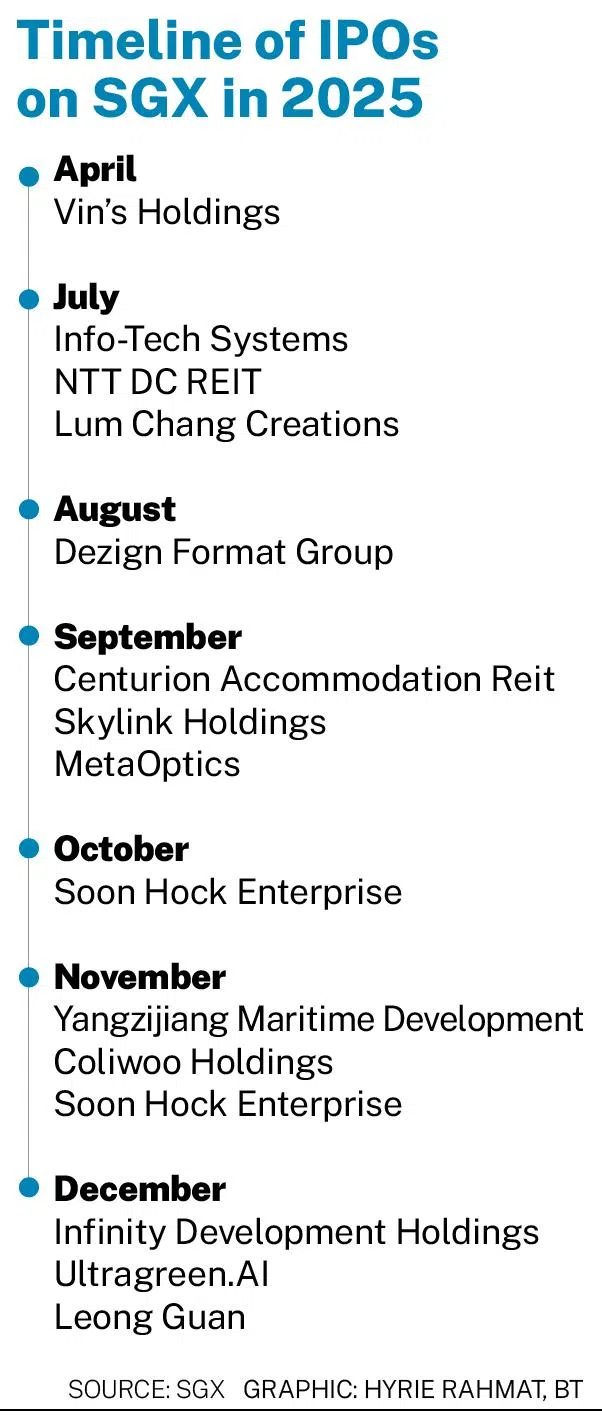
“Reits, digital infrastructure and technology will likely be in focus (in 2026),” Thum said.
Real estate-related listings could be significant in terms of total compositional funds raised, added Jason Saw, group head of investment banking at CGS International Securities.
“Construction-linked and offshore-marine services names may continue to feature, given the sector’s revival,” he said.
However, he anticipates a higher proportion of small- to mid-cap listings, particularly companies with market capitalisations below S$1 billion.
Saw explained that the typical IPO candidate is a business with predictable earnings and a clear plan to scale, which aligns with investors’ growing focus on business models that demonstrate visible growth.
While Singapore investors have traditionally been more income driven, he sees the market now as “entering a period of strong support for companies that innovate and show the potential to double or even triple their revenue within three to five years”.
Looking ahead to 2026, Tay Hwee Ling, capital markets services leader at Deloitte South-east Asia, expects investor interest to be supported by a growing pipeline of upcoming IPOs and cross-border listings, including other South-east Asian companies eyeing a Singapore listing.
Joshua Crabb, head of Asia-Pacific equities at Robeco, noted that more than 30 companies have already engaged advisers and begun preparatory work for listings, evenly split between the mainboard and Catalist.
These companies cover a wide range of sectors, including digital infrastructure, Reits, software-as-a-service and technology, logistics and industrials, healthcare and life sciences, as well as other “new economy” businesses.
Rebound in 2025
Crabb noted that SGX’s IPO performance in 2025 marked a “significant rebound following a drought in 2024” despite Singapore experiencing fewer IPOs compared to markets such as Hong Kong.
A recent Deloitte report indicated that Singapore emerged as South-east Asia’s top IPO hub by funds raised, achieving the highest proceeds since 2019.
Twelve listings raised US$2 billion, led by two landmark Reits – NTT DC Reit and Centurion Accommodation Reit – which accounted for 70 per cent of total proceeds.
Regulatory reforms and market initiatives have supported this growth. Deloitte’s Tay highlighted the role of the MAS Equities Market Review Group and the EQDP in boosting liquidity and institutional participation.
Saw noted that the latter has expanded the pool of institutional capital ready to consider new listings, particularly in the mid-cap segment.
“We have already seen managers increasing their assets under management in Singapore because interest has picked up,” he said.
Thum pointed to initiatives such as the SGX-Nasdaq Dual Listing Bridge, which will allow companies with market capitalisations above S$2 billion to dual list with simplified documentation. This, along with measures such as reduced board lot sizes and the Value Unlock Programme, is expected to improve accessibility and investor engagement.
However, Tay stressed that market-friendly regulations and sustained investor participation will remain crucial to maintaining Singapore’s appeal as a listing venue.
“Ultimately, companies typically choose to list in an IPO market that best fits their fundraising aspirations – whether they are intending to raise funds for expansion, branding or to raise their profile, or for existing investors to exit,” she said.
TRENDING NOW

Once staunchly pro-China, Malaysian Chinese businesses are now distancing themselves from Beijing

Looking beyond looming CEO succession, should UOB potentially pursue a transformative merger?

Could stablecoins be the future of money?

Grab CEO’s wife Chloe Tong on life with Anthony Tan and finding her purpose

