South Korea hit by steepest stocks sell-off since 2008, currency tumbles
Foreigners sell a net 35.9 trillion won in Kospi shares this month
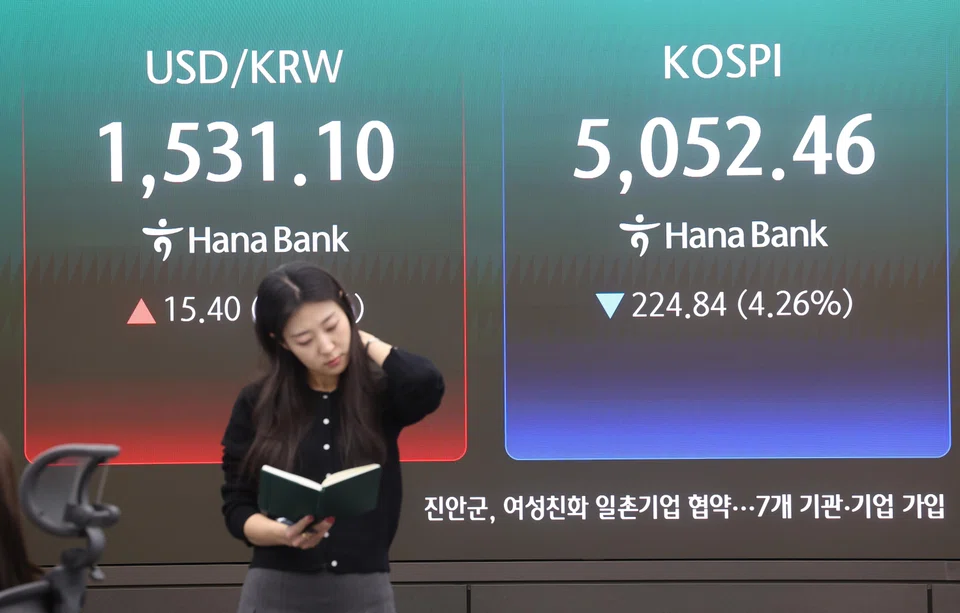
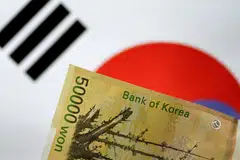
[SEOUL] South Korean markets buckled on Tuesday (Mar 31), with shares sliding towards their worst monthly performance since the global financial crisis and the won sinking to post-crisis lows, as the Middle East war sent investors fleeing worldwide.
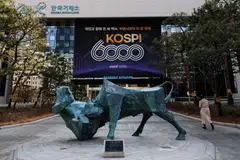
The benchmark Kospi sank 4.3 per cent on Tuesday, taking its fall from late February’s record closing high to 19.9 per cent, a whisker short of confirming, on some measures, a bear market.
The monthly drop of 19 per cent is the largest since 2008 and the won slumped around 1 per cent to trade weaker than 1,500 to the US dollar – levels previously broached only in the aftermath of the global financial crisis in 2009 and the late 1990s Asian crisis.
The market’s earlier gains this year only deepened the rout, as soaring energy prices and fading risk tolerance left global investors with nowhere to hide, forcing a rapid unwinding of once-favoured assets.
Foreigners sold a net 35.9 trillion won (US$23.5 billion) in Kospi shares this month, exchange data shows, the largest outflow on record and one which has pushed the currency lower.
The rush out is positioning-driven, said Rajiv Batra, head of Asia and co-head of global emerging markets equity strategy at JPMorgan in Singapore.

“The market did not look into how much growth damage is there, earnings damage is there ... wherever people were significantly positioned and that money was in profit, that’s where people started doing de-risking.”
Analysis from Goldman Sachs shows foreign selling has been heaviest in market-darling chipmakers Samsung Electronics and SK Hynix, driving foreign ownership in the pair to its lowest since 2022.
Both dropped sharply on Tuesday, shedding 5.2 per cent and 7.6 per cent respectively and both are down more than 20 per cent through March. Even so, the sheer scale of the rally before the Iran war has left them sharply higher for the year, with the broader Kospi still up about 20 per cent. REUTERS
Decoding Asia newsletter: your guide to navigating Asia in a new global order. Sign up here to get Decoding Asia newsletter. Delivered to your inbox. Free.
Share with us your feedback on BT's products and services