Asian stocks, bonds fall on oil, inflation woes
The MSCI Asia Pacific Index falls 1.3%, with Japan’s Nikkei 225 Stock Average sinks 2.2%
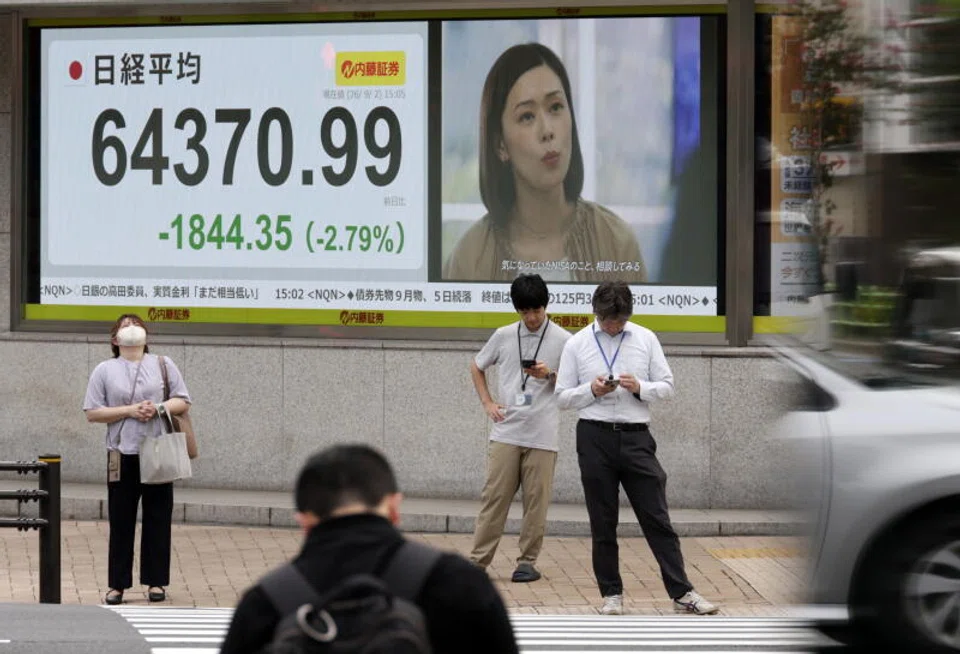
ASIAN stocks and bonds dropped following a surge in oil prices, as investors awaited key US inflation data on Friday (Sep 11) that may determine whether the US Federal Reserve raises interest rates this September.
The MSCI Asia Pacific Index fell 1.3 per cent, with Japan’s Nikkei 225 Stock Average sinking 2.2 per cent.
Among the main moves in markets, the S&P 500 futures rose 0.3 per cent as at 6.47 am London time. Nasdaq 100 futures rose 0.2 per cent, the MSCI Asia Pacific Index fell 1.3 per cent and the MSCI Emerging Markets Index fell 1.4 per cent.
Brent crude traded at US$105.36 a barrel after earlier rising to almost US$110.
Bonds came under further pressure after the US Treasury bought back fewer securities than investors had anticipated on Thursday, pushing 10-year yields to the cusp of 5 per cent.
Asian government bonds followed Treasuries lower. Australia’s three-year yield jumped as much as 20 basis points to 5.05 per cent, its highest level since 2011, while New Zealand’s two-year yield climbed 25 basis points.
The US 10-year yield fell one basis points to 4.95 per cent on Friday after surging 12 basis points in US trading.
“It’s a broad risk-off move across Asian markets,” said Mohit Mirpuri, a partner at SGMC Capital in Singapore.
“The continued sell-off in bonds and the US 10-year yield now flirting with 5 per cent are naturally weighing on risk assets. With US consumer price index due later today, investors are understandably reluctant to take much risk.”


There were still some positive pockets in the markets. Oracle shares gained in extended trading after the company reported faster growth in its cloud computing business than analysts had projected. US stock futures also ticked higher.
Friday’s US consumer price index report will now be a key test for risk sentiment, with investors looking to see whether higher energy costs are spilling over into broader price pressures.
Producer price inflation data published on Thursday showed renewed pressure from rising energy prices last month, potentially adding to the case for a Fed rate hike next week.
Fed policymakers – notably governor Christopher Waller – have signalled that the outcome of the Fed’s Sep 15 to 16 meeting hinges on evidence that inflation is moderating.
Bloomberg Economics estimates that headline CPI accelerated in August due to a resurgence in petrol prices, while core CPI likely rose at a similar pace to July.
Treasuries fell across the curve on Thursday after the US government purchased fewer 10- to 20-year securities than investors had expected in US Treasury Secretary Scott Bessent’s first expanded buyback operation. The 10-year yield has climbed 16 basis points this week.
“Hitting 5 per cent on the 10-year Treasury yield looks more like an inevitability here than a forecast,” said Padhraic Garvey, head of research for the Americas at ING Groep. “These are worrying times for bond markets.”
Swaps are now pricing in about a 70 per cent chance of a Fed hike next week and fully discounting a move by October. European Central Bank president Christine Lagarde added to concerns over tighter global monetary policy, saying the region’s inflation would remain well above target into 2027.
“A hot US producer (price index print) and a hawkish-sounding Christine Lagarde both speak to a reality that points to the possibility a global central bank rate hike cycle may be in the offing, which does not support risk assets today or in the short term,” said Joe Brusuelas, chief economist at RSM US.
Oil’s surge has added another complication for central banks as the conflict around the Strait of Hormuz threatens to keep energy prices elevated.
An increase in attacks on shipping in the waterway has pushed up prices for oil, natural gas and diesel, adding to concerns that energy costs will feed through to inflation.
Iran-backed Houthis advanced towards coastal areas along the Bab al-Mandeb Strait, gaining ground in their attempt to seize Mokha near the southern end of the Red Sea.
“Rising oil prices will be a concern ahead of the midterms,” said Warren Patterson, head of commodities strategy at ING Groep.
“In order to see prices moving significantly higher, we would need to see recent escalation feeding through to renewed disruptions in oil flows through the Strait of Hormuz.” BLOOMBERG
Decoding Asia newsletter: your guide to navigating Asia in a new global order. Sign up here to get Decoding Asia newsletter. Delivered to your inbox. Free.
Share with us your feedback on BT's products and services