

South Korea’s Kospi plunges nearly 10% after regulator cautions on leveraged ETFs
The Kospi has risen 94.67 per cent so far this year
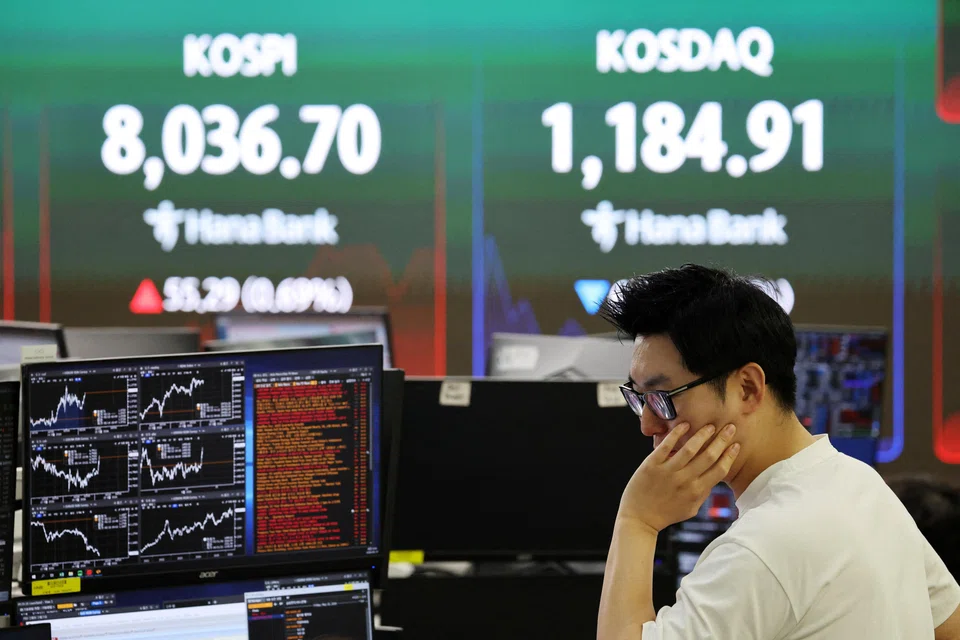
[SEOUL] South Korea’s Kospi plummeted 9.99 per cent, its steepest drop in more than three months, on Tuesday (Jun 23) as overseas investors sold chipmakers following regulatory signals that the sector’s rally had gotten overheated.
The benchmark Kospi closed down 910.71 points, its biggest daily plunge since March 4, at 8,203.84 points.
Market bellwether Samsung Electronics and peer SK Hynix shed more than 12 per cent each, wiping out billions in market value and triggering an automatic 20-minute bourse-wide trading halt in the afternoon.
The Kospi index has become increasingly dominated by the two chipmakers that now make up more than half of the market value, as they propelled the index past the historic 9,100-point level for the first time on Monday.
Tuesday’s pullback underscores the intensifying volatility of a market that critics worry has become dangerously overstretched, says Alexander Redman, chief equity strategist, CLSA.
“Volatility has blown out. (This kind of volatility) cannot be explained without heavy retail engagement,” said Redman. “What worries me is that retailers are in the driving seat, because they use a lot of margin, though the ratio to market cap is small. What is more worrying is that regulators have now allowed leveraged single security ETFs, pouring fuel onto the fire.”
On Monday, the head of South Korea’s market watchdog Lee Chan Jin said the government had been too hasty in approving leveraged funds tied to some of the country’s best-known chip stocks, which were introduced last month and have contributed to heightened volatility.
Regulators recently cautioned retail investors against the use of leverage on the Kospi, as margin debt, or borrowing to buy stocks, rose to a record high in June.
The Kospi has risen 94.67 per cent so far this year while the won has weakened 6.5 per cent against the dollar.




In money and debt markets, September futures on three-year treasury bonds gained 0.14 point to 103.01.
The most liquid three-year Korean treasury bond yield fell by 3.1 basis points to 3.772 per cent, while the benchmark 10-year yield fell by 1.8 bps to 4.179 per cent. REUTERS
Decoding Asia newsletter: your guide to navigating Asia in a new global order. Sign up here to get Decoding Asia newsletter. Delivered to your inbox. Free.
Share with us your feedback on BT's products and services






