

STI closes higher as Dow futures rise
Pictet exec identifies four reasons for worst start to new year for equity markets since 1897
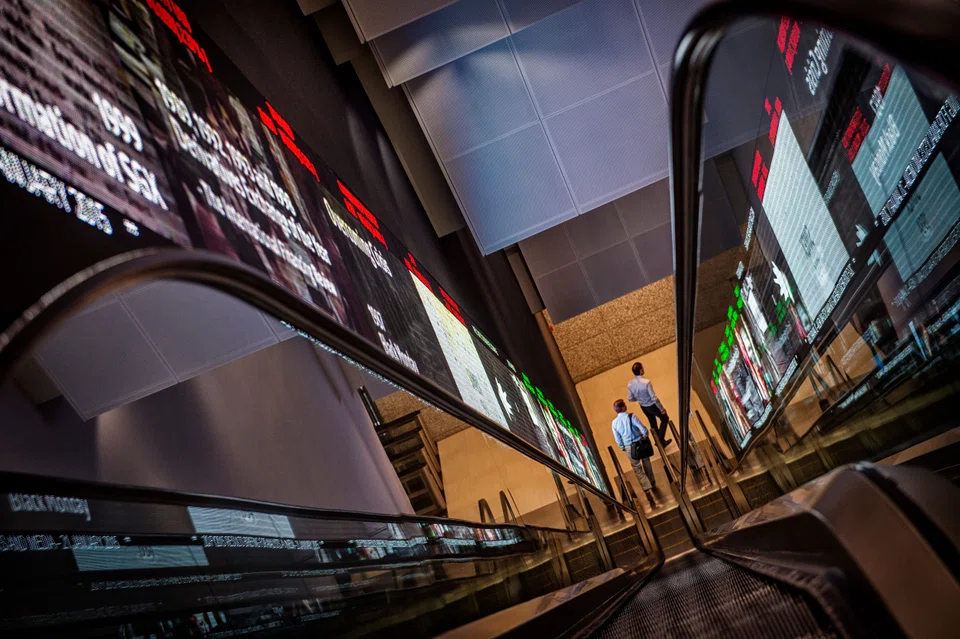
THE Straits Times Index (STI) on Thursday finished with a rise of 16.27 points at 2,562.45 thanks mainly to an afternoon push that came when the Dow futures rose 120 points and Europe opened in the black. Turnover was below average at 745 million units worth S$901 million and, excluding warrants, there were 187 rises versus 192 falls.
Among the few features of note was a S$0.09 or 6.5 per cent collapse in Singapore Post (SingPost) shares to S$1.30 on volume of 31 million. The counter has now plunged S$0.155 or 10.6 per cent in two days, drawing on Thursday a noon query from Singapore Exchange (SGX). SingPost has been in the news recently because of various governance concerns, and has appointed its external auditor PricewaterhouseCoopers to conduct a special audit to address those concerns.
The market's latest entrant, security specialist Secura Group, did not enjoy a particularly distinguished debut on Catalist when it closed at S$0.225 versus its offer price of S$0.25. A total of 30.4 million shares were traded, making it the day's fourth most active counter.
Elsewhere, the collapse in shares of offshore and marine firm EMS Energy continued when the counter crashed S$0.12 or 55 per cent to S$0.10 on volume of 5.5 million. The stock had lost S$0.08 or 27 per cent on Wednesday, drawing an SGX query, to which the company replied that it did not know of reasons for the fall. In two days, EMS Energy has lost 67 per cent for reasons unknown.
On Wednesday, the US Federal Reserve lived up to expectations when it kept interest rates unchanged. However, its accompanying statement was ambiguous - some observers interpreted it as being hawkish, thus leading Wall Street to dive on Wednesday, while others thought it was less so.
Pictet Wealth Management's head of asset allocation Christophe Donay in a Jan 26 Market Brief identified four reasons for the worst start to a new year for equity markets since 1897.
"1) Monetary policy running out of steam - the Fed lacks a clear model following the end of QE (quantitative easing), which creates uncertainty, and other central banks' QE is too weak to sustain financial markets. . .;
2) The fall in commodities prices - although lower oil prices benefit consumers, prices have dropped below the threshold (probably around US$40/b) where the negatives in terms of financial disruption start to outweigh the positives; and
3) Concerns about China - the authorities have the capacity to keep economic growth on target, but their management of financial markets has been poor;
4) The strengthening US dollar, which is putting pressure on the US manufacturing sector and emerging-market borrowers in US$."
Mr Donay added the absence of deterioration in fundamentals suggests rather that current turmoil on global markets is in line with Pictet's core scenario in which solid economic fundamentals continue to support developed market equities in 2016. A rebound therefore is on the cards, he said.
The possibility that the local market might post a modest second half rebound formed one theme for RHB's Singapore Strategy report.
"Singapore's growth prospects are increasingly looking uncertain (with the recent worst manufacturing decline in 14 years), and we do not rule out chances of further earnings downgrades in the coming quarters," said RHB. "With catalysts lacking in the domestic markets, we expect the share prices of Singapore companies to continue to be swayed by external events, spanning from the volatility in the Chinese equity markets, oil price fluctuations and timing of further US rate hikes."
For full listings of SGX prices, go to http://btd.sg/BTmkts
TRENDING NOW
Simba admits exceeding spectrum limits amid failed M1 deal; full-year profits surge 277%

Temasek’s Wan Chee Foong to helm PIL, Lars Kastrup to be board adviser

He built the Vingroup empire. Now South-east Asia’s richest man is handing some key roles to his sons
One-third of Singapore-listed firms at risk in severe AI downturn: MAS

