

STI dives 4.3% in worst post-crisis fall
Sharpest fall since global financial crisis comes as Wall Street plunges amid a host of adverse factors
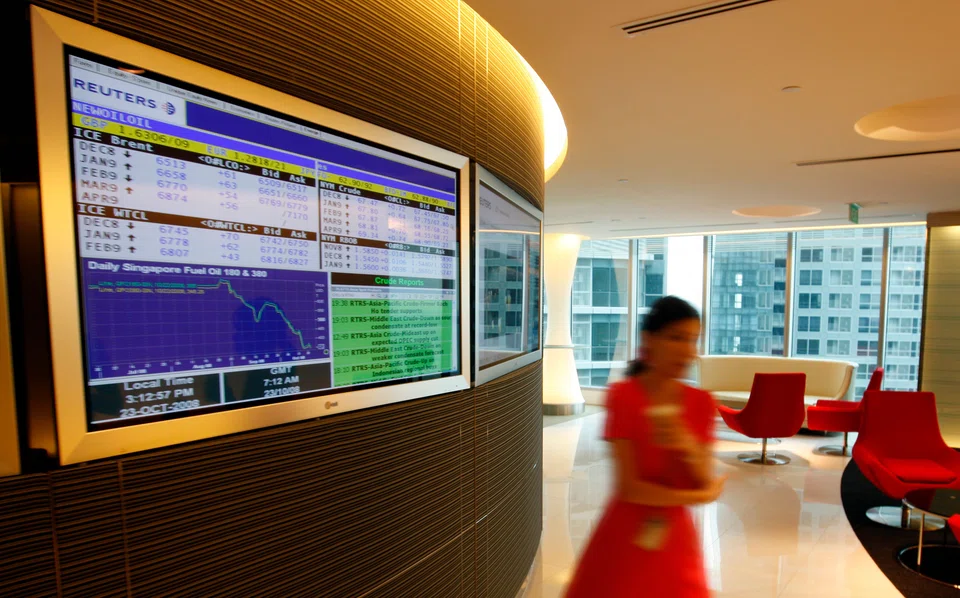
THE Singapore market continued to skid southwards and deeper into sub-3,000 territory on Monday after an ominous gap-down in early trade that had no immediately obvious trigger apart from Wall Street's Friday tumble - which itself appeared to have been brought about by the same fears that overran local shares last week.
Notching up its worst drop since the dark days of the global financial crisis, the Straits Times Index (STI) fell 127.62 points to end the day at 2,843.39, amid a losing streak that has lasted six sessions. Its 4.3 per cent dive was the sharpest percentage drop since an 8.3 per cent plunge in October 2008, and marked an accelerating pace of decline over the past few days.
The index broke below successive psychological levels of 2,950 and then 2,860 to reach its lowest point since June 2012's 2,841.6, with some analysts warning it could fall even further to as low as 2,698 - its early June 2012 trough.
Large-caps bore the brunt of the selling frenzy. About 1.85 billion shares worth S$1.89 billion in total changed hands, which worked out to a mean unit price of S$1.02 per share - considered a relatively high average these days.
The broad market was also evidently spooked, with losers overwhelmingly outnumbered gainers 522 to 50 or an alarmingly high 10 down for every one up.
But what was particularly unsettling about Monday's decline was the relative murkiness over what exactly prompted such a drastic sell-down in regional stocks, given that global conditions have not undergone a significant change over the weekend.
As IG market strategist Bernard Aw put it: "The lack of clarity on what was the trigger for the stock slump makes it difficult to get a sense of the market. This suggests that the selloff could still have some room to go."
The factors that have been cited as possible reasons for the steep drop remain largely the same as those last week. Briefly, these were the state of China's economy after the yuan devaluation; capital flight out of Asia; a further slump in crude oil prices; and not knowing whether the US Fed will choose to raise interest rates in September. The lack of good news may have caused these worries to intensify this week, as analysts predicted at the end of last week's carnage.
"Real money and leveraged investors continued to pull out of Asia. These outflows may continue especially given sharp deterioration in equity sentiment," Citi Research said in a forex flows report on Monday.
Some dealers who spoke to The Business Times after the market closure on Monday said that they were hopeful that stability could soon return to the local bourse, with one saying he was starting to see some "genuine investors" hunting for cheap stocks or averaging down.
However, analysts warned about jumping in too soon. "We think the time is not ripe yet for mid-term investors to bargain hunt. We identify the next major support at 2,750 that coincides with the 38.2 per cent retracement of STI's entire post-GFC rally," DBS Group Research said in a report.
"Using the 38.2 per cent downward retracement of the entire post-GFC uptrend, we now see UOB shares falling to S$18.55 and OCBC shares falling to S$8.20. Among the STI component stocks, we see downside bias for ComfortDelgro shares to S$2.66."
OCBC was the biggest drag on the STI on Monday, shedding S$0.40 or 4.4 per cent to S$8.70. Interestingly, Phillip Securities Research said in a report last week that it had found OCBC to be the stock most correlated with the STI. The next worst blue-chip performer was Singtel which lost S$0.16 or 4.1 per cent to S$3.78.
For full listings of SGX prices, go to http://btd.sg/BTmkts
TRENDING NOW
Motoring tycoon Peter Kwee is back in court: Here are his previous legal battles

Peter Kwee’s Ridley Park bungalow on the market with S$100 million asking price

Demand, tech capabilities position Apac and AI as Skyscanner’s next growth frontiers: CEO Bryan Batista

South-east Asia has lost Nvidia’s best salesman

