STI closes 2.2% down as Asia markets drop on Trump, Iran threats; gold wipes out gains this year
US president says America will ‘obliterate’ Iran’s power plants if it does not fully reopen the Strait of Hormuz
 Add BT as a preferred source
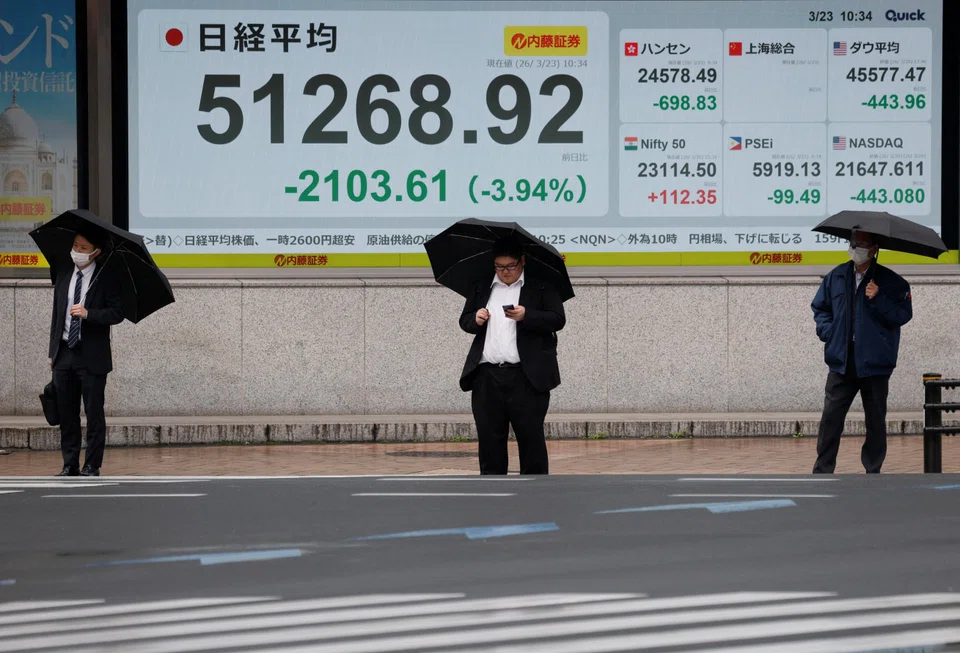
[SINGAPORE] Asian markets fell in reaction to an escalation of tensions in the Middle East over the weekend, after both US President Donald Trump and Iran threatened to hit key infrastructure in the region.
The Straits Times Index (STI) closed 2.2 per cent lower on Monday (Mar 23) at 4,841.3 in Singapore. The benchmark fell 2.1 per cent in the first 15 minutes of trading, before recording a 2.5 per cent decline in the afternoon.
Trump on Saturday said the US would “obliterate” Iran’s power plants if it did not fully reopen the Strait of Hormuz within 48 hours, or a deadline of 7 am, Tuesday, Singapore time. In response, Iran on Sunday said it would attack US infrastructure in the region, such as energy facilities, if Trump followed through on his threat.
Iran also threatened to launch attacks on all US-linked energy, information technology and desalination infrastructure in the region.
Other Asian indices were also down, with Japan’s Topix and the Nikkei closing 3.4 per cent and 3.5 per cent lower, respectively. South Korea’s Kospi was the worst hit, retreating 6.5 per cent on the day.
Hong Kong’s Hang Seng Index ended 3.5 per cent down on Monday, and China’s CSI 300 closed about 3.3 per cent lower. Thailand’s SET50 ended Monday’s session 2.5 per cent down.
Markets in Malaysia and Indonesia were closed for Hari Raya.
Oil prices slumped as at Monday evening in Asia, with West Texas Intermediate crude futures down by 8.5 per cent at US$89.85 per barrel. Brent crude futures were down 13 per cent at around US$92.58 per barrel.
Gold was far from a safe haven amid the uncertainty. The yellow metal has been volatile, as it erased more than 10 per cent in what was its worst week in 43 years. The spot price of the precious metal slumped as much as 8.8 per cent at 3.20 pm in Singapore – briefly bringing it below US$4,100 per ounce. It was hovering around US$4,400 as at Monday evening in Asia.
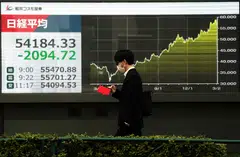


The drop erased all of the metal’s gains in the year to date.
Its prices face downward pressure as global central banks pivot to aggressively hawkish monetary policies, said Maybank analysts on Monday, with the potential to drop to as low as US$4,092 per ounce.
Institutions including the US Federal Reserve, European Central Bank and Reserve Bank of Australia are now pre-emptively raising interest rates, they noted. This coordinated tightening has driven up bond yields, creating a tougher environment for non-yielding assets such as gold.
“Energy and stagflationary risks remain heightened, and risk sentiment remains poor,” they added, noting that Saudi Arabia’s backup oil pipeline had a rolling average of only about 3.7 million barrels on Friday – “far short of the estimated 20 million barrels that Hormuz’s closure affects”.
Decoding Asia newsletter: your guide to navigating Asia in a new global order. Sign up here to get Decoding Asia newsletter. Delivered to your inbox. Free.
Copyright SPH Media. All rights reserved.