Nikkei 225 slips 3.6%, Kospi slumps 12.1% as Asia-Pacific indices tumble on Iran worries
Sell-offs in airline counters come amid surging jet fuel prices and flight corridor suspensions
 Add BT as a preferred source
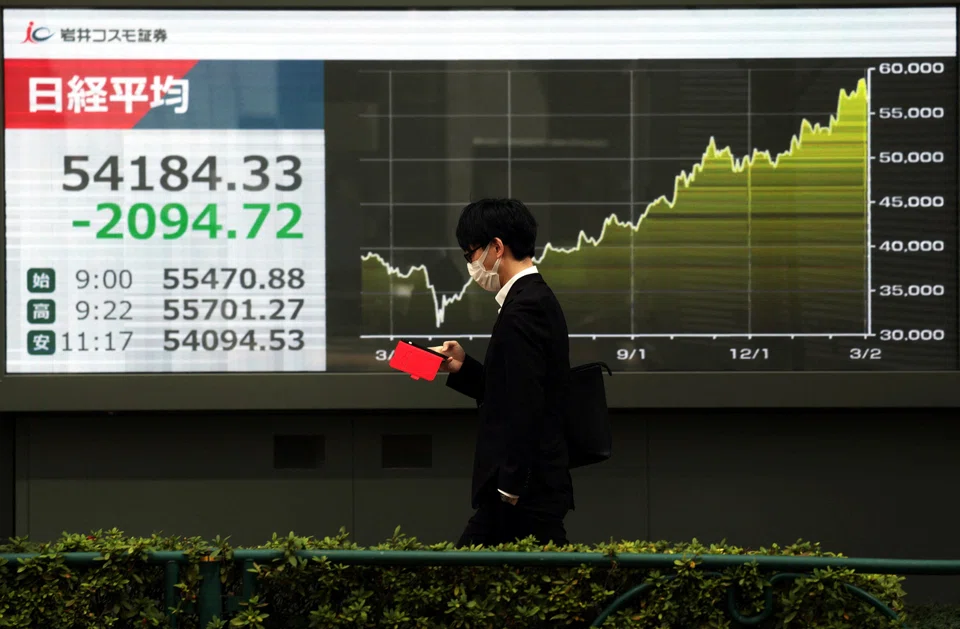
[SINGAPORE] Markets in Asia continued to feel the ripple-on effects of the US-Israeli attacks on Iran on Wednesday (Mar 4).
In Singapore, the Straits Times Index hit an intraday low of 4,770.54 at midday before paring some losses to end 2.1 per cent or 103.9 points lower at 4,812.75.
The trio of local banks lost ground. DBS ended 1.1 per cent lower at S$55, OCBC closed 1 per cent down at S$20.90, and UOB ended 1.4 per cent lower at S$35.83.
Shares of national carrier Singapore Airlines were down, having fallen 2.1 per cent to S$6.64.
Other airlines in Asia-Pacific, such as Cathay Pacific, have also taken a hit amid the conflict. Chen Jingwei, regional chief investment officer at WRISE Group, noted that the carrier’s share price was down 3.1 per cent at HK$12.70.
Chen added that the sharp sell-offs came on the back of the “dual blow” of surging jet fuel prices and the suspension of Middle Eastern flight corridors.
Singapore’s shipping stocks also slumped on Wednesday. Yangzijiang Shipbuilding closed 4.9 per cent lower at S$4.28. Marco Polo Marine fell as low as S$0.164 before ending the day 4.1 per cent down at S$0.166.
Maritime and offshore engineering company Seatrium closed 1.3 per cent down at S$2.32, after trading as low as S$2.28.
Infrastructure giant Keppel dived 5.8 per cent to close at S$12.

Elsewhere in Asia, Japan’s Nikkei 225 ended 3.6 per cent down, while the Topix closed 3.7 per cent lower. South Korea’s Kospi recorded a 12.1 per cent slide, ending at 5,093.54.
Australia’s ASX 200 was down 1.9 per cent, Hong Kong’s Hang Seng Index ended 2 per cent lower, and Shanghai’s CSE 300 Index closed 1.1 per cent lower.
West Texas Intermediate crude oil futures were up 2.7 per cent at US$76.56; Brent was up 2.1 per cent at US$80.03 a barrel. Spot gold was 1.4 per cent higher at US$5,183.12 on Wednesday evening in Asia.
Norbert Rucker, head of economics and next generation research at Julius Baer, said oil prices could top “in the US$80s to US$90s” within this month – though the spike will likely be short-lived in a base-case scenario.
This comes as various uncertainties surround the situation in Iran, particularly the country’s “capability and success so far in causing severe damage”, he said.
Chen from WRISE kept a high-conviction “overweight” stance on gold, miners and defence stocks for the long run, recommending that clients add or maintain exposure to such counters.
“Those positions act as ‘geopolitical insurance policy’ within a diversified portfolio, often moving inversely to broad market volatility,” he said.
Decoding Asia newsletter: your guide to navigating Asia in a new global order. Sign up here to get Decoding Asia newsletter. Delivered to your inbox. Free.
Copyright SPH Media. All rights reserved.