STI slips 1.5% in line with regional bourses
Traders spooked by China slowdown, slumping oil prices, and Middle East conflict

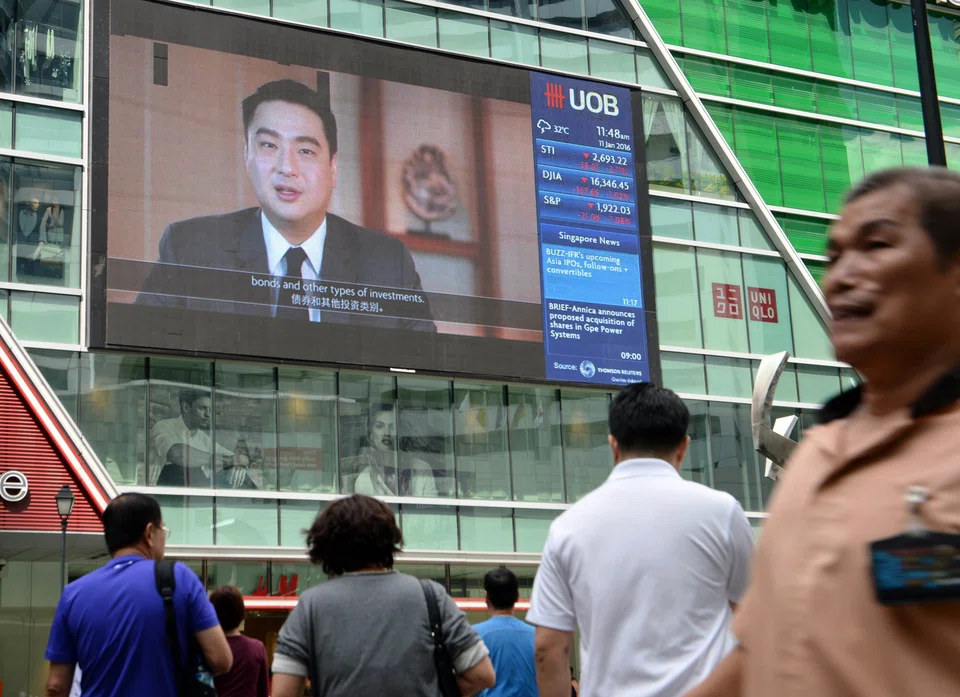
CHINA woes continued to spook the local stock market on Monday, with the benchmark Straits Times Index (STI) losing 42.4 points or 1.5 per cent to finish the day at 2,708.85.
The losses on its sixth trading day of 2016 leaves the key index in the red by some 6 per cent so far this year.
Trading sentiment was weighed down by further losses in Chinese equities, with the Shanghai Composite losing more ground and tumbling over 5 per cent.
China's ongoing currency and equity weakness, falling oil prices and the geopolitical turmoil in the Middle East led to a selloff in all the other regional stock markets, too.
"So far, equity markets have had a year to forget," said Columbia Threadneedle Investments chief investment officer Mark Burgess.
"We are now in a world where bad news is bad news, because policy tools are exhausted and the Fed wants to raise rates, albeit in a measured fashion.
"Moreover, the geopolitical environment is deteriorating in a manner that has taken some investors by surprise," he added.
This is unlike in the past, when the market could rest easy in the knowledge that it could "drink from the punchbowl of QE (quantitative easing)", where bad economic news was deemed good news as it meant more QE.
Mr Burgess, like most market pundits, opines that China's rebalancing story has a long way to run.
"When stockmarket historians look back at the period post the financial crisis, they may look at 2009-14 as the 'easy' phase when asset prices in general were fuelled by historically low interest rates and abundant liquidity.
"2015 was the first year when betting on further asset price inflation and 'buying on the dips' didn't work very well. This represents a return to normality, where asset prices move in a random - and sometimes volatile - fashion," he added.
Trading volume in the local bourse stood at some 1.8 billion shares worth S$1.05 billion, higher than last Friday's turnover of 1.4 billion shares worth S$1.2 billion.
Losers outnumbered gainers with 342 counters up and 90 counters down.
DBS Group led the losses in the market, falling 34 Singapore cents or over 2 per cent to S$15.38. Other banking stocks also closed lower, with OCBC shedding 11 Singapore cents or 1.3 per cent to S$8.29 and UOB retreating 14 Singapore cents or 0.8 per cent to S$18.27.
The day's other big loser included Keppel Corp, which slipped 26 Singapore cents or 4.5 per cent to S$5.54.
Some of the infamous October 2013 penny stocks saw some action - namely LionGold, which shed 17 per cent to 0.5 Singapore cent. Annica Holdings, which announced a S$1.8 million proposed acquisition of a Malaysia-incorporated firm that provides power generation solutions, closed unchanged at 0.2 Singapore cent.
LionGold and Annica saw 142 million shares worth S$712,000 and 67 million shares worth S$133,000 done respectively.
UOL Group fell 21 Singapore cents or nearly 4 per cent to finish at S$5.71.
A recent report by SGX's My Gateway pointed out that almost a third of Singapore's 50 biggest stocks represent real estate and, together, these 50 stocks have suffered an average decline of nearly 3 per cent over the year's first trading week.
The 16 "real estate plays", it said, have fallen an average of 2 per cent in this period.
For full listings of SGX prices, go to http://btd.sg/BTmkts