

Stock watch: 2020 stars and laggards likely to switch sides in 2021
Analysts see STI landing between 3,000 and 3,200 points at end of next year

Singapore
ANALYSTS expect the benchmark Straits Times Index (STI) to land between 3,000 and 3,200 points at the end of 2021, as investors monitor the pace of inoculation and how fast the economy picks itself up from the pandemic.
And, investors could expect market outperformers and underperformers in 2021 to be the opposite of those in this year, analysts added.
Lim Siew Khee of CGS-CIMB expects investors to be comforted by green shoots in economic activities, leading her to arrive at a target of 3,068 points for the STI.
But she was the least bullish among the brokerages polled by The Business Times. RHB Securities Singapore forecasts the STI to be at 3,144 points at end of 2021.
UOB Kay Hian team sees the gauge at 3,158 points using a bottom-up and earnings-per-share methodology, and slightly higher at 3,180 with a top-down approach using mean price-to-earnings and price-to-book valuations.
DBS Equity Research also sees the benchmark at 3,180 while Phillip Securities Research is the most bullish at 3,200 points.
The STI ended at 2,846.52 points on Monday, down 0.09 per cent or 2.46 points.
DBS analyst Yeo Kee Yan said: "The current vaccine-led recovery optimism should see a return of the traditional sector rotation that accompanies a typical economic cycle.... We see early cycle winners holding up their outperformance that should broaden to mid-recovery cycle performers - for example, industrials, capital goods - in 2021 as the economic recovery unfolds."
He noted that banks, consumer discretionary and transportation stocks that are outperformers in the early recovery cycle have led the recent rally, whereas "pandemic winners" such as supermarkets, personal protective equipment (PPE) manufacturers, and technology and other work-from-home beneficiaries have underperformed.
He, however, sees technology counters to hold up better vis-a-vis PPE makers as the former are underpinned by longer-term growth potential from the continued adoption of new technologies.
Vaccines against the novel coronavirus are making their way across the globe, with Singapore receiving its first batch from Belgium on Monday.
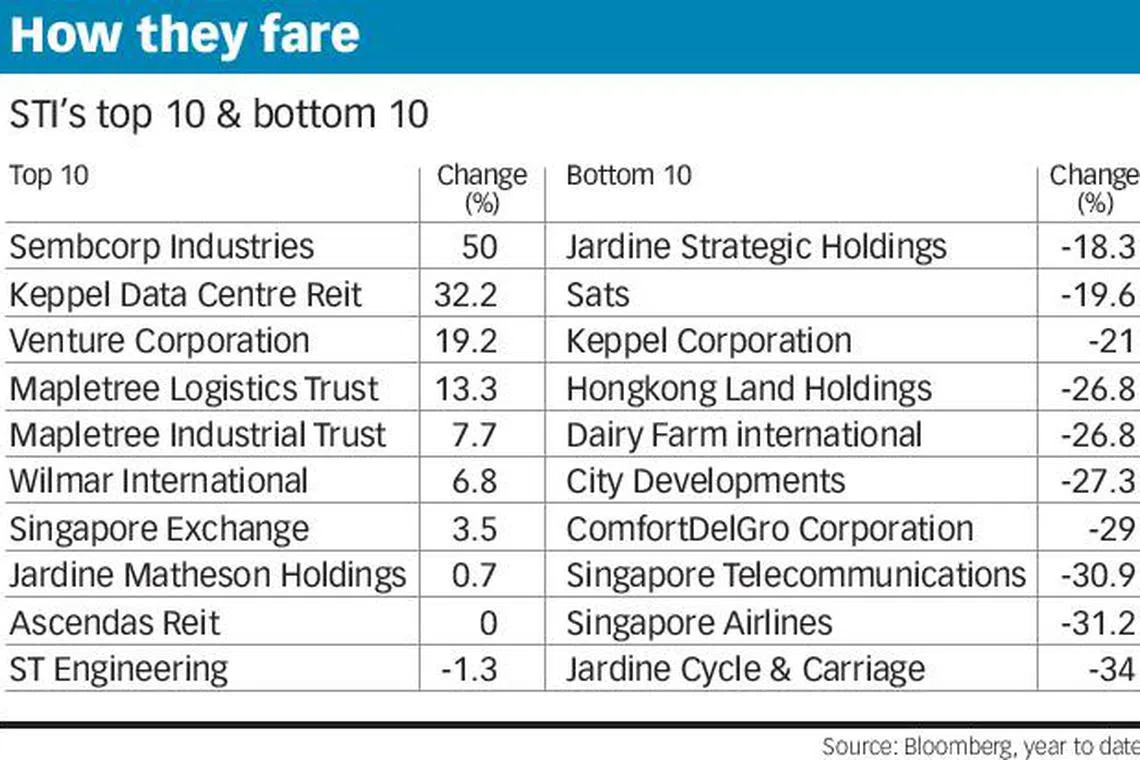
Paul Chew, head of research at Phillip Securities Research, said a reversion-to-mean trade is expected in the new year. "Sectors that suffered the most this year will recover as borders open and activities normalise. Such stocks include ComfortDelGro, Genting Singapore and Ascott Reit (real estate investment trust).
"On some key events, any restructuring at Keppel Corporation will be keenly watched as a possible re-rating trigger for the stock."
United First Partners' head of Asian research Justin Tang suggests investors looking for value to be unlocked to hunt for stocks that are family owned, preferably in the cyclical industry on the cusp of a turnaround. The slew of majority owner-led privatisations in the region indicates a mismatch between value and price, he noted.
Carmen Lee, head of OCBC Investment Research, pointed out that value stocks tended to narrow the gap with growth stocks, and small-cap stocks tended to show better returns historically during an economic recovery.
She noted: "The Straits Times Index, which has a higher proportion of value stocks versus some of the north-Asian bourses, should see some re-rating in 2021. Despite the strong rally in November, the STI is still down for the year and is one of the underperformers in the region."
The STI has declined by 11.7 per cent year to date.
"With the recovery theme, we expect some rotational play into value and cyclical stocks and this should benefit stocks listed on the Singapore Exchange (SGX)," added Ms Lee.
Shekhar Jaiswal, RHB Securities' Singapore analyst, said economic recovery will be uneven and tilted towards the second half of the year. As he sees the Covid-19 situation going on until vaccines are widely available, he recommends investors have a balanced investment portfolio, by sticking with defensive earnings and high- yielding companies while selectively adding exposure to earnings recovery plays in cyclical sectors.
He commented that sectors dependent on domestic demand recovery will post earnings growth first, with the global cyclical and sectors that are dependent on the wide availability of vaccines to report improved performance only from the latter half of next year.
Looking back, DBS' Mr Yeo said there was a dichotomy between the firms that were impacted by the pandemic and those that were either resilient or even benefited from it this year.
Directly hit were hospitality, travel and tourism counters, with national carrier Singapore Airlines having had to do an eye-watering rights issue to raise S$8.8 billion - and that still may not be sufficient to cover the cash burn if the vaccines are not made widely available globally soon enough.
Also hit but perhaps less were the food and beverage players, retailers and retail landlords, especially when Singapore went into a "circuit breaker" and imposed social distancing.
Also resorting to a cash call was Sembcorp Marine (Sembmarine), the oil and gas unit of conglomerate Sembcorp Industries. The two also went their separate ways as Sembmarine was hived off in a bid to strengthen their financial positions and to unlock shareholder value.
The Sembcorp-Sembmarine restructuring did not come as a surprise to DBS research, Mr Yeo said, as the research house had held the view for several years that a restructuring could help to unlock value for shareholders.
Sembmarine had a five-for-one renounceable rights issue at a price of 20 Singapore cents per share in the recapitalisation exercise. The rights issue and deconsolidation were approved by shareholders.
The green light was given a day after their largest shareholder Temasek Holdings decided not to proceed with its S$4 billion partial offer for Keppel Corporation, following the latter making a massive loss and breaching a pre-condition of the proposed deal.
Temasek's role in making the bid for Keppel and moving to directly own a stake in Sembmarine had been viewed by many as critical for a consolidation of the struggling offshore and marine sector. While that bid failed to crystallise, there were privatisation attempts by major shareholders, including BreadTalk Group, Perennial Real Estate, SK Jewellery, Dynamic Colours, Teckwah Industrial and Sunningdale Tech.
Conversely, a few counters debuted on the Singapore Exchange, including Nanofilm Technologies International, which would offer a play on growth stocks in the tech space.
TRENDING NOW

Philippine power giant First Gen rebuffs foreign offers, plans up to US$2.6 billion in expansion

Cliff Tan has 7 million followers and a 4-month waitlist. Why won’t he expand his business?

Could stablecoins be the future of money?

From finance aspirant to Asean CEO: TUV SUD’s Jonas Strahberger on finding people who believe in you

