Tokyo: Shares sink to lowest in more than 3 years
 Add BT as a preferred source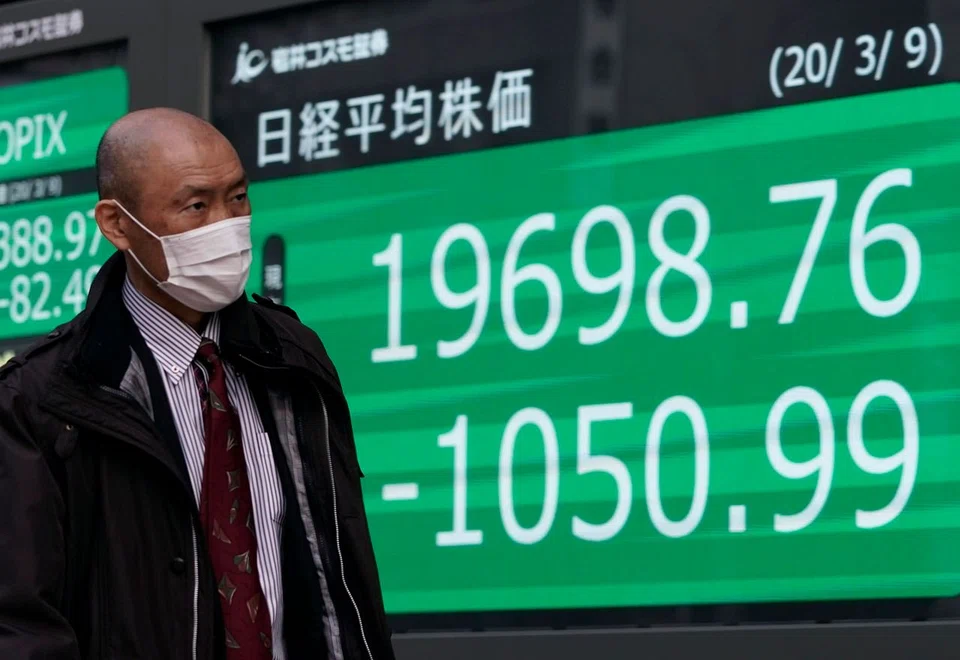
[TOKYO] Tokyo stocks slid to their lowest in three and a half years on Monday as the Bank of Japan's emergency pledge to boost buying of Exchange Traded Funds (ETF) by up to double current levels failed to calm investor nerves.
The BOJ move, announced in statement after an emergency meeting, came as global central banks step up efforts to combat the widening economic fallout from the coronavirus epidemic.
The benchmark Nikkei average skidded 2.5 per cent in choppy trading to finish at 17,002.04, its lowest closing level since November 2016.
The Nikkei's volatility index, a measure of investors' volatility expectations based on option pricing, jumped 17 per cent to 60.03, its highest level since March 2011 when massive earthquakes and a tsunami struck Japan.
"The market got excited by the US$113 billion figure before quickly finding out a footnote that says it is the maximum figure," said Yusuke Ikawa, Japan strategist at BNP Paribas.
While the BOJ said it could buy about 12 trillion yen (S$160.3 billion) of ETFs, in a footnote to its statement it also said it will continue buying ETFs at around 6 trillion yen annually in principle.
"The market is no longer reacting to each step the BOJ is taking, looking at whether any of them work. Rather, markets are reacting negatively because they have lost confidence in the BOJ," said Yasuo Sakuma, chief investment officer at Libra Investments.
"Now it's obvious that the BOJ has no card left to play."
Earlier in the day, the US Federal Reserve slashed interest rates in an emergency move and its major peers offered cheap US dollars to ease a logjam in global lending markets.
On the Tokyo bourse the broader Topix shed 2.0 per cent to 1,236.34, its lowest close since July 2016.
Four-fifth of the 33 sector sub-indexes on the Tokyo Stock Exchange traded lower, with rubber products, transport equipment and electric machinery being the worst three performing sectors.
Automakers were hit hard, with Toyota Motor Corp losing 2.4 per cent, Nissan Motor Co falling 3.5 per cent and Honda Motor Co declining 3.4 per cent.
REUTERS
Decoding Asia newsletter: your guide to navigating Asia in a new global order. Sign up here to get Decoding Asia newsletter. Delivered to your inbox. Free.
Share with us your feedback on BT's products and services