

Tokyo stocks have nowhere to go but up in 2015: analysts
The Bank of Japan's monetary stimulus and corporate profits will power market
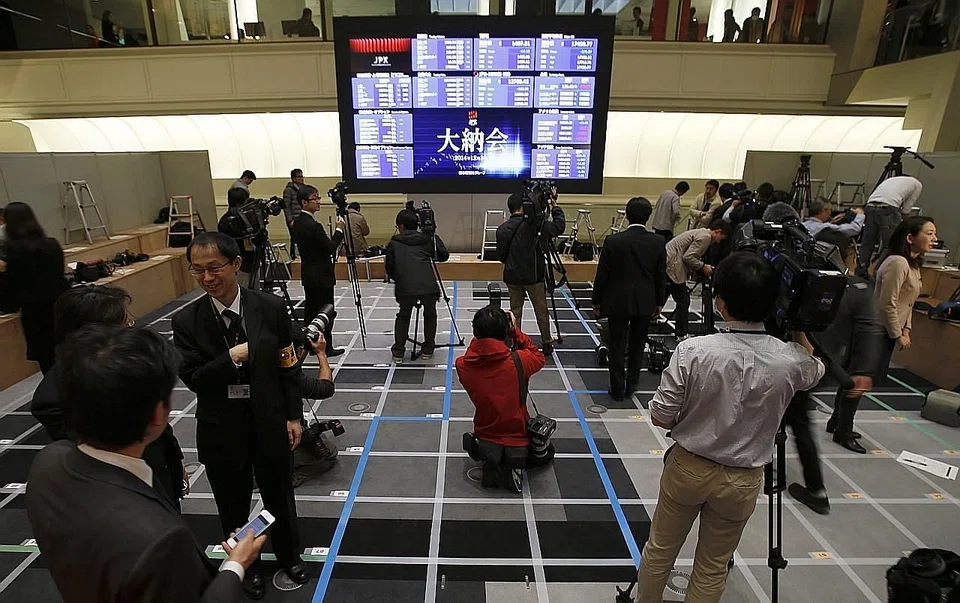
Tokyo
WHILE Tokyo stock prices ended their last trading day of 2014 a modest 8 per cent up on the year on Tuesday, analysts generally agree that the Tokyo market can expect further significant gains in the new year.
The 8 per cent rise in the Nikkei 225 index followed its soaring 57 per cent in 2013, and its 23 per cent rally the year before. The Nikkei had appeared on track to breach the 18,000 mark - its highest level in more than seven years this year, except that Tuesday's news of a suspected case of the deadly Ebola virus in Tokyo knocked it back to end 0.8 per cent down on the day at 17,672.97.
The Japanese man, who developed a fever upon his return from Sierra Leone, tested negative for Ebola, however, the health ministry told Kyodo news service.
Analysts, looking ahead to 2015, say a variety of factors will combine to push the Tokyo market up, possibly dramatically.
Head of equity research at JPMorgan Chase Bank in Tokyo Jesper Koll told The Business Times on Tuesday that the new year will be a strong year for Japan equities. The investment bank's forecast is for the Topix to rise to 1,700 over 12 months and for the Nikkei to go up to 21,000, he said. These represent gains of around 20 per cent over current levels.
William Thomson, chairman of Private Capital, Hong Kong and director of Finavestment, London, told BT: "Japanese equity in yen terms should be a winner (in 2015)."
Echoing these positive sentiments, Takashi Hiroki, chief strategist at Monex, Inc in Tokyo, told Reuters that the new year would be "very positive", and that Tokyo stocks would be boosted by likely additional easing by the Bank of Japan (BOJ) and by corporate earnings growth.
Meanwhile, for Prime Minister Shinzo Abe, having secured an almost certain four more years in office through the snap election this month - the governing coalition led by the Liberal Democratic Party scored a convincing win - means that he has a clear runway in which to achieve his economic policy goals.
His brand of economic policies, dubbed "Abenomics", is underpinned by continuing aggressive monetary stimulus by the BOJ and sustained fiscal stimulus by the government itself. Last Saturday, he approved a US$29 billion fiscal-stimulus package, intended to boost consumer spending and regional economic activity, in a bid to revive the world's third-largest economy, which slipped into recession in the third quarter.
JPMorgan's Mr Koll told BT on Tuesday: "Japanese risk assets - equities and real estate - remain on track for a multi-year structural bull market."
The reason: corporate profits, he said. "Japan Inc has become hyper-competitive and profit/earnings power is still vastly underestimated. Consensus analysts expect Topix profits to rise by around 9 per cent in 2015. In contrast, I forecast earnings will rise by 25 per cent."
Productivity is boosting margins as Japanese firms close "zombie facilities", he said.
"Fixed-asset gearing and capacity utilisation is running very high, about 92 per cent on average. Japan Inc makes money when utilisation is higher than 80 to 82 per cent, and sales growth is accelerating for the first time in decades."
Mr Koll added that in the new year, the full competitive power of Japan Inc will feed a relentless rise in the visibility of earnings/profits. He said that the stock market had not yet priced in a premium for the success of Abenomics, which could give a "bonus" to investors if achieved.
Meanwhile, the continuing weakness of the yen against the dollar and other major currencies is expected to boost corporate earnings in 2015, analysts said.
Kenneth Courtis, former vice-president of Goldman Sachs Asia, told BT: "The structural dollar bull market is set to continue well into the future, driven by the falling trade deficit and increasing investment and growth in the context of low inflation. Given these factors, the BOJ will maintain its extremely aggressive monetary policy. With the central bank now purchasing virtually all new government debt, Japan has in effect merged fiscal and monetary policy in a way that no other large, developed economy has done since the Weimar Republic."
Chief foreign exchange strategist Tohru Sasaki at JPMorgan Chase Bank in Tokyo told BT that he expects the dollar to reach above 125 against the yen in the first half of next year. "The yen is likely to remain a weak currency, but the key is probably what happens to the dollar, which tends to hit a peak around the timing of a rate hike by the Fed. We expect the Fed to hike the policy rate in June. Therefore, the dollar's general trend may hit its peak around mid-2015. So, the pace of dollar appreciation against the yen will be relatively fast in the first half of 2015 and then slow down in the second half."
Interest rate differentials between the eurozone and Japan on the one hand and between the US and the UK on the other, particularly at the short end, are set to rise, suggested chief global economist at Standard & Poor's in New York Paul Sheard. "This points to an environment of sustained downward pressure on the euro and the yen and upward pressure on the dollar and on emerging market currencies," he told BT.






