

Tokyo: Stocks rise on bargain-hunting after falls
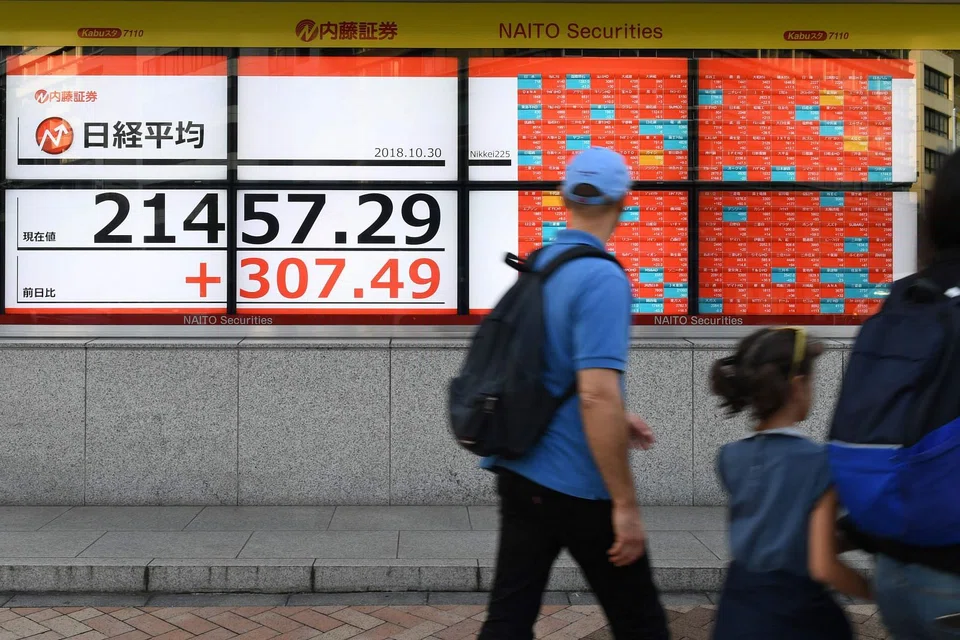
[TOKYO] Tokyo stocks recovered early losses to close higher on Tuesday as investors bought on dips following recent declines.
The benchmark Nikkei 225 index, which fell for the third straight session on Monday, rose 1.45 per cent or 307.49 points to 21,457.29 while the broader Topix index was up 1.38 per cent or 21.90 points at 1,611.46.
Tokyo shares opened lower amid fears of a fresh escalation in the US trade row with China.
Wall Street was dealt a blow after Bloomberg reported that President Donald Trump's administration plans more tariffs on China if talks between Trump and Chinese President Xi Jinping next month are unsuccessful.
"But bargain-hunting easily emerged as shares fell excessively in recent days," said Toshikazu Horiuchi, a broker at IwaiCosmo Securities.
"Recoveries in Chinese shares encouraged Japanese investors to buy back stocks," Mr Horiuchi told AFP, adding that a weak yen also helped improve market sentiment.
The dollar has rebounded from the 111-yen range, trading at 112.69 yen against 112.32 yen in New York Monday afternoon.
The yen hardly moved after government data early Tuesday confirmed Japan's jobless rate remained low, edging down to 2.3 per cent in September from 2.4 per cent in the previous month.
In individual stocks trade, Sony rose 1.03 per cent to 5,862 yen before its release of April-September results. After the market closed, Sony said its first-half net profit nearly doubled.
Nintendo jumped 1.67 per cent to 35,250 yen as it was also set to announce first-half results later Tuesday.
Toyota rose 0.91 per cent to 6,485 yen with Nissan up 1.47 per cent at 1,009 yen.
AFP
Share with us your feedback on BT's products and services
TRENDING NOW

Fed hike throws Singapore banks a margin lifeline; UOB likely to benefit more

He built the Vingroup empire. Now South-east Asia’s richest man is handing some key roles to his sons

Chagee, Mixue and Luckin won the market. Sustaining their edge is the harder part

Canada is upping oil flows to Asia, but South-east Asia’s refineries aren’t ready to handle them yet

