

Trading begins on new Beijing Stock Exchange
 Add BT as a preferred source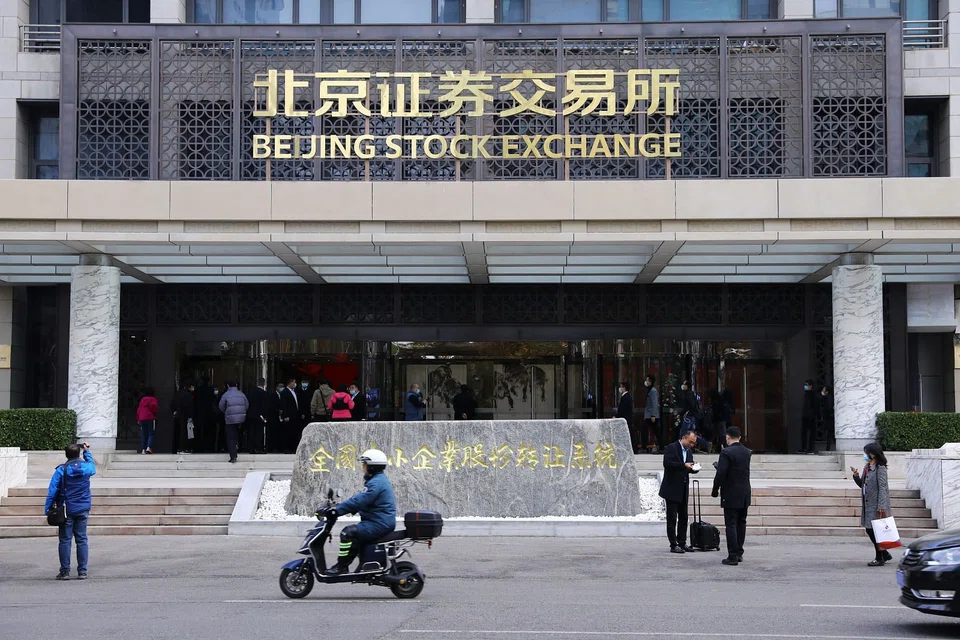
DeeperDive is a beta AI feature. Refer to full articles for the facts.
[BEIJING] A new Chinese stock exchange focused on SMEs began trading in Beijing on Monday, boosting support for smaller-scale firms as economic growth slows and Beijing cracks down on domestic tech giants.
Over 80 companies started trading on the Beijing Stock Exchange, which is expected to complement two main bourses in Shanghai and Shenzhen by catering to smaller enterprises that have long faced difficulty getting funding from banks.
Chinese media reported Monday that a number of new stocks on the exchange rose by more than 30 per cent.
Stocks will not be allowed to rise or fall more than 30 per cent in a single trading day on the exchange, but earlier reports had said there would be no cap for the first day of listing.
On Monday, 10 newly-listed companies triggered temporary suspensions when their shares surged more than 60 per cent, state media said.
The new exchange is vital for "improving financial support for SMEs, as well as promoting innovation-driven development," Yi Huiman, the chairman of the China Securities Regulatory Commission, said at an opening ceremony.
Navigate Asia in
a new global order
Get the insights delivered to your inbox.
The new exchange follows the 2019 launch of a Nasdaq-style board focused on science and technology listings on the Shanghai Stock Exchange.
It comes as authorities move to develop the country's capital markets amid slowing economic growth and as Beijing clamps down on tech giants in a bid to stem the sector's aggressive growth, alleged data misuse and monopolistic practices.
The Beijing exchange provides a capital-raising conduit for SMEs and takes in companies on the top tier of China's existing National Equities Exchange and Quotations (NEEQ), founded in 2012.
The NEEQ is an entry level, over-the-counter stock trading platform allowing firms to raise funds before listing on a stock exchange.
Seventy-one companies from the NEEQ - or "New Third Board" - were transferred to the Beijing exchange and 10 others were listed directly.
The Beijing exchange's rules allow it to process listing applications more quickly than some other boards.
Hong Hao of financial services firm Bocom International told AFP that the exchange's long-term success "remains to be seen".
"You need to have credible companies to be listed on the exchange, to generate enough interest," he said.
Many Chinese companies including giants like Alibaba and Baidu have in the past listed on the more developed US exchanges.
But Beijing has been pressing companies to instead list on home soil, and Chinese firms hoping to trade shares in the United States face heightened scrutiny from regulators there as the economic and tech rivalry between the two countries deepens.
But Hong Kong remains a more likely location for large Chinese companies seeking to list outside the country's mainland, observers note.
AFP
Decoding Asia newsletter: your guide to navigating Asia in a new global order. Sign up here to get Decoding Asia newsletter. Delivered to your inbox. Free.
Share with us your feedback on BT's products and services
TRENDING NOW

Autobahn Rent A Car directors declared bankrupt over S$50 million each owed to DBS

Higher costs, lower returns: Why are Singaporeans still betting on real estate?

Richard Eu on how core values, customers keep Singapore’s TCM chain Eu Yan Sang relevant

Loyang Valley sold for S$880 million to SingHaiyi-led consortium

