US dollar tumbles to 6-week low after soft jobs data
 Add BT as a preferred source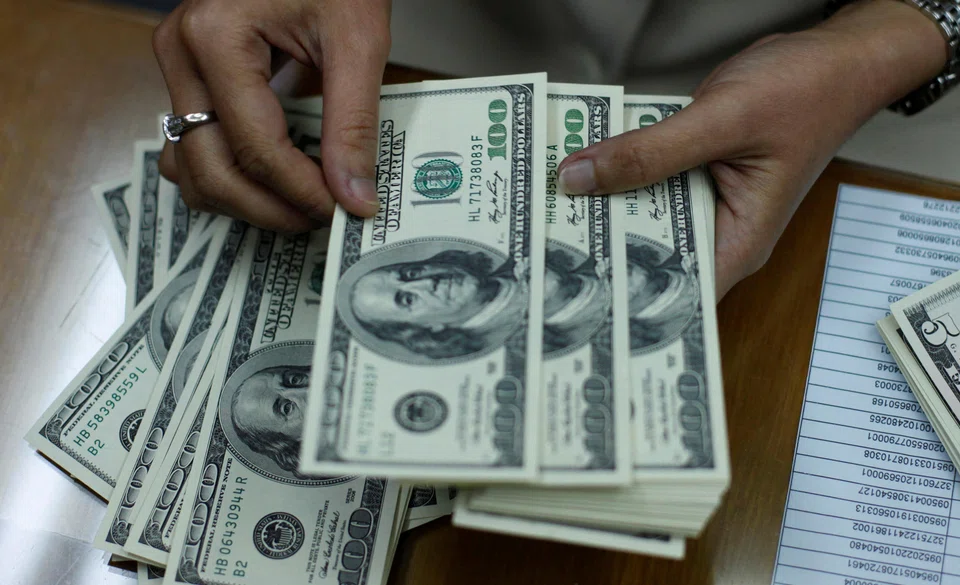
DeeperDive is a beta AI feature. Refer to full articles for the facts.
THE US dollar fell to a six-week low on Friday (Nov 3) after data showed the world’s largest economy created fewer jobs than expected last month, reinforcing expectations the Federal Reserve is likely to hold interest rates steady again at its December meeting.
The US dollar index, a gauge of the greenback’s value against six major currencies, dropped 1.1 per cent to 105.03, after earlier sinking to 104.93, its lowest since Sep 20. The index was on track for its largest one-day fall since July.
For the week, the greenback was down 1.4 per cent, on pace for its worst weekly performance since July as well.
Data showed non-farm payrolls increased by 150,000 jobs last month. The numbers for September were revised lower to show 297,000 jobs created instead of 336,000 as previously reported.
“From my view, the Fed rate-hike cycle is over, and this reaffirms the view that the Fed should not hike rates again,” said Ronald Temple, chief market strategist at Lazard in New York.
“If you look at the new jobs, 150,000 versus 180,000 expected – that is still a strong jobs-creation number, but more in line with what the US economy needs, relative to population growth and the stable unemployment rates. That is a Goldilocks number,” he said, suggesting it was ideal for the economy.
Navigate Asia in
a new global order
Get the insights delivered to your inbox.
Against the yen, the US dollar fell to a two-week low of 149.18, and was last down 0.8 per cent at 149.315 yen, capping a whirlwind week in which the Japanese currency touched a one-year low against the US dollar and 15-year trough against the euro.
On the week, the US dollar was down 0.2 per cent versus the yen, its biggest weekly loss since late July.
The drop in the yen earlier in the week came after the Bank of Japan tweaked its yield curve control policy on Tuesday, but not by as much as markets had expected.

Kazuo Ueda, the central bank’s governor, will continue to dismantle its ultra-loose monetary policy and look to exit the decade-long accommodative regime next year, Reuters reported on Thursday, according to six sources familiar with the central bank’s thinking.
Another piece of economic data released on Friday also depicted a slowing economy.
The US services sector slowed for a second straight month in October, according to the Institute for Supply Management (ISM). Its non-manufacturing purchasing managers’ index (PMI) dropped to a five-month low of 51.8 from 53.6 in September. The services PMI has been declining since August, when it rose to the highest level in six months.
In other currencies, the euro was last up 1.1 per cent at US$1.0735, and thanks to gains earlier in the week was headed for a weekly gain of 1.6 per cent, the largest in four months.
Sterling rose 1.5 per cent versus the US dollar to US$1.2381, after earlier hitting a six-week high of US$1.2389. The British pound posted its best daily performance since January.
It is also set for a weekly gain of 2.4 per cent, the biggest since November 2022.
The US dollar’s fall mirrors a decline in Treasury yields. The benchmark US 10-year yield slid to a five-week low of 4.484 per cent, and headed for a more than 30 basis point retreat, its most since March 2020.
This week’s fall was sparked by a combination of the US Treasury Department announcing smaller-than-expected increases in longer-dated Treasury supply, and Fed chair Jerome Powell seemingly less hawkish than markets expected at his press conference after the Fed’s Wednesday meeting. He did, however, leave the door open to a further increase in borrowing costs, in a nod to the economy’s resilience.
Post-jobs and services sector data, markets are now pricing in a less than 5 per cent chance of a rate increase in December, compared with nearly 20 per cent late on Thursday, according to the CME’s FedWatch tool. REUTERS
Decoding Asia newsletter: your guide to navigating Asia in a new global order. Sign up here to get Decoding Asia newsletter. Delivered to your inbox. Free.
Share with us your feedback on BT's products and services