US stock market may post annual 'Santa Claus Rally' this time also
Equities surge on stellar jobs report in November and signs of compromise from Beijing
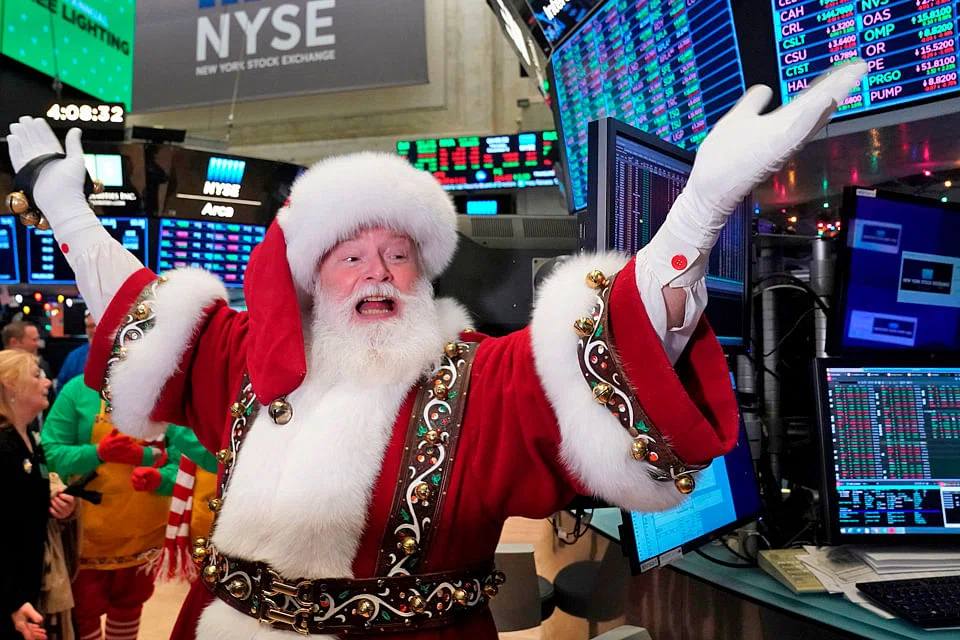
THE "Santa Claus Rally" - the tendency of the US stock market to reach its annual peak in December - looks set to repeat itself this year.
US stocks surged to the brink of new record highs last week after a stellar November jobs report and signs of a compromise from Beijing, and those records are likely to be broken if the "phase one" US-China trade deal is somehow confirmed this week.
The US added 266,000 jobs in November, one of the largest increments this year, partly because of the cessation of a General Motors strike.
Investors took the jobs report, which also showed the jobless rate at a half-century low of 3.5 per cent and wage growth of 3.1 per cent, as a sign that the US economy had survived the economic war with China unscathed so far.
The bulls may be getting ahead of themselves with a trade deal yet to be signed and so many risks, including unrest in Hong Kong, still unfolding, said Edward Moya, senior market analyst at foreign-exchange brokerage Oanda.
The jobs report shows the divergence between the services side of the US economy, which is growing near its peak level, and the manufacturing side, which is showing signs of a slowdown, if not a recession.
"It shows that the US labour market is still strong, the consumer is not necessarily going to show signs of weakness, and we're probably going to see in the short term further upside for US equities," added Mr Moya.
The sense of a flush consumer gleaned from the jobs report was backed up by earnings from retailers from jeweller Tiffany to retail company Big Lots and by a strong confidence reading in a survey by the University of Michigan.
European luxury house LVMH, which has agreed to buy Tiffany, and Gucci owner Kering, which is reportedly circling ski-jacket maker Moncler, also clearly have confidence in the consumer.
Some Wall Street strategists believe investors are under-appreciating the implications of this strident consumer and jobs data. Brokerage Citigroup went so far as to tell its wealthy clients not to be so nervous about stocks.
But Mr Moya and other analysts warn that weak industrial data suggest that another cornerstone of the US economy - business-to-business commerce - remains very vulnerable.
Stocks plunged last Tuesday after US President Donald Trump indicated he was ready to walk away from the negotiating table with the Chinese.
But the plunge moderated late in the session as investors reinterpreted Mr Trump's comments as classic hardball haggling from the real-estate mogul.
Some were not so quick to discount Mr Trump's comments about delaying a deal until after the 2020 presidential elections.
"Happy Christmas (Trade war is not over)," wrote strategists at Bank of America (BofA) Merrill Lynch Global Research.
They have a theory on trade negotiations that neither the US nor China will be motivated to compromise on major sticking points until there is another bout of economic or market pain such as that experienced late last year.
The "short bout of profit-taking on trade fears this week" was "a timely reminder that US-China trade deal is still the No 1 risk catalyst for markets and its resolution not guaranteed ahead of Dec 15 tariff deadline," said the BofA strategists.
The most likely outcome is that a very limited "phase one" deal will be confirmed at some stage this week.
There were recent signs that China was preparing to exempt US agricultural products like soyabeans and pork from tariffs. From the US, investors are hoping for concessions on the Dec 15 tariffs.
"Right now, it seems we'll be kicking the can down the road on this Dec 15 trade deadline," said Mr Moya.
If the trade can is not kicked, however, much of the October and November gains would likely be wiped out.
"Once we try to tackle more difficult issues on intellectual property and access to their market, we start to see those discussions go well beyond the election," Mr Moya noted.
A side-effect of the strong jobs report is that this Wednesday's Federal Reserve statement will likely be another exercise in can-kicking.
With inflation subdued and economic growth strong, the logical thing for the central bank to do with interest rates is nothing at all.
"If Fed chairman Jerome Powell has his way, this will be a non-event and the message will remain that the institution is on hold until meaningful evidence forces it to change their minds," said analysts at Briefing.com in a commentary.
With the Fed set to be on hold, the only lump of coal Santa Claus could possibly deliver to Wall Street is a new set of tariffs on Dec 15.