

US stocks end higher on week, after early wobble
Clinton's commanding debate performance and Opec output deal offset European banking fears
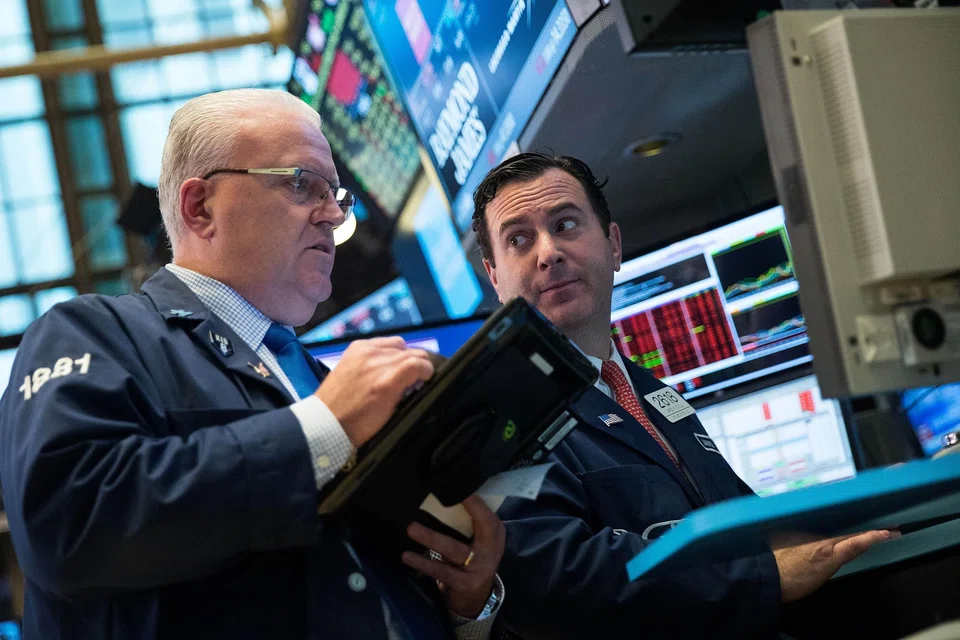
THE US stock market finished slightly higher on the week, as Hillary Clinton's commanding debate performance and a production deal at the Organization of the Petroleum Exporting Countries (Opec) offset European banking fears.
Usually, Friday's September jobs report would be the pivotal moment of the first week of a new month, but investors will pay more attention to the latest threat to financial stability. Deutsche Bank has replayed almost line-for-line the tragic endings of investment banks Bear Stearns and Lehman Brothers.
First came the speculation that the bank was facing liabilities so large that it would not have enough cash on hand to meet them (in this case, a reported US$14 billion Department of Justice fine related, ironically, to the bank's conduct during the mortgage crisis). Then came the swirling rumours about hedge funds pulling their money out of the bank's prime brokerage, citing the risk of bank failure. Finally, there were the sudden intraday plunges of the bank's stock and bonds. In 2008 and 2009, this cycle was known as a "death spiral", akin to an institutional investors' run on the bank. Once the bank's stocks and bonds hint at distress, hedge funds take precautionary measures, which cause more panicky drops in the shares.
After the initial panic, shares of Deutsche Bank rebounded as "cooler heads prevailed a little bit", said Joe Kinahan, chief derivatives strategist at TD Ameritrade.
Energy stocks rallied last week and could continue their run this week after an unexpected production deal in Algiers. Opec will limit production at around 33 million barrels of oil a day, just below August production levels if the preliminary deal sticks.
Markets wobbled early in the week as national polls showed Donald Trump narrowing Mrs Clinton's lead in the polls. But Mr Trump drew poor reviews for a debate performance perceived by analysts as a display of many of the weaknesses the Republican candidate's critics have long harped on: peevishness, disrespect of women, and a lack of a firm handle on policy.
For her part, Mrs Clinton made progress addressing some of the criticisms of her "cold" demeanour, appearing more personable and relaxed than in previous public appearances.
Financial markets scored the fight unanimously for Hillary. The Mexican peso, under pressure because of Mr Trump's promises to undo the North American Free Trade Agreement and militarise border policy among other anti-Mexican measures, rallied against the dollar.
If stock markets seem to be rooting for Hillary, it's partly a case of "better the devil you know", said portfolio strategists at Texas money manager Alpha Capital Management. The first female president of the US is expected to also adopt some market-friendly policies.
"We view Secretary Clinton's support for a US$12-US$15-per-hour minimum wage as a risk to labour-intensive industries like restaurants and gaming and lodging, but a benefit to low-income household spending," said brokerage Morgan Stanley, in a research note.
"Higher wages could be a tailwind for consumer staples, but prospects for a more stringent FDA are a risk, particularly for food/tobacco."
Unlike some of the proposals on the Democratic side, tighter Food and Drug Administration regulations are fully in the purview of the president and would not require congressional approval.
Mr Trump's policies are more of a mystery - perhaps even to the man himself.
While corporate and income-tax cuts could help profit growth for certain areas like retailers, who pay an outsize share of taxes and thrive with high-income earners, trepidation about his presidency could have a cooling effect on consumer confidence, warned the Morgan Stanley note.
"We see Trump's immigration policy as the biggest risk, largely because of the significant impact that deportation could have on consumer demand and labour," it added.
TD Ameritrade's Mr Kinahan said the presidential election is something of a non-event for stock traders. "We all tuned into the reality show that was the debate the other night. In reality the markets don't take it that seriously yet."
Traders like "binary" events - up or down bets on outcomes like the survival of Deutsche Bank. There are too many moving parts in the November elections to place any logical trades, explained Mr Kinahan.
How results in House of Representative and Senate races line up with those in the presidential race is almost impossible to predict. But that, according to economists, is what ultimately affects the performance of the economy and markets.
For the broad Standard & Poor's 500, the combination of a Democratic presidency and a Republican-dominated House and Senate has been the most salutary with the S&P 500 sporting an average annual return of 17 per cent in such years, according to personal finance website WalletHub. The worst combination is under a Republican presidency and a divided Congress, according to WalletHub.
Barring a shock from the jobs report on Friday, some analysts say the election will soon be a driving force for markets. "The election has become one of the most significant near-term risks to the economy, in our view," said Bank of America Merrill Lynch in a note to clients. "Even before policies are enacted, uncertainty could knock back stocks."
October is hardly a happy hunting ground for stocks. "Pick a reason, but September and October tend to see the most volatility," said Ryan Detrick, senior market strategist for LPL Financial. "Last year it was China concerns and 2014 was Ebola worries. This year it'll likely be higher rate jitters or election concerns. Whatever the reason, volatility tends to spike up around now, so don't be surprised if that happens once again."






