

US stocks: Wall Street ends mixed as tech dips, defence stocks rally
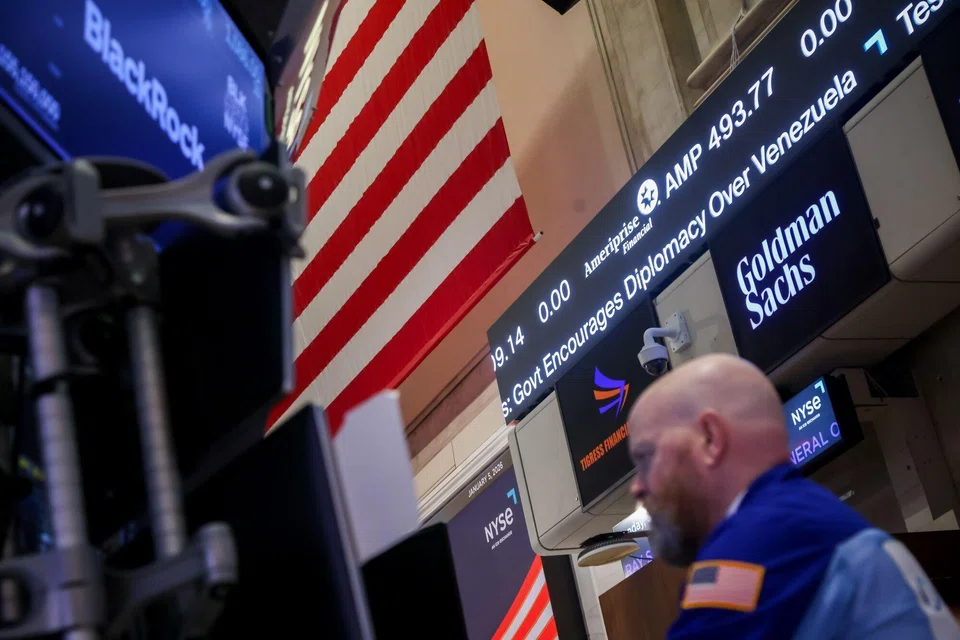
WALL Street ended mixed on Thursday, as Nvidia and other technology stocks dipped, while defence companies advanced after President Donald Trump called for an enlarged US$1.5 trillion military budget.
Nvidia slid 2.2 per cent, Broadcom declined 3.2 per cent and Microsoft dipped 1.1 per cent. The S&P 500 technology index lost 1.5 per cent, leaving it down about 1 per cent so far in 2026, as investors grew more finicky about AI-related stocks whose valuations have been inflated by outsized gains in recent years.
Alphabet gained 1.1 per cent the day after the Google parent surpassed Apple in market capitalization for the first time since 2019, becoming the second-most valuable US company. The iPhone maker was down 0.5 per cent.
“While AI is still hot, there are going to be winners and losers,” said Art Hogan, chief market strategist at B. Riley Wealth. “It’s become a ‘show me’ sector. Show me how you monetise this. Show me if there’s going to be a return on the capex you’re putting into your development.”
Defence stocks gained after Trump said the 2027 US military budget should be US$1.5 trillion, much higher than the US$901 billion approved by Congress for 2026.
Lockheed Martin rose 4.3 per cent, Northrop Grumman added 2.4 per cent and Kratos Defense jumped 13.8 per cent.
Some defence stocks fell in the prior session, after Trump threatened to block defence contractors from paying dividends or buying back shares until they speed up weapons production.
The S&P 500 and Dow Jones Industrial Average briefly hit intra-day record highs on Wednesday, and valuations remained relatively high ahead of fourth-quarter earnings season.
The S&P 500 is trading at about 22 times expected earnings, down from 23 in November, but above its five-year average of 19, according to LSEG data.
The S&P 500 climbed 0.01 per cent to end the session at 6,921.45 points.
The Nasdaq declined 0.44 per cent to 23,480.02 points, while the Dow Jones Industrial Average rose 0.55 per cent to 49,266.11 points.
The number of Americans filing new applications for unemployment benefits rose moderately last week, though demand for labour remained sluggish, supporting Wednesday’s ADP employment and JOLTS figures.
Traders were focused on Friday’s crucial nonfarm payrolls report for December, which would be among the first reliable datasets after the longest US government shutdown in history.
Fitch raised its US growth outlook, estimating GDP expanded 2.1 per cent in 2025 and forecasting 2.0 per cent growth in 2026 after incorporating economic data delayed by last year’s government shutdown.
AI-related memory chipmakers lost ground after a stellar rally. SanDisk lost 5.4 per cent, Western Digital declined 6.1 per cent and Seagate fell 7.7 per cent.
Ford jumped 4.7 per cent after Piper Sandler upgraded the automaker to “overweight” from “neutral”.
Advancing issues outnumbered falling ones within the S&P 500 by a 2.4-to-one ratio.
The S&P 500 posted 43 new highs and 13 new lows; the Nasdaq recorded 133 new highs and 51 new lows.
Volume on US exchanges was relatively heavy, with 16.9 billion shares traded, compared to an average of 16.3 billion shares over the previous 20 sessions. REUTERS
Decoding Asia newsletter: your guide to navigating Asia in a new global order. Sign up here to get Decoding Asia newsletter. Delivered to your inbox. Free.
Share with us your feedback on BT's products and services
TRENDING NOW

LTA proposes combining car COE categories, adding rebate-surcharge system

StarHub to acquire MyRepublic’s mobile business amid ongoing telco consolidation

DBS, OCBC, UOB rout lops billions off STI as inflation, rate concerns spook investors

Grab CEO’s wife Chloe Tong on life with Anthony Tan and finding her purpose

