

Violent stock reversals are coming faster than at any time since 2011
 Add BT as a preferred source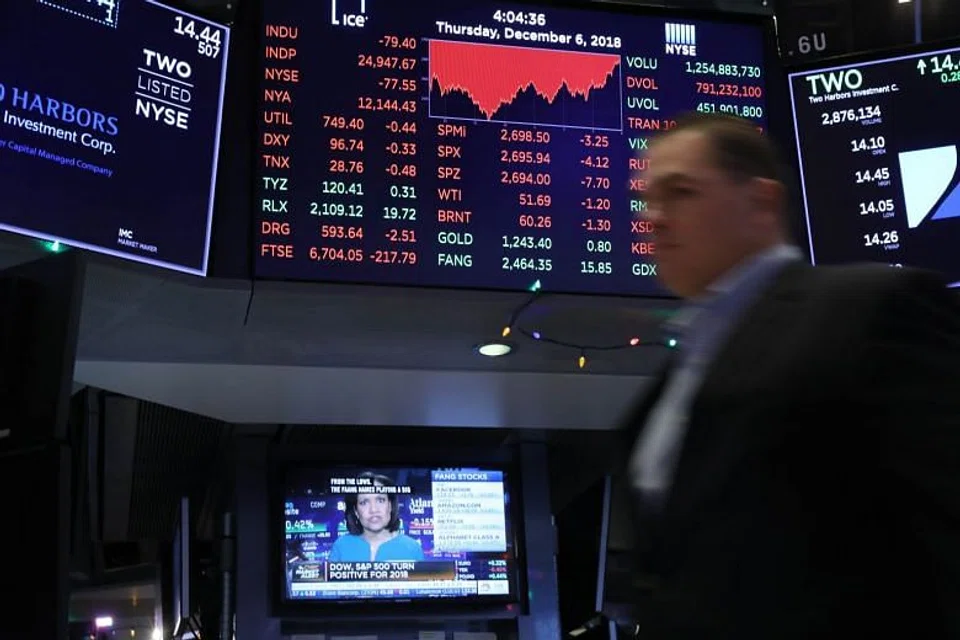
[NEW YORK] Equity investors are getting used to whiplash.
They got a dose on Tuesday (Dec 11) today, when the S&P 500 wiped out a 1.4 per cent rally. And the day before, when a 1.9 per cent loss was erased.
The 30-stock Dow Average fell 53.02 points to close at 24,370.24 on Tueasday after swinging more than 500 points. At its high of the day, the Dow rose as much as 368 points. It also fell as much as 202 points.
So far, there have been six days this quarter when stocks completely reversed an intraday move of at least 1 per cent, the most since 2011, when Standard & Poor's downgraded the US sovereign rating, sending stocks to the brink of a bear market.
The back-to-back reversals underline the market's nervousness as bulls and bears debate fast-shifting narratives on interest rates and US-China trade. While the S&P 500's bounce from below 2,600 signaled to some that a floor may be forming, its failure to hold above 2,650 became grist for arguments against more upside.
The flip-flops are particularly frustrating for money managers, who have been off guard during the latest market turmoil, according to Mike Wilson, chief US equity strategist at Morgan Stanley. Take hedge funds, for example. Data from Goldman Sachs and JPMorgan showed they were just starting to warm up to stocks before last week's tumble.
"For our regular conversations with clients over the past month, we sense too many have been caught buying the highs and selling the lows," Mr Wilson wrote. "But what's what choppy markets are designed to do - trap you - and why our advice has been to fight the momentum on both the upside and downside."
BLOOMBERG
Share with us your feedback on BT's products and services
TRENDING NOW

Yeoh Pei Xien: YTL’s third-gen scion with a pastor’s heart

Singapore banks’ battle for wealth talent goes beyond private bankers

Car dealer charged in S$1.1 million tax evasion case involving Porsches, Ferraris, Rolls-Royces
A ‘shadow bank’ hiding in Singapore’s Little India casts light on financial services gap

