

Wall Street ends lower, off record highs, as Treasury yields climb
All three major US stock indices were modestly lower
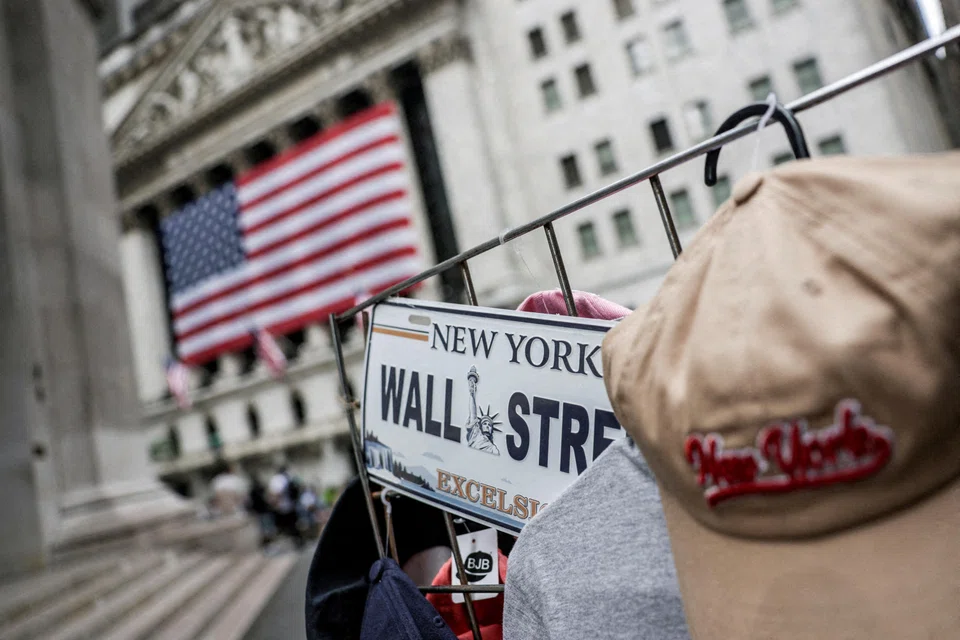
[NEW YORK] Wall Street closed lower on Wednesday (Oct 7), as long-dated US Treasury yields resumed their climb, reviving fears about inflation and mounting debt the day after the S&P 500 Index and the Nasdaq Composite hit record closing highs.
All three major US stock indices were modestly lower, with the S&P 500 and the Dow Jones Industrial Average snapping four-day winning streaks. The Nasdaq notched its first down day in six.
The small-cap Russell 2000 Index underperformed its larger-cap counterparts, dropping 1.3 per cent.
In the wake of Tuesday’s stock market rally, Brent crude settled above US$100 per barrel and long-dated Treasury yields touched a 24-year high.
Iran war-related supply concerns have led to soaring oil prices, which in turn have revived inflation worries and raised the chances of a prolonged central bank rate-hiking cycle.
Those concerns, combined with mounting corporate and sovereign debt levels, have caused a global bond sell-off, which rattled global markets in recent weeks.
Investors “have been looking for some relief on oil, which would drive some relief on rates and that would therefore help the stock market,” said Thomas Martin, senior portfolio manager at Globalt in Atlanta.
“The third quarter was supposed to be the weak quarter of the year; we were supposed to get a correction,” Martin added.
“That didn’t happen, so it’s three cheers and let’s take some money off the table.”

Stocks pared losses after crude prices turned lower following the International Energy Agency’s agreement to speed up the release of oil stocks, prioritising diesel.
Minutes from the US Federal Reserve’s September monetary policy meeting, at which the central bank unanimously approved its first interest rate hike since July 2023, revealed divisions over the rationale of the increase.
Some participants saw a hike as necessary to keep the impact of energy price shocks at bay, while others felt the increase was necessary to curb demand-driven inflation.
Financial markets are currently pricing in a 17.2 per cent likelihood that the Fed will implement a second consecutive rate hike at the conclusion of its October meeting, down from 37.6 per cent a week ago, per CME’s FedWatch tool.
“The market’s Fed expectations are going to seesaw as it gets new bits of data,” Martin said.
“There’s still an expectation for more rate hikes, but it isn’t necessarily going to be a hike every meeting and that’s what the market is telling you; October will be a pause.”
The Dow fell 341.11 points, or 0.66 per cent, to 51,180.17, the S&P 500 lost 17.18 points, or 0.22 per cent, to 7,801.75 and the Nasdaq lost 61.19 points, or 0.22 per cent, to 27,538.69.
Among the 11 sectors in the S&P 500, industrials suffered the steepest percentage drop, while healthcare stocks led the gainers.
Following the upward march of benchmark Treasury yields, the 30-year fixed mortgage rate surged last week to a near three-year high, according to the Mortgage Bankers Association.
Housing and homebuilders slipped 2.3 per cent and 2.9 per cent, respectively.
Chip stocks, which have soared over 80 per cent so far this year, dropped 1.2 per cent.
SpaceX lost 2.5 per cent following media reports that Elon Musk’s aerospace firm was seeking US$40 billion in financing to fund purchases of Nvidia chips.
Next week, third-quarter reporting season is expected to begin in earnest with a spate of high-profile financial firms expected to post results.
Investors are likely to scrutinise the extent to which massive expenditures on artificial intelligence technology are beginning to show results, while also watching for clues regarding the health of the US consumer at a time of mounting inflationary pressures.
Analysts currently expect year-on-year S&P 500 earnings growth of 30.6 per cent, on aggregate, for the July-through-September period, according to LSEG.
Declining issues outnumbered advancers by a 3.34-to-1 ratio on the NYSE.
There were 115 new highs and 497 new lows on the NYSE.
On the Nasdaq, 1,421 stocks rose and 3,371 fell as declining issues outnumbered advancers by a 2.37-to-1 ratio.
The S&P 500 posted nine new 52-week highs and 12 new lows while the Nasdaq recorded 32 new highs and 250 new lows.
Volume on US exchanges was 16.21 billion shares, compared with the 17.57 billion average for the full session over the last 20 trading days. REUTERS
Decoding Asia newsletter: your guide to navigating Asia in a new global order. Sign up here to get Decoding Asia newsletter. Delivered to your inbox. Free.
Share with us your feedback on BT's products and services
TRENDING NOW

What role can Japan play in Asean’s future?

IOI Properties and CapitaLand Investment closer to acquiring One Raffles Place in joint bid

AI bubble may burst soon amid financing concentration, rising rates: Ray Dalio

OCBC sheds S$8 billion in value as shares close nearly 6% down; analysts cautious on banks

