

Wall Street ends mixed ahead of big tech earnings
Rising energy prices have revived fears of broader inflation
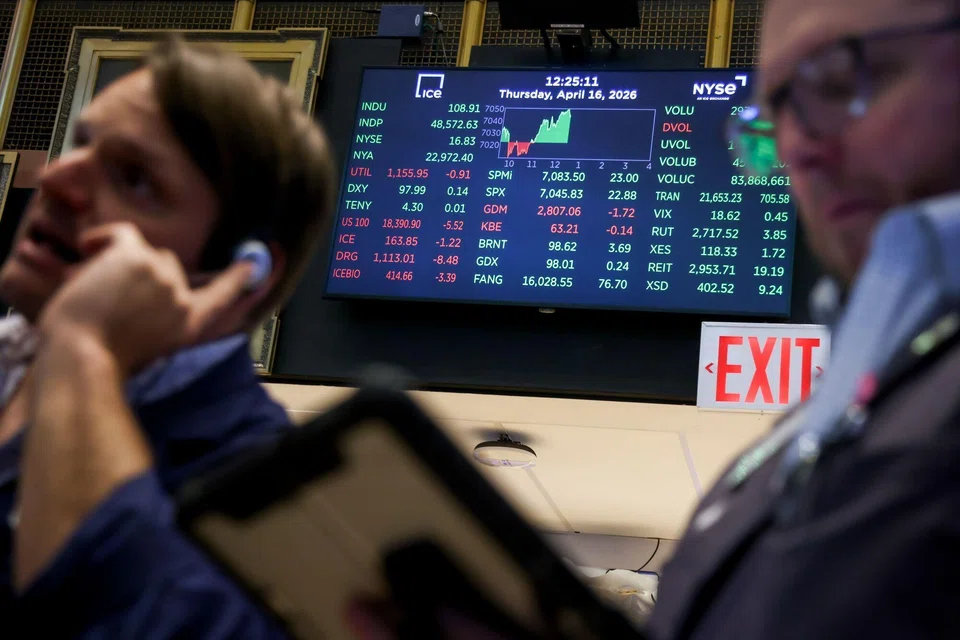
[NEW YORK] Wall Street oscillated on Wednesday (Apr 29), as investors juggled spiking crude prices, the US Federal Reserve’s interest-rate decision, and a quartet of high-profile earnings released after the closing bell.
The three major US stock indexes gyrated after the Fed’s policy statement revealed the decision to hold rates steady was its most divided since 1992, along with uncertainties concerning rising energy prices due to turmoil in the Middle East.
It was likely the Fed’s last policy meeting under Powell, who vowed at the subsequent press conference that he would stay on as governor.
Crude prices jumped after the White House confirmed reports that US President Donald Trump told officials to prepare for a prolonged blockade of Iranian ports, which suggests ongoing supply pressures due to restricted traffic in the crucial Strait of Hormuz.
“The longer this conflict in Iran goes and energy prices remain elevated, and the global uncertainty remains, there will be an expectation of that having some sort of effect on spending habits, which will show up at some point in some level in the next round of corporate earnings,” said Matthew Keator, managing partner in the Keator Group, a wealth management firm in Lenox, Massachusetts.
A White House official said that Trump had met with top officials from Chevron and other energy companies to talk about possible steps to calm oil markets in case a prolonged blockade of Iranian ports continues for months.
Rising energy prices have revived fears of broader inflation, even as the Federal Reserve concluded what is probably its last policy meeting of the Powell era by leaving its key interest rate unchanged, as expected.
Tech megacaps report
Four of the companies that comprise the Magnificent Seven group of artificial intelligence-related megacap firms, Amazon, Alphabet, Meta Platforms and Microsoft, released quarterly results after the bell.
In extended trading, Alphabet shares were up over 3 per cent, Amazon and Microsoft were down more than 3 per cent and Meta was off more than 6 per cent.

The Philadelphia SE Semiconductor index rose 2.4 per cent, having gained 45 per cent so far this year.
“Of course, the numbers matter,” Keator added. “But it’s not about what they did in this past quarter, but what they see going forward in terms of capex spending and how AI might affect their business model.”
On the economic front, new orders for core capital goods, considered a barometer of corporate capex plans, jumped 3.3 per cent in March, the largest monthly increase since June 2020.
The Dow Jones Industrial Average fell 280.12 points, or 0.57 per cent, to 48,861.81, the S&P 500 lost 2.85 points, or 0.04 per cent, to 7,135.95 and the Nasdaq Composite gained 9.44 points, or 0.04 per cent, to 24,673.24.
Among the 11 major sectors of the S&P 500, energy stocks, benefitting from the jump in crude prices, led the gainers. Utilities and materials suffered the steepest percentage losses.
Robinhood Markets fell 13.2 per cent after the online brokerage missed first-quarter profit expectations.
Shares of data-storage companies climbed following an upbeat fourth-quarter forecast from Seagate Technology. Seagate jumped 11.1 per cent, while peers SanDisk and Western Digital gained 6.2 per cent and 5.6 per cent, respectively.
Starbucks advanced 8.5 per cent after raising its annual profit forecast. Visa jumped 8.3 per cent after the payments processing company raised its forecast for full-year earnings.
NXP Semiconductors surged 25.5 per cent after providing second-quarter revenue and revenue expectations that beat Wall Street estimates. Declining issues outnumbered advancers by a 2.52-to-1 ratio on the NYSE.
There were 187 new highs and 84 new lows on the NYSE. On the Nasdaq, 1,474 stocks rose and 3,347 fell as declining issues outnumbered advancers by a 2.27-to-1 ratio. The S&P 500 posted 20 new 52-week highs and 25 new lows while the Nasdaq Composite recorded 85 new highs and 124 new lows.
Volume on US exchanges was 16.37 billion shares, compared with the 17.81 billion average for the full session over the last 20 trading days. REUTERS
Decoding Asia newsletter: your guide to navigating Asia in a new global order. Sign up here to get Decoding Asia newsletter. Delivered to your inbox. Free.
Share with us your feedback on BT's products and services






