CapitaLand Ascott Trust’s divestments could help it buffer against higher-for-longer interest rate scenario
It should seize opportunities available in market, as long as exit yields remain favourable

THE managers of CapitaLand Ascott Trust (Clas) have announced a flurry of divestments for the lodging trust in recent months.
Most recently, Clas in October said that it will be selling the Somerset Olympic Tower Tianjin serviced residence in China for an undisclosed price to an unrelated third party. The transaction is expected to be completed in the second quarter of 2025.
In the same month, it also announced two divestments in Japan: the Citadines Karasuma-Gojo Kyoto serviced residence for about 6.2 billion yen (S$53.1 million) and the Infini Garden rental housing in Fukuoka for 12.7 billion yen.
These represented premiums of about 40 per cent and 55 per cent, respectively, over the book values of the properties.
Earlier this year, Clas also announced or completed a series of divestments in Sydney, Australia; Osaka, Japan; and Singapore – with premiums over book values ranging from 5 to 19 per cent. These included the high-profile sale of the Citadines Mount Sophia Singapore serviced residence to BlackRock and Weave Living for S$148 million.
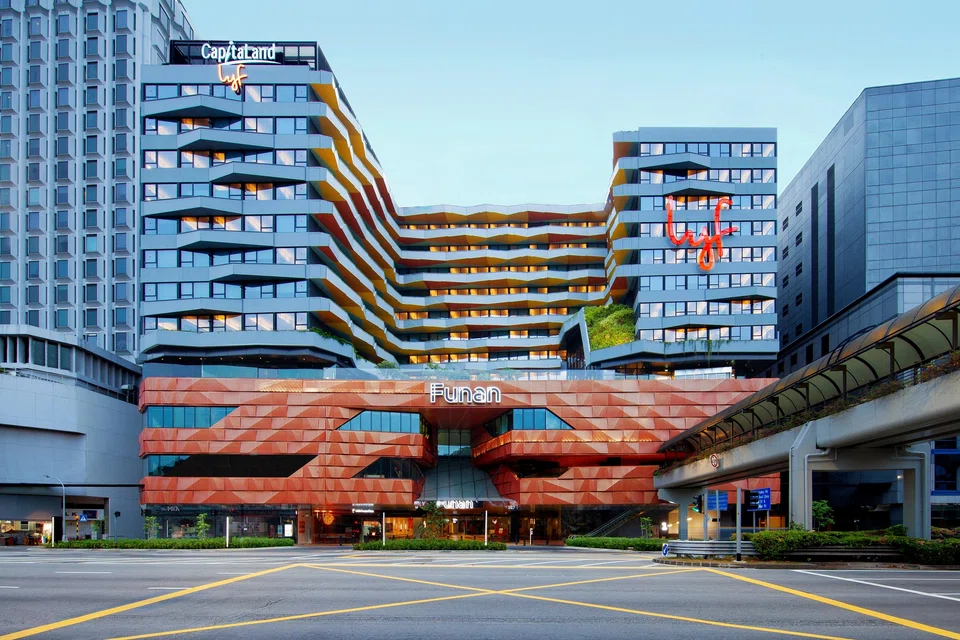
The proceeds of the sale of Citadines Mount Sophia Singapore will be going towards the S$146.4 million purchase consideration for lyf Funan Singapore, which Clas has agreed to acquire at an agreed property value of S$263 million.
Year to date, Clas has completed over S$500 million in divestments – all at premium to book value – and has unlocked some S$60 million in net gains.
As at end-September, Clas’ portfolio comprised 101 properties – down from 103 properties the year before – with total assets worth S$8.5 billion.
Sound strategy
A closer look at the properties being divested suggests that it is part of the lodging trust’s long-term strategy.
Properties such as Citadines Karasuma-Gojo Kyoto are mature and have “reached the optimal stage of its life cycle”, explained Serena Teo, chief executive of Clas’ managers.
Ascott first bought the Citadines serviced apartment chain in Europe in 2004, before expanding the European brand to Asia.
Some properties under the brand, such as Citadines Les Halles Paris and Citadines Holborn-Covent Garden London, have recently undergone asset enhancement initiatives. Others, while clean and spacious, may not be as recently refurbished.
If the cost of asset enhancement outweighs the increase in income a property can generate, perhaps it is not a bad idea to recycle the capital instead into higher-yielding acquisitions.
One clear example is Citadines Mount Sophia Singapore, which Clas is divesting at an exit yield of 3.2 per cent. The proceeds will be reinvested into lyf Funan Singapore at an entry earnings before interest, taxes, depreciation and amortisation (Ebitda) yield of 4.7 per cent.
The acquisition of the co-living property, which is expected to be completed in this quarter, will translate to a distribution per stapled security (DPS) accretion of 1.5 per cent.
Built in 2019, lyf Funan is located within Singapore’s Civic District, with direct connectivity to the City Hall MRT. The 329-room property has a hotel licence, making it suitable for both short-term and long-term guests.
The valuation of lyf Funan at S$799,000 per key is also more attractive than Citadines Mount Sophia’s S$961,000 per key, a UOB Kay Hian report in October noted.
Clas’ Teo said the property has an average daily rate of more than S$200, and that it is currently more than 80 per cent occupied. At this price point, lyf Funan is able to appeal to both mass-market leisure and corporate travellers, DBS Group Research said.
Eyes on Trump
It remains to be seen, though, how the divestments will impact Clas’ DPS and stapled security prices in the nearer term.
For the first half ended June, Clas reported DPS of S$0.0255, down 8 per cent from S$0.0278 in the year-ago period.
The decline came despite revenue growing 11 per cent to S$386.4 million in H1, while gross profit rose 12 per cent to S$172.9 million.
Year to date, Clas has generated total returns of negative 5 per cent, with dividends reinvested. This was worse than the total returns of negative 4.5 per cent logged by Singapore-listed real estate investment trusts (Reits), represented by the iEdge S-Reits Index.
In contrast, the benchmark Straits Times Index – buoyed by the three local banks – has recorded total returns of 20.3 per cent over the same period.
Reits and business trusts have taken a hit over the past two years, as rising interest rates to quell inflation caused borrowing costs to surge while property valuations fell.
There was a sigh of relief as the US Federal Reserve in September finally moved to slash overnight interest rates – by 50 basis points to between 4.75 and 5 per cent.
However, Donald Trump’s victory at the US presidential elections last week has ignited fears that his administration policies would raise inflationary pressure on the US economy and lead to a slowdown in interest rate cuts by the Fed.
Hot market
Perhaps it makes sense for Clas to continue to focus on divestments while the market for hospitality assets remains hot. It would not take long to find a buyer in this climate, especially if the asset is well-located and supply remains tight.
JLL Research estimates that between 2024 and 2027, hotel room supply in Singapore is expected to grow marginally at a compound annual growth rate of 1.9 per cent.
Major hospitality assets that have changed hands this year so far include the 72-unit Fraser Residence River Promenade, which was sold for S$140.9 million to Tuan Sing in May, and the 313-room Capri by Fraser Changi City, which was bought by a consortium comprising family office Atelier Capital Partners Singapore, TPG Angelo Gordon, Heeton Holdings and Far East Consortium International for about S$171.8 million.
Deals recorded in 2024 have eclipsed the previous years, JLL said, and full-year hotel investment volume is expected to reach US$1 billion.
Across Asia-Pacific, hotel investment sales are expected to cross US$12 billion, supported by a more favourable interest rate environment and positive tourism sentiment.
Clas should ride on these tailwinds and continue its portfolio reconstitution strategy as long as exit yields remain favourable, so that it can seize better opportunities available in the market.
In any case, Clas’ divestments put it in a stronger position that can act as a buffer against potentially higher-for-longer interest rates and further macroeconomic uncertainties ahead.
As at end-September, Clas’ gearing stood at 38.3 per cent – giving it a debt headroom of some S$1.9 billion. It also has some S$1.4 billion in total available funds, comprising S$535 million of cash on hand and S$864 million in available credit facilities.