CapitaLand chases faster growth with restructuring, planned listing of CLIM


CAPITALAND on Monday said the proposed overhaul of its structure is meant to sharpen the group's focus on strategic growth and create shareholder value.
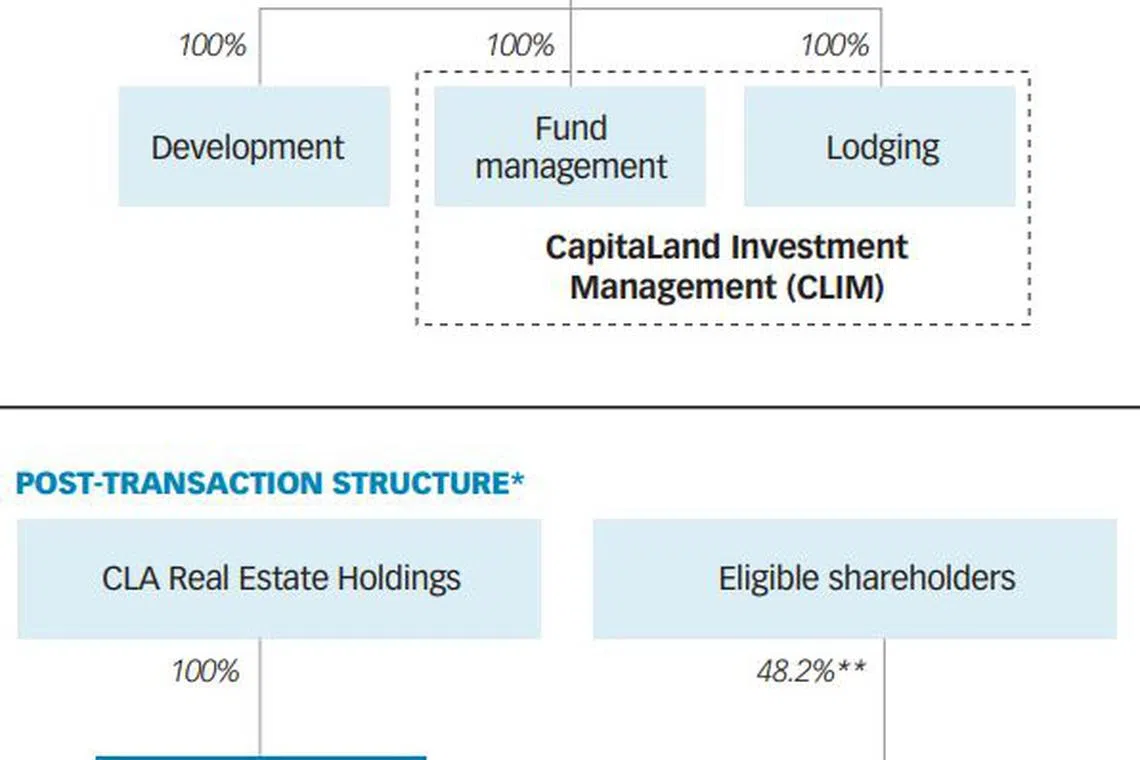
The real estate behemoth is looking to split itself into two: the real estate development business will be placed under private ownership, while the investment management platforms and lodging arm will be consolidated into a newly created entity.
CapitaLand Investment Management (CLIM), to be listed on the Singapore Exchange (SGX), will hold the managers of all the group's listed real estate investment trusts (Reits) and business trusts, as well as selected unlisted funds currently managed by CapitaLand. The lodging business, including the serviced-residence management platform under The Ascott Limited, will also become a part of CLIM.
The new entity, expected to be asset-light and scalable, will drive growth in fee income and funds under management (FUM), as well as spur higher capital productivity, efficiency and returns.
The focus for CLIM - from the onset - is growth, CapitaLand group chief financial officer Andrew Lim emphasised at a briefing for analysts and the media on Monday. Asked about the entity's possible dividend policy, he said the group is still working on the details - but investors cannot expect CLIM to be both a yield stock and a growth stock.
CLIM is "all about finding ways to grow FUM, fee-related earnings (FRE) and real estate assets under management (AUM)", Mr Lim said. "I'm not saying we won't pay any dividends, but I would hope that the emphasis will shift from how many cents in dividends (CLIM is going to pay out), to earnings-per-share growth, FUM growth, and FRE growth."
At the same time, the proposed restructuring will separate the capital-intensive and longer-gestation property development business and assets, which "are not adequately appreciated by the public markets", said CapitaLand group chief executive officer Lee Chee Koon.
This will entail the privatisation of CapitaLand's SGX-listed stock, after which its largest shareholder CLA Real Estate Holdings will fully own the development business. CLA, an indirect subsidiary of Temasek Holdings, held a 52 per cent stake in CapitaLand as at March 12.
A privately held business will be able to better ride property development cycles to optimise returns across asset classes and geographies, Mr Lee said. "We can make more appropriate risk-return decisions to undertake attractive but longer-gestation projects, and optimally build our pipeline and incubate projects."
The privatised development entity will develop projects as a key source of pipeline for CLIM, as well as act as an incubator for potential new businesses.
"Patient" capital is needed for the property development arm, Mr Lee said during the briefing. "So the idea of this restructuring really is to match the capital to the rewards and the kind of returns that investors are seeking ... (while) not having to overly expose the balance sheet to huge development projects, which may not be so appealing to public investors."
The new structure also does not prevent CLIM from gaining exposure to development projects, as it can still raise development funds to do so, and will in fact have more flexibility to choose the type of projects to participate in, be it for offices, integrated developments or even logistics, Mr Lee said.
CapitaLand chairman Ng Kee Choe said there has been "significant progress" in the last few years to pivot the group to a more asset-light and fee-income driven business, from a largely traditional development focus.
CLIM's investment portfolio will include over S$10.1 billion worth of high-quality, income-generating properties, most of which can be recycled and serve as a potential pipeline to grow fund AUM over an expected monetisation period of around three years, CapitaLand said. The recycling will also generate financial resources for further growth.
Mr Lee noted that listed real estate investment managers generally trade at a premium to their net asset values (NAVs) in the capital markets. CapitaLand is thus confident that CLIM will be able to drive returns for shareholders given its scale, capabilities and a strong ecosystem, he added.
Analysts were generally positive on the proposal. Citi's Brandon Lee wrote that the planned restructuring should narrow the group's historical NAV discount of 20-25 per cent and bring it closer to the price-to-earnings ratios that investors give global fund managers.
OCBC Investment Research said CLIM could be less susceptible to property cooling measures, which tend to be more targeted at the residential sector. The new entity is also likely to generate more recurring income streams and fetch a higher valuation than the traditional development business, OCBC added.
Meanwhile, RHB analyst Vijay Natarajan said the transaction will unlock "good value" for CapitaLand shareholders, who can retain exposure to a pure-play fund-management and fee-income business and participate in its future upside potential, which is less risky than the development arm. "Development business margins across markets have also been under pressure due to government cooling measures and rising construction costs," he noted.
Mr Lee stressed that the restructuring exercise is "really only step one" and not a "silver bullet" that will instantly get the group to its goals. "It takes hard work ... dedication, making sure we're razor focused, building the DNA, staying very disciplined... but we're totally committed," he added.
The planned restructuring came after CapitaLand in 2020 sank into its first annual loss in almost two decades, dragged by hefty impairments and revaluation losses. Property developers have been grappling with a challenging operating environment amid the Covid-19 pandemic.
After the closing bell on Monday, CapitaLand, CapitaLand Integrated Commercial Trust, and CapitaLand China Trust lifted their trading halts, which they had requested before market open. The counters ended Friday at S$3.31, S$2.18 and S$1.39 respectively.
Additional reporting by Rae Wee
READ MORE: