CapitaLand China Trust H1 DPU falls 1.6% after sale of Chinese mall
Its H1 revenue slips 4.4% to S$152.3 million; excluding the divested mall, revenue is down 0.2% and DPU, up 2.9%


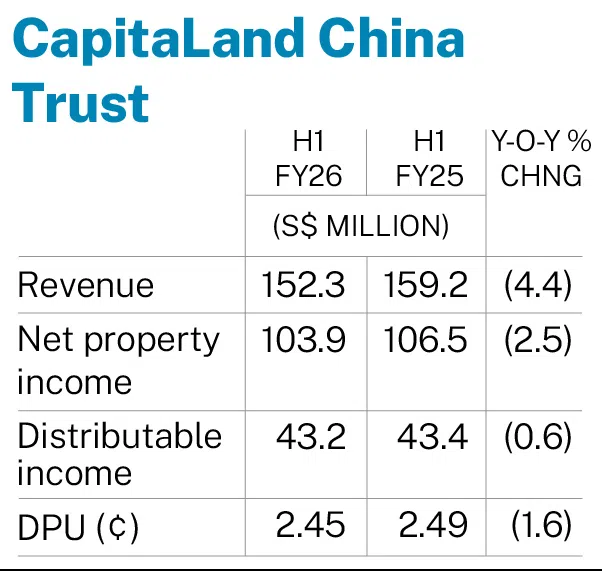
[SINGAPORE] The distribution per unit (DPU) for CapitaLand China Trust (CLCT) slipped 1.6 per cent to S$0.0245 for the first half ended Jun 30, 2026, from S$0.0249 the year before.
Revenue fell 4.4 per cent to S$152.3 million in the first half, from S$159.2 million; net property income (NPI) declined 2.5 per cent to S$103.9 million, from S$106.5 million the year before.
Distributable income came in at S$43.2 million, down 0.6 per cent from S$43.4 million. It will be paid out on Sep 9.
Speaking at an earnings briefing on Wednesday (Aug 5), the CEO of the manager Gerry Chan framed the marginally lower DPU as largely a base-effect from being “one asset short”, following the divestment of CapitaMall Yuhuating in October last year.
The asset was sold to CapitaLand Consumption C-Reit, the first China real estate investment trust (Reit) of CapitaLand Investment (CLI), at 813.8 million yuan (US$120.6 million). This was an 8.8 per cent premium to its floor price and around 3.7 per cent over its end-2024 valuation.
Excluding CapitaMall Yuhuating’s contribution in H1 2025, the DPU for the latest half-year would have increased 2.9 per cent from S$0.0238.
Gross revenue would also have been “relatively stable”, down 0.2 per cent, and NPI would have increased 1.3 per cent.
Earnings were weighed down by poorer performance from the lower occupancy and rental rates at three of CLCT’s malls in Chengdu, Beijing and Harbin, as well as by the poorer performance at its business and logistics parks in Hangzhou, Jiangsu, Wuhan and Chengdu.
The revenue of the retail sector, in particular, fell 5.3 per cent to S$109.4 million; NPI fell 4.4 per cent to S$73.4 million.
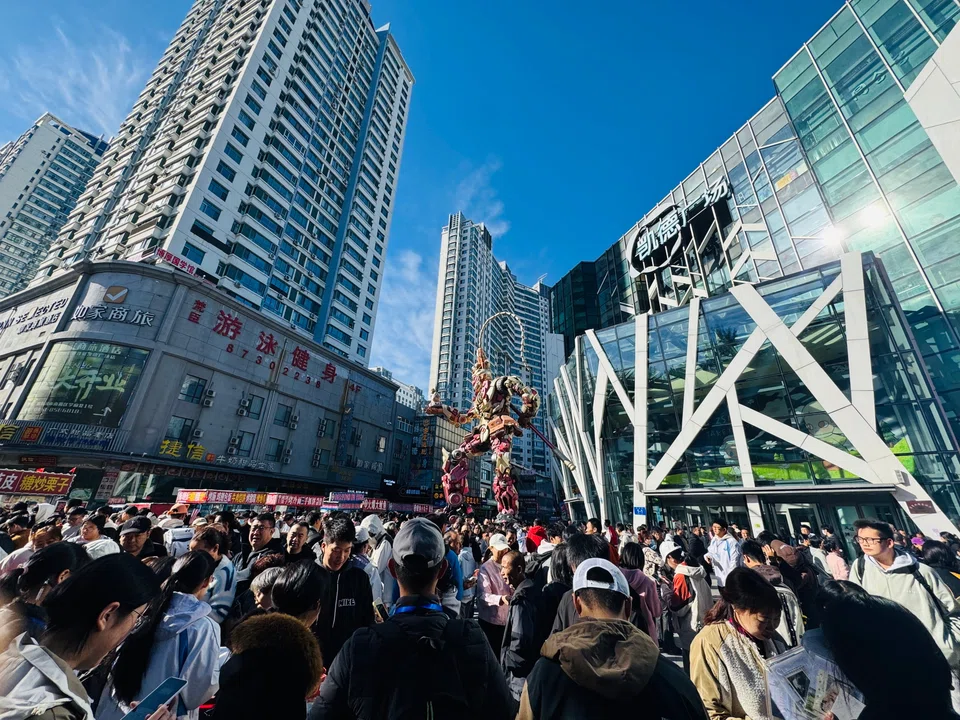
Still, Chan noted that shopper traffic grew 3.2 per cent and tenant sales was up 2.6 per cent in the first half, both at a faster pace than in the whole of 2025.
Tenant sales were partly driven by three supermarkets that had recently completed asset enhancements, which contributed 153 million yuan in sales.
Retail occupancy stood at 97.3 per cent as at Jun 30, 2026, and occupancy cost was “healthy” at 17.5 per cent.
Retail reversion for the first half was minus 2.7 per cent, similar to 2025 levels, Chan said. This was mainly due to “strategic lease actions” involving two major anchor tenants, aimed at improving the malls’ attractiveness and “paving the way for a more robust surrounding tenant ecosystem”.
While such changes are beneficial overall, they could require the manager to accept negative rental reversions in the near term, he said.
“It’s not that tenants aren’t doing good sales,” Chan added. But retailers remained cautious about expanding and therefore “feel no particular pressure” to agree to higher rents.
“That doesn’t mean that we don’t get positive reversions in some of our leases,” he said.
Softer market
For business parks, NPI rose 3.3 per cent to S$27.9 million, despite a 1.6 per cent fall in revenue to S$38.7 million.
“Our business parks generally outperformed their sub-markets despite the general soft leasing environment,” Chan said. For instance, occupancy rates at other assets near its Hangzhou business park ranged from 50 to 70 per cent, below the business parks’ 70.8 per cent.
Overall, CLCT’s business park occupancy was 85.1 per cent. Rental reversion was minus 12 per cent in H1.
Chan said that the manager prioritised occupancy through active retention of existing tenants and conversion of new leasing pipelines.
“We did a lot of new leases, but of course, the competition is fierce,” he said.
Rental reversions are expected to remain negative up to 2027 due to the supply glut, added You Hong, the manager’s investment and portfolio management head. “We hope …demand can come quicker so that it will be better after 2027.”
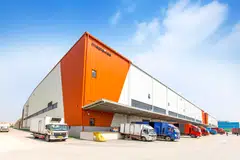
On the logistics side – which Chan noted accounted for the smallest part of the portfolio at 3 per cent – revenue slipped 4.7 per cent to S$4.2 million, and NPI declined 6 per cent to S$2.5 million. Occupancy was 99 per cent.
Rental reversion for the half-year was minus 1.2 per cent, though Chan pointed out that this was an improvement from FY2025’s minus 24.5 per cent. “We think (the market) has truly bottomed in terms of rents, and (the business) has stabilised.”
These headwinds were cushioned by the manager’s “disciplined” capital management, said Chan. “With strong renminbi (RMB) trends, which appreciated about 4 per cent over the last year, we see benefits to gearing, cost of debt and DPU.”
Aggregate leverage stood at 40.4 per cent.
The average cost of debt was 3.06 per cent as at Jun 30, 2026, which is a nearly 40-basis-point reduction year on year, and translates to around 16 per cent interest savings – “tangible outcomes from our active finance cost management”, said Yan Lintong, chief financial officer of the manager.
He said the manager aims to maintain a low-3 per cent cost of debt, and even report a high-2 per cent in the near future.
At the same time, the manager has increased its proportion of RMB-denominated borrowings to 73 per cent, from 59 per cent in end-Q1.
The pivot from Singapore-dollar to RMB debt was undertaken over the past year due to China’s “accommodative” monetary policy and more favourable interest-rate environment, said Yan. “It has put us in a very good position… (generating) significant savings.”
RMB-denominated debt will be kept between 70 and 80 per cent of CLCT’s total debt.
“We are ready to actually take the opportunity to (leverage) the favourable interest rate environment, that will help us in terms of stabilising DPU and driving growth for CLCT,” Yan said.
Asked about acquisition opportunities in China’s Tier 1 and 2 cities, chief executive Chan said the manager was “certainly” scouting the market for potential deals, with focus still on the retail market.
“We’ve seen a few interesting (ones) and are working on them,” he added. “We hope to get something done by this year.”
On CapitaLand Commercial C-Reit, CLI’s second C-Reit that has yet to list, Chan said it could be “one source of capital recycling” in the future, given that they are both in the CapitaLand ecosystem.
But the manager’s priority is first to boost CLCT’s income, before it “thinks about extracting value from any assets”.
Units of CLCT closed up 2.3 per cent or S$0.015 at S$0.67 on Wednesday, after the announcement.
Decoding Asia newsletter: your guide to navigating Asia in a new global order. Sign up here to get Decoding Asia newsletter. Delivered to your inbox. Free.
Copyright SPH Media. All rights reserved.