CapitaLand China Trust posts 8.8% drop in H1 DPU to S$0.0374

Raphael Lim &
Mia Pei
CAPITALAND China Trust ’s (CLCT) distribution per unit (DPU) fell by 8.8 per cent to S$0.0374 for its first half ended June, from S$0.0410 the year before.
The financials of the real estate investment trust (Reit) for the six-month period took a hit from foreign currency translation, as the Singapore dollar grew stronger against the yuan, the manager said on Thursday (Jul 27).
Gross revenue fell 7.4 per cent to S$184.5 million from S$199.3 million in the year-ago period. In yuan terms, gross revenue was up 0.8 per cent on the year to 947.8 million yuan (S$175.5 million) supported by stronger performance in the Reit’s retail portfolio.
Meanwhile, net property income (NPI) fell 7.4 per cent on year to S$129.2 million. In yuan terms, NPI was up 0.8 per cent to 663.7 million yuan.
The rise in NPI was boosted by better performance in the Reit’s retail portfolio, but partly offset by lower contributions from its new-economy portfolio, the manager said.
Tan Tze Wooi, chief executive of the manager, noted at a results briefing that the earnings were being translated from the Chinese currency to Singapore dollars, and that the currency pair had weakened by nearly 9 per cent over the past year. He noted that the Reit had seen a “slow” first quarter, but things improved in the second quarter, especially in the retail portfolio.
Retail portfolio occupancy improved to 96.8 per cent as at Jun 30; the segment’s rental reversions in the first half were positive, at 4.1 per cent.
CLCT said that tenant sales in the second quarter of 2023 exceeded pre-Covid-19 levels in the second quarter of 2019.
Malls that have been through asset enhancement initiatives (AEI) with “dominant characteristics” have been able to do better, Tan said. But certain malls have been weaker, and unable to generate as much sales despite footfall returning.
“On a net portfolio basis, I think we are looking into a better retail performance in the second half than the first,” he said, noting that this accounted for around 70 per cent of the portfolio. But he added that the new-economy segment – comprising business park and logistics park – may see a softer second half.
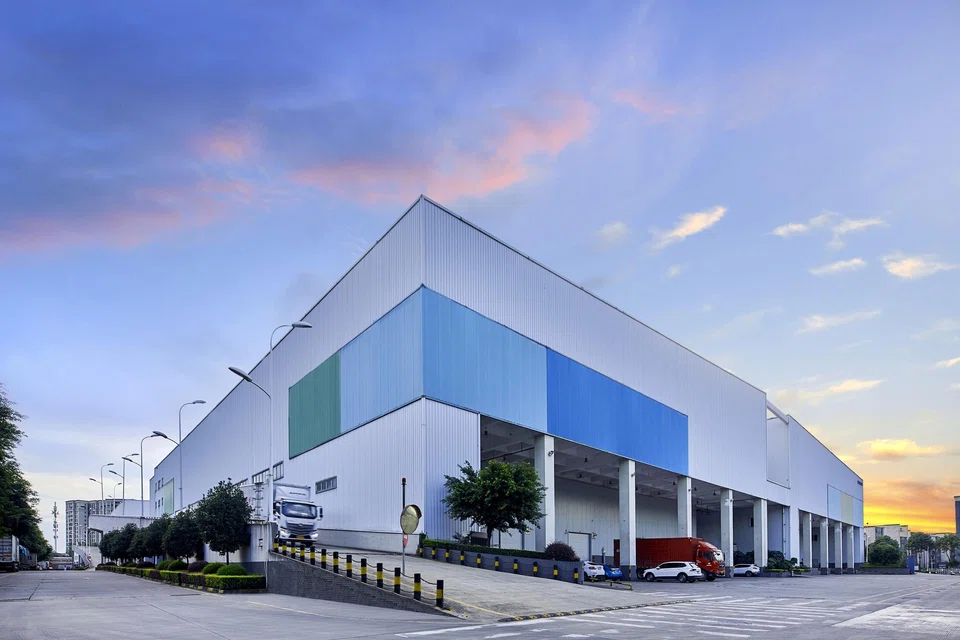
For the first half, CLCT reported lower contributions from Singapore-Hangzhou Science and Technology Park Phase I and II, as well as Chengdu Shuangliu Logistics Park. Occupancy rates of these properties fell.
Notably, Chengdu Shuangliu Logistics Park’s occupancy rate dropped 22.9 percentage points to 67.5 per cent as at Jun 30, compared with the year before.
Tan said that large logistics users have undergone a moderation in their business outlook, and tenants are also re-looking at their space footprint. “Given the supply-demand imbalance, and looking at where some of these big space users are consolidating, I do feel that if you want to fill up occupancy, I think rent is something that you have to be willing to go lower than passing,” he noted.
As at Jun 30, CLCT’s gearing stood at 40.2 per cent, slightly above the 40 per cent in March. The Reit’s cost of debt stood at 3.54 per cent per annum. The manager said that it will continue to leverage lower onshore interest rates to reduce the overall cost of debt.
CLCT will carry on reconstituting its portfolio. Its long-term roadmap targets a portfolio with 40 per cent in commercial/integrated developments, 30 per cent in new economy and 30 per cent in retail.
The manager is actively looking at opportunities to monetise retail assets that have matured to unlock value.
“We want to keep the strong, dominant malls that continue to be competitive in the catchment that we operate our business,” Tan said.
However, the manager would consider divesting assets that are performing below expectations if good exit opportunities emerge.
He added that CLCT is studying developments in relation to China Reits (C-Reits). In March, the Chinese government expanded the scope of C-Reits to include consumption infrastructure projects, allowing retail malls to be part of the eligible asset class.
“We are definitely studying the policy details into seeing how we can, together with our sponsor, participate in this area,” Tan noted. “If we can successfully do that, I think that’s also another active channel for us to balance our holdings.”
CLCT’s distribution will be paid out on Sep 25, following the record date on Aug 4.
CLCT units fell 1 per cent, or S$0.01 on Thursday to close at S$1.04.
TRENDING NOW
One-third of Singapore-listed firms at risk in severe AI downturn: MAS
‘Not done’: Keppel CEO Loh Chin Hua transformed the group, but says there’s ‘still a lot to do’
He built the Vingroup empire. Now South-east Asia’s richest man is handing some key roles to his sons
‘We don’t want to stay as we are’: CEO Patrick Ng builds a more resilient Huationg