

CapitaLand China Trust’s H2 DPU falls 12% to S$0.0264
The distribution will be paid out on Mar 27, after the record date on Feb 14


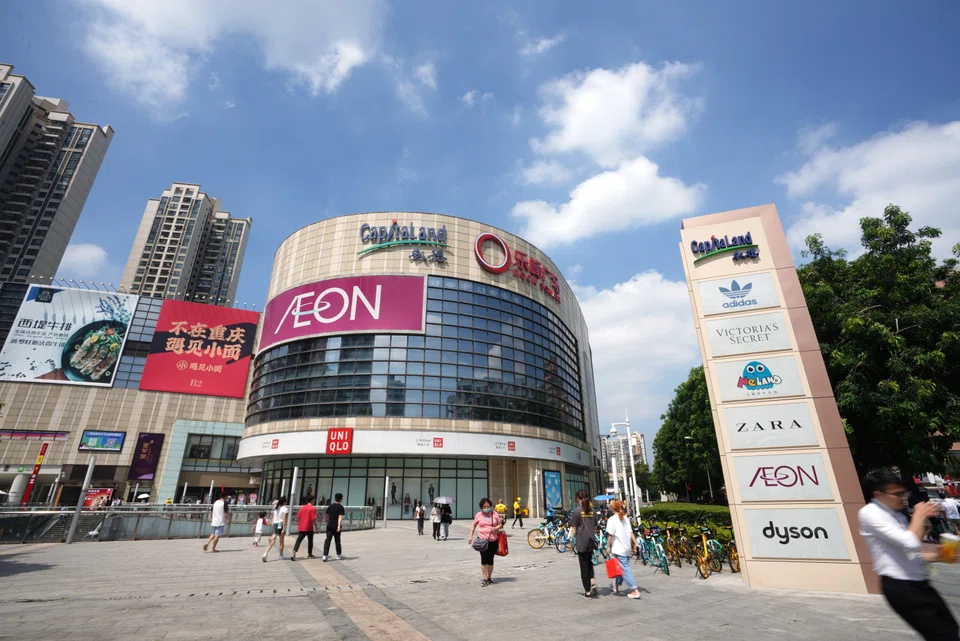
THE manager of CapitaLand China Trust (CLCT) on Thursday (Feb 6) posted a 12 per cent decline in distribution per unit (DPU) to S$0.0264 for the second half ended Dec 31, from S$0.03 in the year-ago period.
This brings total DPU for FY2024 to S$0.0565, down 16.2 per cent year on year (yoy) from S$0.0674, and was attributed to an enlarged unit base. Based on the closing price of S$0.73 per unit on Wednesday, CLCT’s distribution yield for the full year was 7.7 per cent.
The decline in DPU in H2 2024 has narrowed from a 19.5 per cent drop for the first half, said Gerry Chan, chief executive officer of CapitaLand China Trust’s manager.
He said: “Overall, our results reflect strong performance from our largest asset class, which is the retail portfolio, and (this) was driven by our asset enhancement initiative (AEI) efforts. The market for business park and logistics assets has been relatively more challenging, offsetting our retail performance.”
The China-focused real estate investment trust posted a 6.5 per cent decrease in revenue for the half-year period to S$168.5 million from S$180.2 million, due to a weaker yuan against the Singapore dollar.
On a yuan basis, revenue fell 5.5 per cent yoy. The manager attributed this decline to lower revenue contributions from the business parks and logistics parks segments, owing to lower occupancy and rental rates. There was also an absence of contributions from CapitaMall Shuangjing, which was divested in January last year.
Additionally, there was a decline in revenue contribution from CapitaMall Xinnan due to lower average occupancy and gross rental rate resulting from rental adjustments and tenants remix.
This was partially offset by improved performance in CapitaMall Grand Canyon, Rock Square and CapitaMall Yuhuating, which benefited from AEIs.
Net property income (NPI) for the second half stood at S$108.6 million, down 7.6 per cent from S$117.5 million in the same period a year earlier.
The three malls that underwent AEIs in 2023, however, recorded a 13.7 per cent year-on-year increase in NPI.
Distributable income was down 10.3 per cent on the year to S$45.5 million from S$50.7 million. The distribution will be paid out on Mar 27, after the record date on Feb 14.
Natural hedging strategies
For the full year, distributable income fell 15 per cent yoy to S$96.8 million from S$113.9 million. Revenue was down 6.4 per cent to S$341.5 million from S$364.7 million previously, and NPI fell 8.2 per cent to S$226.6 million from S$246.7 million.
Gearing as at end-December stood at 41.9 per cent, up from 41.5 per cent as at end-September. Around 76 per cent of CLCT’s total debt is on fixed interest rates.
Chan said: “CLCT is well-positioned to capitalise on further interest rate reductions as the renminbi rate-easing cycle continues. This will effectively lower our overall cost of debt and enhance our natural hedging strategies.”
Its retail portfolio achieved 98.2 per cent occupancy as at end-December – the same as the previous year – with the majority of its retail assets recording improved occupancy yoy.
The business park segment’s occupancy was 87.6 per cent, while the logistics park segment’s was 97.6 per cent as at end-December.
However, rental reversion for the three segments was affected by subdued consumer spending in China.
The manager reported a negative rental reversion of 24.5 per cent for the logistics park segment. Rental reversions for CLCT’s retail and business park segments were also negative, at -1.1 per cent and -4.5 per cent, respectively.
Said Chan: “The market in China for logistics has been tough, with low demand and oversupply issues. Average vacancies of 20 to 30 per cent in many sub-markets are common. We prioritised occupancies in this market for 2024.”
As at end-December, CLCT’s portfolio valuation declined 1.7 per cent on the year to about 24 billion yuan (S$4.4 billion).
“Within the retail sector, smaller and weaker assets faced greater downside pressure, while business parks and logistics parks were impacted by near-term supply-demand imbalances and a softer market outlook,” said the manager.
Sharing his outlook for 2025, Chan said he sees “stable to very small” negative rental reversions for the Reit’s retail portfolio due to subdued consumer spending.
He said: “We are well-positioned for (the) retail portfolio when domestic consumption grows.”
For the business park segment, Chan said the business climate remains cautious, and some sub-markets may continue to face pressure.
He said: “We expect negative single-digit reversions... Our portfolio leans towards innovation-driven sectors including electronics and technology for business parks, (for) which government policies signal stronger support. We will focus on these policy-aligned areas to better position our assets.”
The logistics sector is still exposed to geopolitical risk and trade uncertainties, Chan said. However, the Reit sees smaller negative reversions for its portfolio compared to previous years.
“We will continue to review portfolio reconstitution options for logistics assets when there are opportunities, but certainly we are committed to maintaining a high occupancy.”
CLCT’s units closed 0.7 per cent or S$0.005 higher at S$0.73 on Wednesday.
TRENDING NOW

ComfortDelGro appoints two new independent directors

Once staunchly pro-China, Malaysian Chinese businesses are now distancing themselves from Beijing

NoonTalk needs continued financial support from CEO Dasmond Koh, auditors warn

DP Architects sets the benchmark for sustainability disclosure and design

