

CapitaLand Investment to restructure portfolio, recycle up to S$9 billion
It plans to monetise legacy, non-core balance-sheet assets; pare excess holdings in some Reits, private funds

[SINGAPORE] CapitaLand Investment is undertaking a portfolio restructuring with up to S$9 billion of non-core and legacy assets earmarked for capital recycling, as it focuses on growing its listed and private funds businesses, and lightening its balance sheet.
“Since our 2021 transformation, we still have a fairly large balance sheet because a lot of it consists of legacy assets: joint venture funds and development funds created when CapitaLand was still a developer,” said group CEO Lee Chee Koon at an earnings briefing on Thursday (Aug 13).
The portfolio reorganisation will also see CLI reducing its “excess holdings” in some of its bigger real estate investment trusts (Reits), such as CapitaLand Integrated Commercial Trust (CICT), which holds a mix of prime office and retail assets, and the industrial-focused CapitaLand Ascendas Reit (Clar).
CLI will retain its listed and private funds as its core business, supported by key operating capabilities in commercial and lodging management.
Non-core holdings to be hived off include legacy funds and balance sheet assets in markets such as China, Singapore, India and Europe, as well as non-strategic holdings in CLI-managed Reits and private funds.
Group chief financial officer Paul Tham said the majority of the S$7 billion to S$9 billion in value targeted for capital recycling comprises balance-sheet and legacy fund investments, the bulk of which is from China. It also includes some assets in Singapore, India and Europe. About 30 to 40 per cent would come from its sub-scale private funds and the remainder from excess holdings in its Reits and platforms.
Speaking to the media on the sidelines of the briefing, Lee said CLI will also focus on reducing its stakes in its larger Reits. CLI has targeted a sponsor stake of about 15 per cent in its Reits.
The group currently holds a 20 per cent stake in CICT and 16 per cent stake in Clar. Reducing its stakes to an average of 15 per cent across some S$8 billion of Reit units could improve the Reits’ free float and daily trading volumes, while freeing up “a couple of billion dollars” in capital, said Tham.
“Freed up capital would likely go into reinvestment for growth – there are a lot of opportunities in living and credit... We’d also like to pay down some debt. But I’d imagine at least a third could go towards returning capital to shareholders.”
Citi analyst Brandon Lee believes the legacy funds are largely China retail and mixed-use assets, while the balance-sheet investments are mainly in China. He also expects the non-strategic Reit holdings to include CapitaLand Ascott Trust (25 per cent stake), CapitaLand China Trust (25 per cent), CapitaLand India Trust (23 per cent) and CapitaLand Malaysia Trust (37 per cent), alongside investments in private funds.
CLI has yet to determine a timeline for its asset divestment programme, and will provide more details at its upcoming investor day.
A dedicated team is being set up to sell down CLI’s stakes in funds and balance sheet assets, as well as wind down smaller, sub-scale strategies, said Lee Chee Koon.
“We are in conversations with various LPs (limited partners) that want us to focus on deploying capital meaningfully in dedicated strategies, so we need to sunset smaller strategies and channel resources to building repeatable, higher-margin ones with better flow-through to the bottom line.”
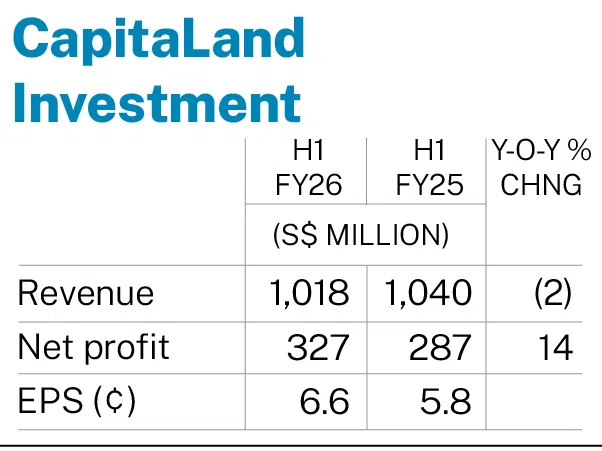
For the first half ended June, CLI posted a net profit of S$327 million, up 14 per cent from S$287 million in the year-ago period. This was driven by higher fee income from its listed and private funds management platforms.
Revenue fell 2 per cent to about S$1.02 billion, from S$1.04 billion previously mainly due to the absence of contributions from divested assets and deconsolidation, partially offset by higher fees from its fee income-related business.
Ascott’s fee-related business grew 4 per cent year on year, led by higher performance of existing properties and contributions from new assets.
Lee said the hospitality arm’s steady performance has attracted interest from investors and LPs.
“We don’t mind bringing in investors that can help further the (mergers and acquisitions) ambitions and strengthen the distribution or the capability of Ascott, so we are totally open-minded about that.”
Still, Ascott remains an “important part” of CLI’s business to “help it to set up new fund strategies”. The potential paring down of stakes in the lodging arm would not be part of CLI’s plan to monetise its non-core assets.
Bloomberg Intelligence (BI) expects the group’s operating earnings before interest, taxes, depreciation and amortisation (Ebitda) to rise year on year in H2, driven mainly by its fee-related business, although this could be partly offset by lower profit from its real estate investment arm as the group advances its asset-light strategy.
Operating Ebitda from the fee-related business rose 30 per cent in H1, with further growth expected from listed and private funds management, BI noted. It added that CLI’s lodging business also has room to expand, with 40 per cent of its portfolio in the pipeline and expected to become operational over the next three years.
For H1, listed funds recorded a 45 per cent year-on-year increase in fee revenue to S$224 million, from about S$10.6 billion of transactions, while private funds fee revenue jumped 59 per cent to S$92 million, driven by the acquisition of real estate private credit platform Wingate last year.
The group plans to accelerate the expansion of its Reit franchise through accretive acquisitions, portfolio rejuvenation and capital market initiatives, while developing new listed vehicles across asset classes and geographies.
Tham said CLI is considering “short-term warehousing”, or temporarily holding acquisitions on its balance sheet before transferring them to its Reits, while also working with the Reits to find DPU-accretive acquisitions and co-investing alongside them on larger deals.
CLI will prioritise its commercial, living, self-storage and credit strategies, while rationalising smaller, sub-scale funds that it does not see the potential to scale meaningfully. It also sees opportunities to grow through separately managed accounts, amid interest from global institutional investors seeking Asia-Pacific-focused strategies.
Private credit will also be a priority for potential mergers and acquisitions, Lee told the media. He added that CLI’s second credit fund was oversubscribed, and that the group is working on its third as it explores opportunities with multiple parties.
Shares of CLI ended Thursday 0.7 per cent or S$0.02 higher at S$2.75, after the release of its results.
TRENDING NOW

Malaysian king buys stake in Singapore-listed mining firm expanding into rare earths

Grab CEO’s wife Chloe Tong on life with Anthony Tan and finding her purpose

Once staunchly pro-China, Malaysian Chinese businesses are now distancing themselves from Beijing

Longer wait times expected as S’pore healthcare institutions report system disruptions

