

Carbon credits in compliance markets make poor strategic investments: Morningstar

Wong Pei Ting
INVESTORS should not bet on the price of carbon credits rising in cap-and-trade regimes, because most compliance carbon markets are ineffective in raising the cost of emissions, according to a recent report by Morningstar Equity Research.
About 17 per cent of the world’s greenhouse gas emissions globally are currently covered under cap-and-trade systems, where governments “cap” the amount of emissions for specified industry sectors, Morningstar wrote. Companies that emit less than their carbon budgets have excess carbon credits, which can be sold on compliance carbon markets to those who need credits.
By controlling the supply of carbon credits, cap-and-trade regimes are supposed to induce a price on carbon. As the carbon budget is lowered, the price of the credits should increase to reflect the higher cost of emissions.
But that outcome has not happened in most compliance markets, said Morningstar, which noted large discrepancies in the price of carbon across different jurisdictions. For instance, credits in the US state of Massachusetts are about US$0.50 per tonne of carbon dioxide equivalent, compared to US$98.99 in the United Kingdom. All but 4 cap-and-trade programmes that Morningstar looked at fell short of the US$50 to US$100 threshold determined by the High-Level Commission on Carbon Prices to be necessary to keep global warming under 2 degrees Celsius.
The problem begins with governments’ poor ability to forecast the trajectory of actual carbon emissions in the short term, Morningstar said. Emissions in jurisdictions covered by cap-and-trade programmes tend to reach targets earlier than forecast, the firm observed. For example, California hit its 2020 abatement targets 4 years ahead of schedule in 2016.
When that happens, companies hoard credits, which leads to an oversupply of credits and perversely lowers the cost of emissions. Governments could make adjustments to correct prices, but doing that takes political will to impose unpopular “sticks” to raise costs.
“Besides being tricky to pass, unpopular sticks that do see the light of day put the governments that pass them into jeopardy,” Morningstar wrote. “They are consistently at risk of getting replaced by those who promise to remove them. Politicians are not likely to crank up the thermostat when they’re in the hot seat, which casts doubt on the potential of cap-and-trades to reach effective price levels.”
All of this suggest that future emissions caps are likely to taper at a lumpier pace than targets promise, if at all, posing ramifications for the health of compliance markets as a medium of financial exchange, the analysts said. Investors with allocations in carbon credits are probably betting on the outcome of carbon markets – how successful regulators are at executing their ambitious aims – rather than the value of carbon, Morningstar argued.
Supporting this theory is the finding that flows have rewarded experience over size, given the steep challenge in implementing these cap-and-trade programmes effectively, the researchers said. The European Union captures three-quarters of emissions under regulation, but generates about 90 per cent of carbon credits’ transaction volume.
Nevertheless, the Morningstar analysts said carbon credits may yet be enticing for investors with environmental, social and governance (ESG) objectives and a keen interest in impact. That potential, however, relied on an “under-explored” concept in carbon credit investing that requires minor tweaks to generate more impact.
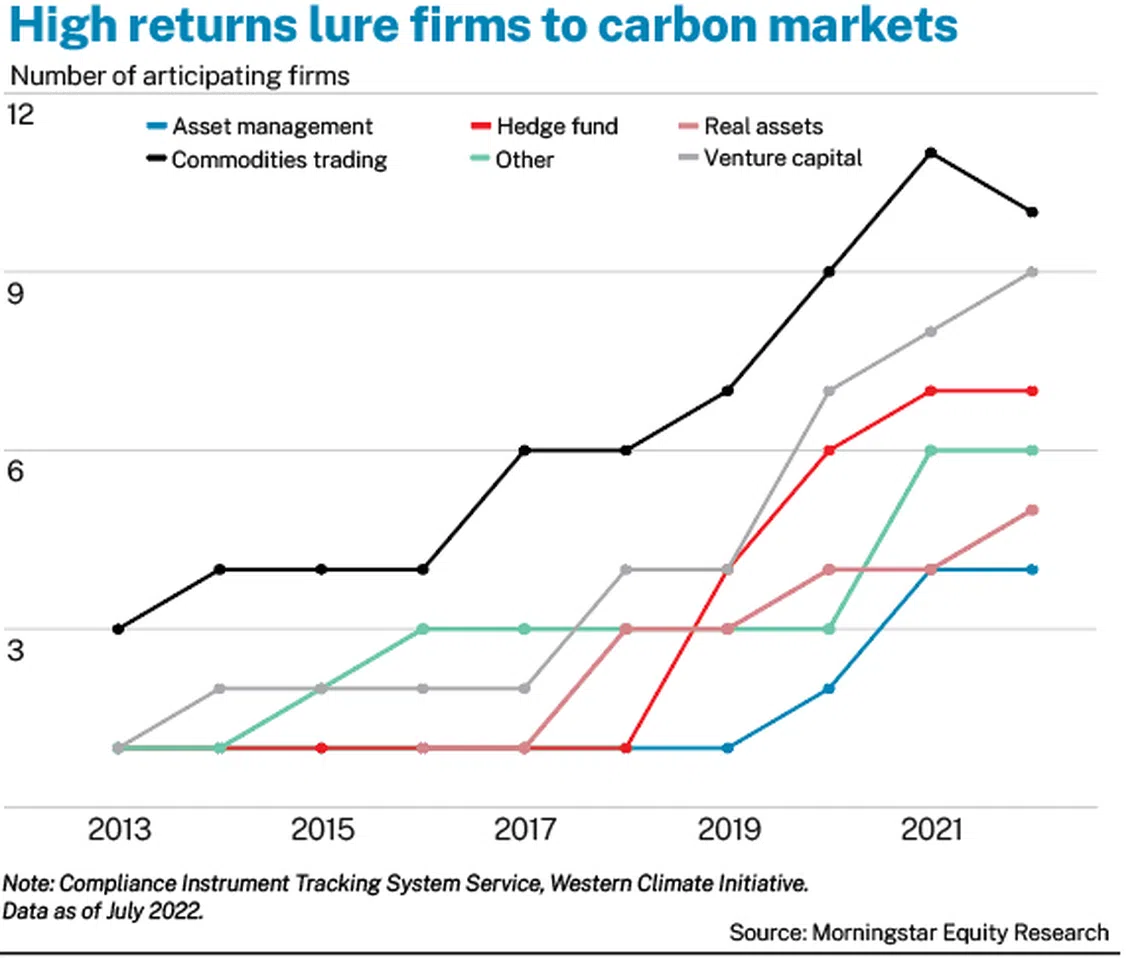
Funds today typically treat carbon credits as a commodity, gaining exposure by buying futures or purchasing a spot in a secondary market and selling futures back to the highest bidder when they roll forward the contracts. However, funds could buy carbon credits at primary auctions instead, where proceeds can be used to bankroll clean energy projects in the jurisdictions that sponsor them, Morningstar said.
Morningstar senior research analyst Madeline Hume told The Business Times that the report did not cover voluntary carbon markets as they are relatively small in terms of the proportion of emissions they cover globally, leading to a lack of investor demand for such offsets.
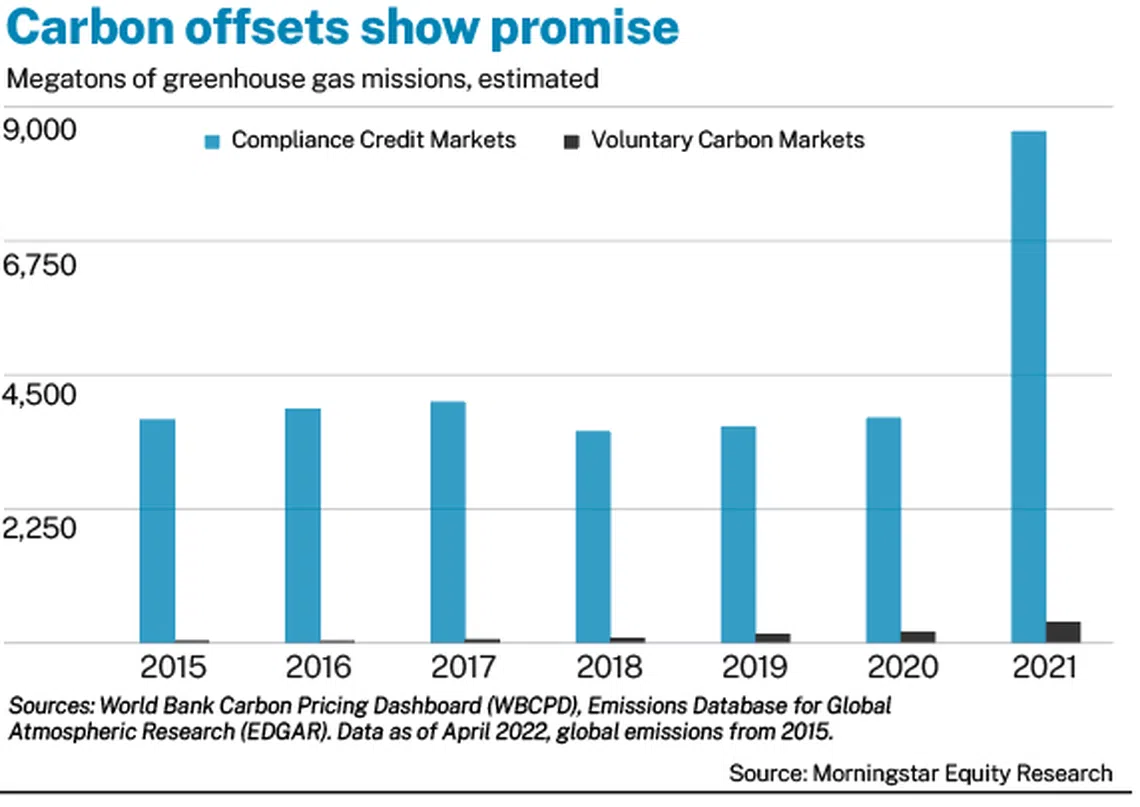
The report also explained the key difference between the compliance markets covered in the report and voluntary markets. “Compliance markets require companies in certain sectors to purchase permits in order to pollute, like paying a toll to drive on an expressway. Meanwhile, voluntary markets function more like the indulgences of medieval Christianity, asking customers to pay retroactively for fossil fuels they have already torched.”
Singapore does not have a cap-and-trade programme in place. Instead, the country uses a carbon tax to set the price of carbon. By 2030, large emitters here will have to pay S$50 to S$80 per tonne of carbon dioxide equivalent, up from S$5 currently. Emitters covered under the tax may, from 2024, buy credits to offset up to 5 per cent of taxable emissions, in lieu of paying tax.
Dr Bo Bai, executive chairman of the Singapore-based MetaVerse Green Exchange, agreed with findings of the report, saying compliance carbon credit markets, whether in the format of a cap-and-trade or a carbon taxation scheme like Singapore’s, are very much driven by each country’s regulator.
It is “surely subject” to the political appetite and the election cycle of each country, he said. “Repetitively, we’ve heard from regulators from emerging markets that they have to weigh the burden of a carbon tax on emission-intensive businesses and hence cannot price compliant carbon credits too high,” he added.
Asked what this spells for the ability of voluntary carbon markets to set or raise prices as well, Bai said the voluntary market is meant to be global in scope, not local, thus the price of voluntary carbon credits should be determined by global supply and demand.
Prices of voluntary carbon credits will be driven up in time to come, he added, as more western corporates and financial institutions are showing strong interest in participating and buying these credits for their net-zero journeys.
This will set in motion the flow of foreign direct investments into emerging markets with carbon credit resources, such as Indonesia and Malaysia, but voluntary markets have a key challenge - the issue of Nationally Determined Contributions, which essentially give every carbon credit a nationality - he said.
Meanwhile, Bai said there will be arbitrage between compliance and voluntary markets as many countries allow about 5 per cent of the compliance market to be offset by credits from the voluntary market. “This friction naturally keeps the price difference for some time, until it eventually converges,” he said.






