Carbon impact on global equity benchmark could be 0-14% of earnings: GIC

Wong Pei Ting

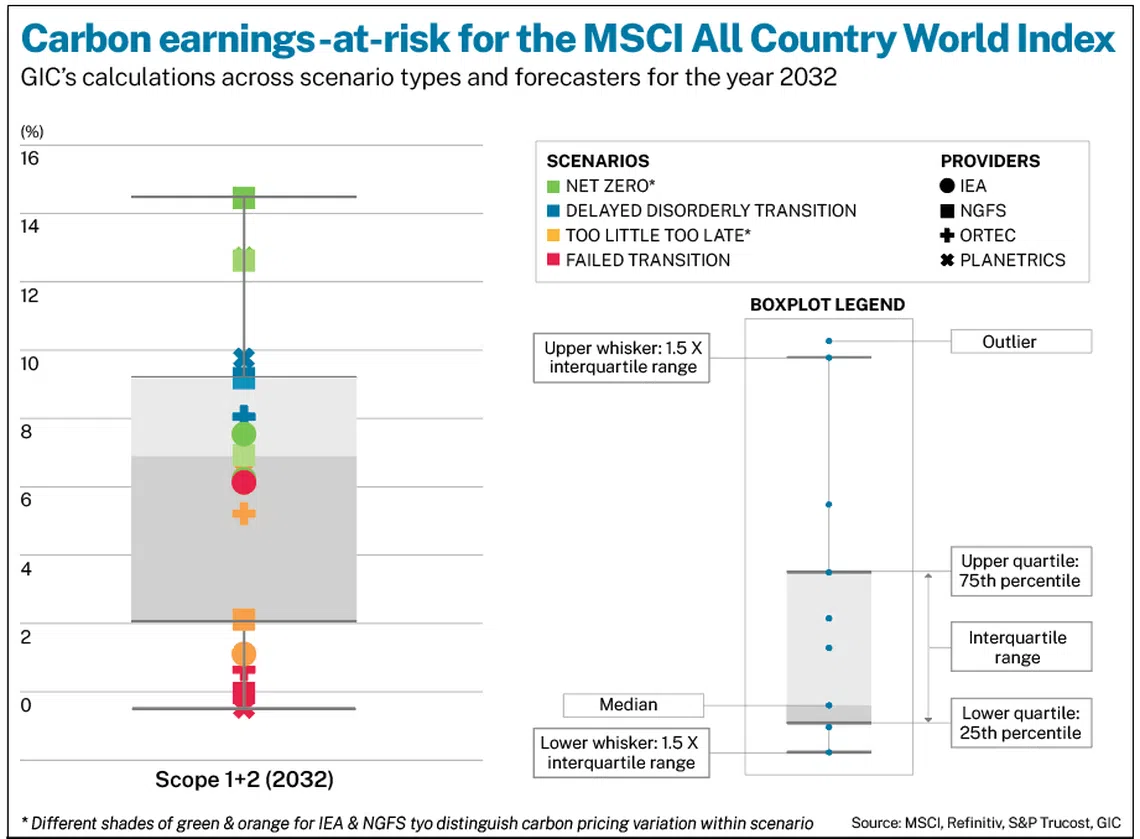
THE projected greenhouse gas emissions of a model global equity portfolio could have an impact between zero and 14 per cent of the portfolio’s net earnings in 10 years, according to an analysis by Singapore sovereign wealth fund GIC.
That finding was the result of a carbon pricing methodology that GIC developed to give itself a more robust, financially material and forward-looking way to assess the carbon risk of its investments.
Called carbon earnings-at-risk scenario analysis (Cesa), the methodology chiefly combines forecasts about an investment’s carbon intensity with models about carbon prices under different scenarios, regions and industries, according to a paper published on Tuesday (Oct 25). GIC head of sustainability and total portfolio sustainable investing Rachel Teo and her associates Wong De Rui and Lloyd Lee authored the paper.
GIC applied Cesa to a model portfolio that replicates the MSCI All Country World Index, a global equity benchmark. The zero per cent lower bound of its impact range reflects a “failed transition” scenario where the world warms by 3 degrees Celsius and higher and carbon prices are low. The other end of the spectrum would occur in a “net zero” scenario where warming is limited to 1.5 degrees Celsius; this would imply the highest carbon prices.
GIC said that it developed Cesa to overcome limitations in the most widely used carbon metrics at this time, such as the weighted average carbon intensity (WACI), which measures the carbon efficiency of an investment on a per-revenue basis. WACI is recommended by the Task Force on Climate-Related Financial Disclosures (TCFD) for assessing portfolios.
But the WACI can be inadequate on three fronts, GIC said. On materiality, the WACI does not reflect estimated impact on earnings. For instance, a company with high carbon intensity might not be as exposed to carbon pricing risks if it has high profit margins or operates in markets with less severe changes in carbon prices.
The WACI is also a historical metric, while the Cesa’s use of estimates and scenarios offers a more forward-looking tool. Finally, the WACI, which is measured in amount of carbon per revenue, is a non-financial metric that needs additional translation to understand impact on investments. Cesa, however, is a percentage of profitability, which makes the impact easier to integrate into investment frameworks.
“While (the universal carbon price change approach) benefits from simplicity, it can lead to carbon pricing risk estimates that do not reflect operating realities,” the authors wrote.
Apart from providing an aggregate portfolio view, Cesa can also help portfolio managers to identify pockets of vulnerabilities where carbon pricing risks are highest and focus efforts on further diligence, they said.
The authors said a company that is assessed as having a high level of earnings at risk “may still be investable” as other dimensions need to be considered as well.
These other dimensions include the company’s competitive positioning relative to its industry peers, the deployment pace of substitutes that could displace the company’s carbon-intensive products or services, and the outlook on carbon prices in jurisdictions that the company operates in, they said.
Carbon pricing risk is also just one amongst a range of financially material climate-related investment issues, they said. For a more holistic appraisal of an investment portfolio’s climate resilience, additional tools are required to assess other forms of transition risks, like demand destruction and physical risks, such as floods, wildfires or droughts, they said.
A concise look at GIC’s carbon earnings-at-risk method
GIC published its carbon pricing risk measure to “provide a starting point” for investors to think more concretely about transition risks in their investment portfolio, beyond just focusing on carbon intensity or footprint metrics in isolation, the authors wrote. Here’s how it works.
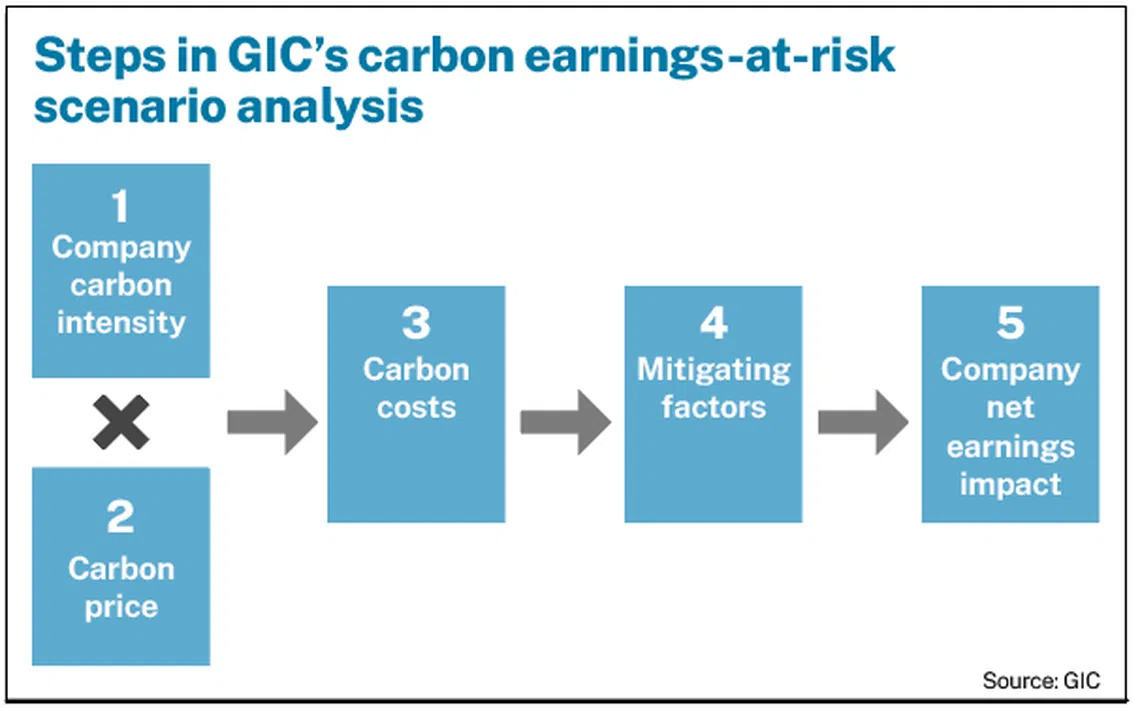
Step 1: Carbon intensity – A company’s emission targets and historical track record are considered. Weights attached to either vary depending on its historical emission trend in relation to the emission trajectory required to achieve its emission commitments.
Step 2: Carbon prices – Varying carbon price levels across different scenarios, regions and industries that the company is potentially exposed to are considered.
Step 3: Carbon costs – Carbon intensity and increase in carbon price are used to compute the company’s carbon cost liabilities. Special attention is paid to Scope 2 emissions, or emissions from the company’s power use, as the cost impact will depend on whether the power utilities would pass-through the carbon costs or absorb them.
Step 4: Mitigating factors – The impact of carbon costs on earnings can vary depending on its ability to pass on those costs to customers without affecting demand for its goods and services. GIC will apply appropriate cost pass-through assumptions here.
Step 5: Company net earnings impact – Lastly, the costs are keyed into the company’s “through-the-cycle” profit margin to minimise distortions from short-term profit volatility.
Amendment note: An earlier version of this story stated that GIC’s findings are that the carbon impact on the MSCI All Country World Index could be -1 per cent to 14 per cent of earnings. On a recalculation, GIC determined that the lower bound of the impact should be zero instead.