

CaterSpot eyes APAC expansion with backing from Tat Hong family office

Sharanya Pillai
Singapore
EVEN amid the Covid-19 outbreak, B2B food delivery player CaterSpot has its eye on growth. The profitable startup is targeting to raise between US$6-8 million in Series A funds in the first quarter of 2021 to fuel its expansion in Asia-Pacific markets - Malaysia, Taiwan, South Korea and Australia - as well as the United Arab Emirates.
To get there, CaterSpot is newly armed with "old money". It recently received a fresh injection of funds from Triplestar Holdings, a family investment holding company helmed by Andrew Ng, the second son of Tat Hong Holdings' chief executive Roland Ng. Tat Hong is one of Asia's largest crane suppliers.
In January, CaterSpot raised US$800,000 in a pre-Series A round led by Triplestar and joined by angel investor network Bansea and other angels. Triplestar had also led a US$800,000 funding round into CaterSpot back in March 2016, within a month of the startup's launch.
Having US$1.6 million in funds raised may seem modest compared to other food delivery startups. But it is precisely because of its B2B focus that CaterSpot did not need much external capital, and even managed to turn a profit within 18 months, co-founder and chief executive Camilo Paredes told The Business Times.
"We enjoy very healthy unit economics; we make money on every single order, as opposed to B2C delivery companies that lose money on every order. Because of the large ticket sizes, we can complete every order profitably, and we get to reinvest the profits... in product development," he said. CaterSpot's average order size is over US$270.
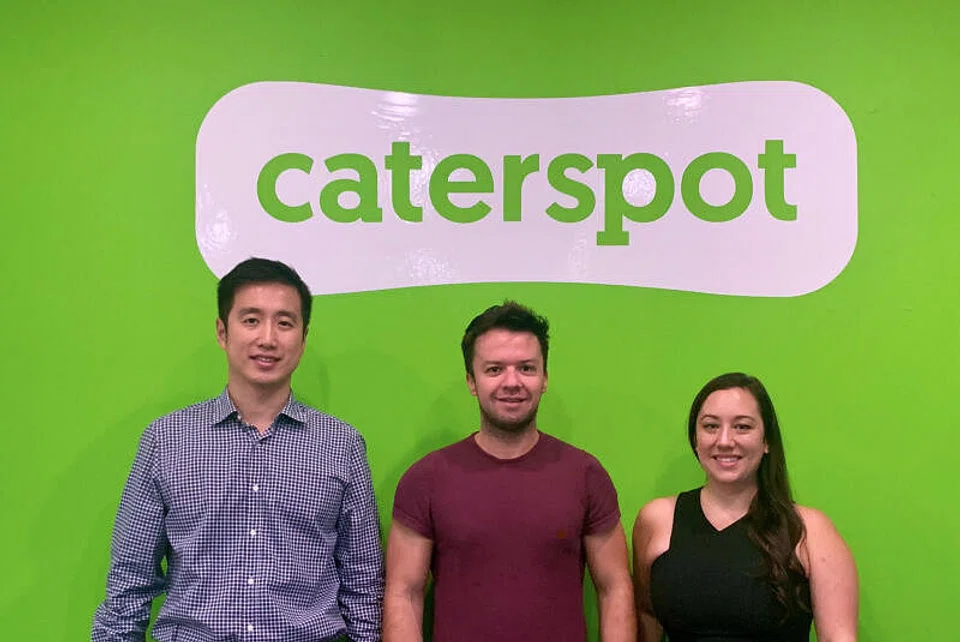
CaterSpot acts as a middleman between corporates and F&B vendors, namely caterers and restaurants. Mr Paredes and co-founder Amanda Ernst were both former managing directors of foodpanda in Latin America.
The duo realised that vendors who prepare corporate meals could benefit from a centralised online ordering platform. But incumbents like foodpanda are not equipped to deal with large order volumes.
"When we were running foodpanda, we realised that we were getting corporate orders but we were not logistically ready to deliver them. I remember getting a large order for 25 pizzas, but we couldn't deliver them with a single bike. I had to get an intern to get his car and pull in a blanket to keep those pizzas warm," Mr Parades recalled.
To address this pain point, CaterSpot set up an online marketplace where companies can order meals from vendors at a click. The startup also runs a food programme service for companies that sponsor employee meals, an events concierge service that prepares quotations for companies that are catering for events, as well as a pantry management service. All of these segments contribute to "steady recurring revenue", Mr Paredes said.
In Singapore, CaterSpot has over 4,000 corporate clients including Stripe, TikTok, DBS, Paypal and Netflix, who can tap on the startup to order from over 360 caterers and restaurants. CaterSpot serves Netflix's employees daily breakfast and lunch.
Over in Hong Kong, CaterSpot serves about 1,200 corporate clients, with a selection of over 280 caterers and restaurants. Its clients there include Verizon, Facebook and HSBC.
The startup has kept its revenue model fairly simple: CaterSpot earns a commission of 30-35 per cent from the caterers and restaurants, for orders where the startup delivers the food using its own fleet.
If the vendor can deliver the food itself, CaterSpot takes a lower commission of between 20-25 per cent.
To be sure, the Covid-19 outbreak has been challenging for CaterSpot. Mr Paredes estimates that the startup's revenue dropped by 40 per cent within two weeks after Singapore raised its Dorscon alert level to Orange.
It is now looking to preserve revenues through loyalty initiatives, such as same-day delivery and exclusive discounts, while cutting costs.
For his part, Mr Andrew Ng of Triplestar is confident of the startup's ability to outperform. He got to know of CaterSpot in 2016 through a business contact, and was impressed by the founders' experience.
"We come from a family of business owners, and being of the younger generation, I always like to be hands-on with the operations... In Camilo and Amanda, I saw very passionate entrepreneurs. The company has had to go through challenges and they have pulled through... That's why I was convinced that these are the right people to back," he said.
CaterSpot is the first tech startup Triplestar has invested in. It has previously invested in a real estate consulting firm, an Asia-Pacific integrated healthcare company and several real estate projects. Triplestar also operates its own preschool chain, Posso Preschool.
TRENDING NOW

Grab CEO’s wife Chloe Tong on life with Anthony Tan and finding her purpose
As Malaysia’s chip goals morph into a multi-state model, are they outgrowing Penang?

Singapore-based Ryde accused of pump-and-dump fraud in class action lawsuit

Green fuels, autonomous ships: How Singapore is future-proofing its shipping industry

