Cathay Cineplexes’ rental arrears unlikely to impact FCT’s bottom line
But dwindling cinema attendance presents challenges for mall operators

DELAYED rental payments by cinema operator Cathay Cineplexes to its landlord Frasers Centrepoint Trust (FCT) will not significantly impact the trust’s bottom line.
Nevertheless, this could indicate a “structural issue” among cinema operators facing declining attendance at cinemas and signal the consolidation of cinemas to malls with higher footfall, said analysts.
Background
On Jan 28, Cathay Cineplexes, which is operated by mainboard-listed media company mm2 Asia , received letters of demand for about S$2.7 million in rental arrears from the landlords of two retail malls where it operates.
The malls are Century Square, which is in Tampines, and Causeway Point, which is in Woodlands. Both properties are owned by FCT.
The slower-than-expected recovery of the cinema industry has delayed the repayment of its arrears, said mm2 Asia on Feb 6.
The outstanding amount is a quarter of the total payment that Cathay Cineplexes owed to the landlords between April 2020 and January 2025, added mm2 Asia.
It added that it is actively engaging with the landlords to resolve the matter, and will work on a payment schedule that is acceptable to all parties. FCT declined comment for this story.
Impact on FCT
The delayed rental payments will not significantly impact FCT’s earnings as Cathay Cineplexes accounts for less than 1 per cent of the trust’s overall income, said analysts.
FCT’s latest business update indicated that the cinema operator is not one of the trust’s top 10 tenants. The net lettable area occupied by Cathay Cineplexes in Century Square and Causeway Point are 11.5 per cent and 9.4 per cent, respectively, according to data compiled by DBS Group Research.
The trust will have to make provisions for the income from Cathay Cineplexes only if the payment delays exceed internal thresholds and security deposits held by the real estate investment trust (Reit), said Vijay Natarajan, a research analyst at RHB Bank Singapore.
Likewise, Rachel Tan, an equity researcher at Macquarie Capital, said that since Cathay Cineplexes has repaid some of the arrears, the risk of arrears snowballing to become uncollectable has been “largely reduced”.
Nevertheless, she warned that the episode could raise concerns among investors about similar structural issues – such as operational performance and cashflow matters – among other cinema operators which could impact their rent payments too.
Shrinking cinema presence
Cathay Cineplexes’s non-payments reflect the challenges faced by the cinema industry to attract footfall, amid competition from streaming services such as Netflix.
Analysts said that going forward, cinema operators may reduce their presence to venues with higher footfall and profitability. This, in turn, will allow Reits to lease the freed up space to tenants in other trades.
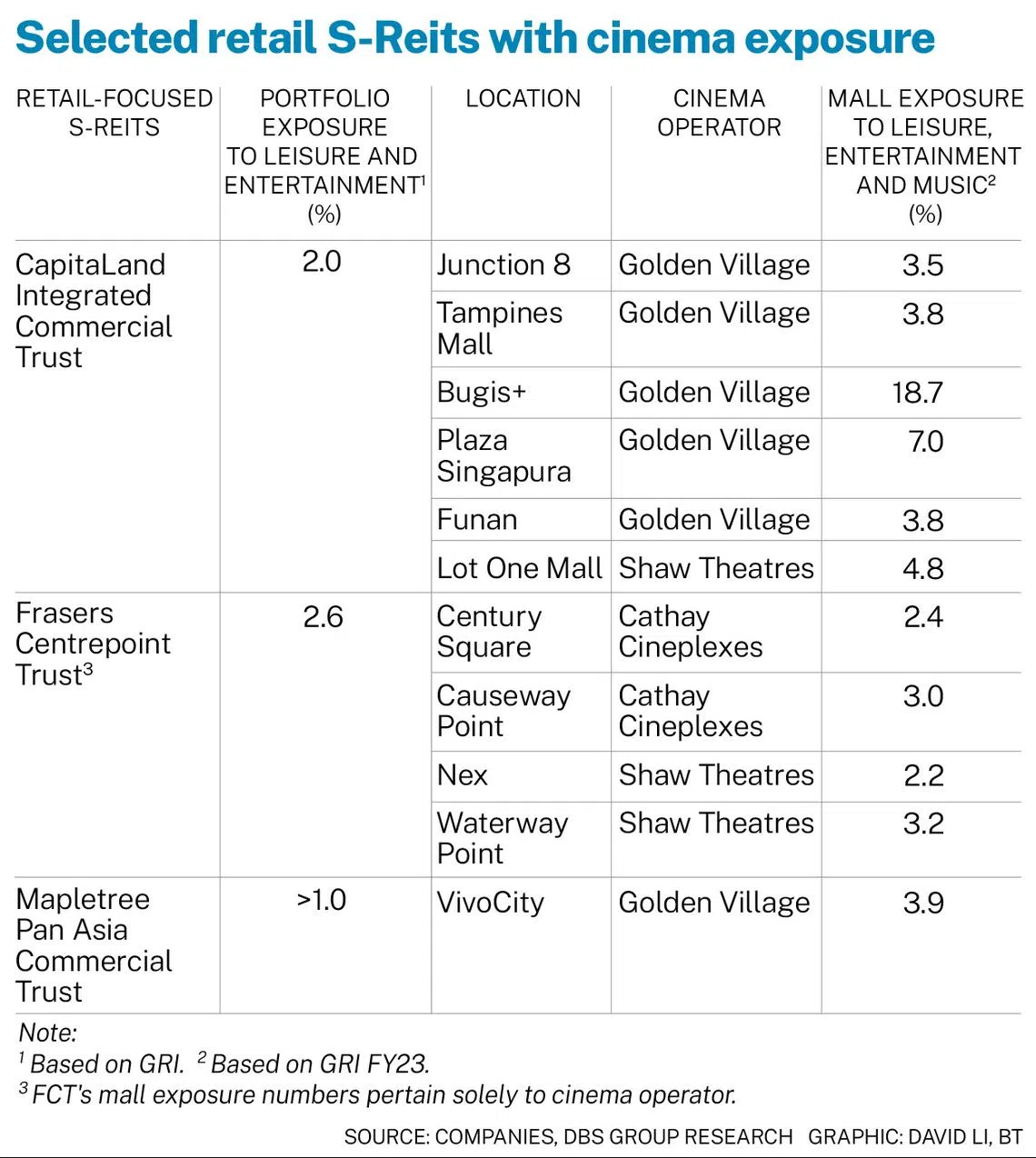
DBS analysts Derek Tan and Geraldine Wong said on Feb 4 that the three major cinema operators – Cathay Cineplexes, Golden Village and Shaw Theatres – operate across 13 malls owned by S-Reits. Most of these malls are owned by FCT and CapitaLand Integrated Commercial Trust (CICT).
Exposure to leisure and entertainment, which cinema operations fall under, is generally kept within 3 per cent of portfolio gross rental income (GRI) across S-Reits, they noted.
They said that rents charged by mall operators for cinemas are typically one-third the average rental rate on a per square foot (psf) basis that a mall commands. This is due to the large space taken up by cinemas as well as their less desirable locations within the mall, such as at the top floor or in the corner of a mall.
“Over time, we foresee cinema operators potentially decreasing the footprint or consolidating to venues that rank higher in profitability,” said the DBS analysts.
Tony Tan, the chief executive of the manager, said that cinemas contribute to less than 1 per cent of total GRI contribution at CICT and do not have a significant risk exposure.
Nevertheless, he acknowledged that as people turn to streaming services for movies, the manager will “actively look” at whether there are alternative uses for cinema space. He added that the manager will take a “targeted” approach in doing so given that cinemas are not located in areas with heavy footfall.
Darren Chan, a senior research analyst from Phillip Securities Research, said that while retail Reits may reduce cinema tenants upon the lease expiry, cinemas are unlikely to be removed entirely as they do not occupy prime spots.
Moreover, with the potential return of blockbuster films, cinemas could continue to drive foot traffic to malls, benefiting other tenants such as food and beverage.
And while Reits can replace cinemas with higher-paying tenants, it would be challenging to secure suitable tenants for such large spaces, he added.
Similarly, RHB’s Natarajan agreed that cinemas play a key role in attracting foot traffic to malls. That said, Reits could eventually repurpose some of the space occupied by cinemas to tenants in the entertainment or education segments, for instance, with little impact to a Reit’s bottom line.
Units of FCT closed flat at S$2.10 on Thursday (Feb 13). Shares of mm2 Asia also ended the day flat at S$0.012.