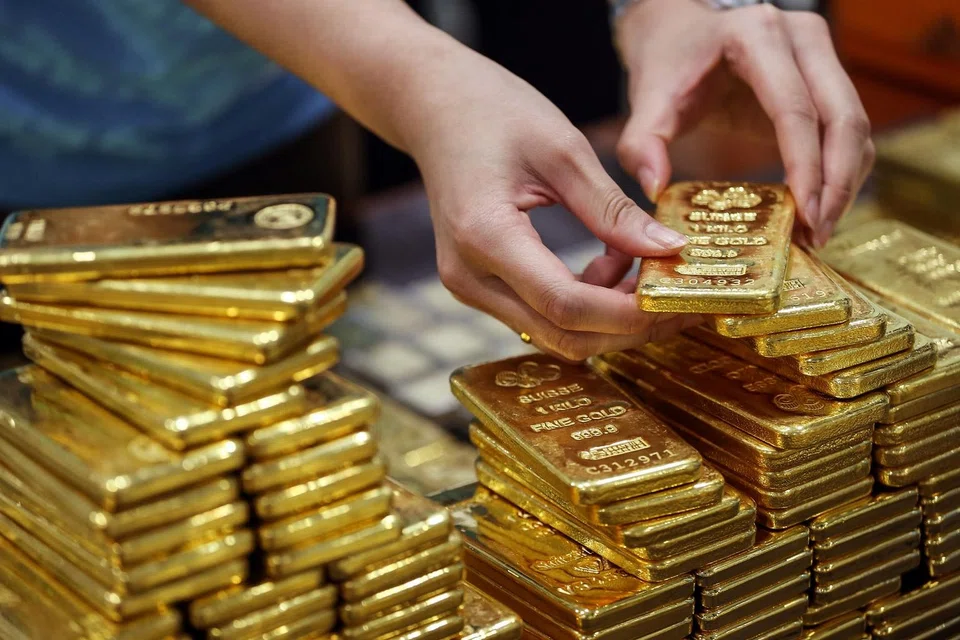
Central banks could increase gold reserves further as shine of US dollar dims: analysts
Sentiment towards gold at most positive levels since 2019, World Gold Council survey indicates

CENTRAL banks are expected to continue to add to their gold reserves over the next year, analysts said, as the US dollar loses its shine in the longer term for investors seeking a safe haven from ongoing macroeconomic uncertainties.
The 2024 Central Banks Gold Reserves survey by the World Gold Council (WGC) noted that central banks are showing a more favourable view of gold’s prospects as a reserve asset.
Some 29 per cent of the central banks surveyed said they intend to increase their gold reserves in the next 12 months, and 81 per cent of respondents said they expect global central bank gold holdings to increase in the period. These responses represent the highest level of positivity towards gold since 2019, WGC said.
Central banks globally in 2022 and 2023 recorded the highest annual purchases of gold in history – at 1,082 tonnes and 1,037 tonnes, respectively – which has lifted gold prices to all-time highs since the start of 2024.
Spot gold prices have been trading at around US$2,300 per ounce in June, up more than 20 per cent on the year, after surging past US$2,400 per ounce in April and May.
The recent dip from record highs comes as the People’s Bank of China (PBOC) did not report any gold purchases in May, ending an 18-month gold buying streak for China’s central bank up to April.
Analysts, however, remained confident that central banks’ gold purchases would continue.
“Just because the central bank didn’t buy gold in one month doesn’t mean it is not going to buy gold in another month,” said Rhona O’Connell, head of market intelligence of Europe, Middle East, Africa and Asia at StoneX.
She noted that PBOC’s gold buying to reduce US dollar dependence sends a clear signal that China is not comfortable with its foreign exchange reserve mix, nor with current geopolitical risk levels.
“If it were to come to light that the official sector as a whole had stopped being a net buyer, that would probably be the big signal for the bull markets (of gold) to come to an end,” said O’Connell.
“But, for the time being, given the background in politics and the fact that we’re still not on an even keel economically in Europe and China, there’s still enough uncertainty going through the market from all those different directions to keep gold in the spotlight as a safe haven.”
Similarly, Suki Cooper, precious metals analyst at Standard Chartered Bank, highlighted that gold fulfils central banks’ objectives on stability, liquidity and returns when allocating reserves, amid the need for de-dollarisation. “We continue to expect central banks to allocate to gold, albeit the pace of net buying may slow,” said Cooper.
US dollar under pressure
The WGC survey indicated that the top three reasons to hold gold now are: its long-term value; performance during a crisis; and role as an effective portfolio diversifier.
The survey was conducted in partnership with YouGov between Feb 19 and Apr 30 with a total of 70 respondents. “While influences like price may temporarily slow down purchases in the near term, the broader trend remains in place, as managers recognise gold’s role as a strategic asset in the face of ongoing uncertainty,” said Shaokai Fan, global head of central banks and head of Apac of WGC.
For one thing, the majority of respondents in emerging markets and development economies (64 per cent) as well as advanced economies (56 per cent) believe that the US dollar’s share of global reserves will decline.
“The US dollar’s status as the world’s leading reserve currency will not disappear anytime soon. However, central banks may be considering some longer-term trends in their views on the dollar, including US fiscal sustainability, political disharmony and the blending of geopolitical concerns with the financial system,” Fan told The Business Times.
Despite the current strength of the US dollar, some market watchers noted that concerns over the currency’s value in the future have been lingering among central banks.
“There is a real feeling among central banks… (that the) US dollar is under longer-term pressure,” said John Reade, chief market strategist for Europe and Asia of WGC.
James Luke, fund manager for metals at Schroders, noted that Russia’s US$300 billion of frozen reserve assets could be seen by central banks around the world as a “weaponisation” of the US dollar.
Such dollar hegemony, coupled with vast US Treasury issuance to fund “never-ending deficits” that triggers concerns over long-term debt sustainability, have driven central bank purchases of gold as a monetary reserve asset.
“Central banks... have been listening, though record purchases have so far only taken gold reserves as a share of total reserve holdings from 12.9 per cent at the end of 2021 to 15.3 per cent at the end of 2023,” Luke said.
WGC data showed that global official gold reserves rose by a net 290 tonnes in the first quarter of 2024 – marking the highest Q1 total since 2000. It was also 69 per cent higher than the five-year quarterly average of 171 tonnes.
TRENDING NOW
MAS allocates S$1.45 billion to five asset managers in third EQDP batch: Chee Hong Tat
‘My grandfather’s legacy’: Sherman Kwek lays out three-year plan for CDL to drive returns
He built the Vingroup empire. Now South-east Asia’s richest man is handing some key roles to his sons
‘How many will survive?’: Bubble fears arise as China’s humanoid robotics face reality check