

CGSI upgrades Singapore banking sector to ‘overweight’ on net interest income upside
It raises earnings per share estimates for all three local banks

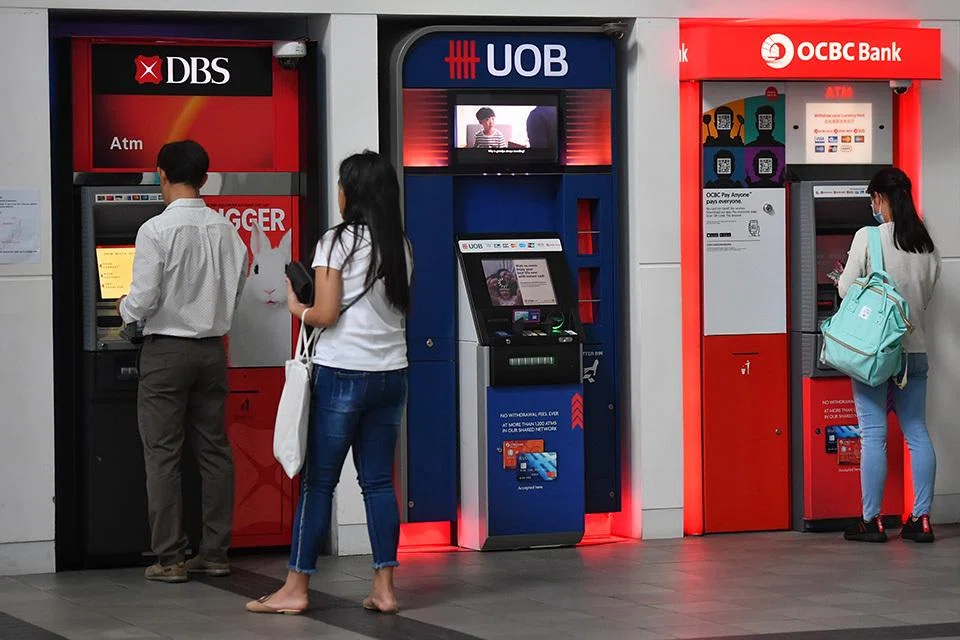
[SINGAPORE] CGS International (CGSI) has upgraded its outlook on the Singapore banking sector from “neutral” to “overweight”, amid robust capital inflows and continued loan growth.
In a note on Tuesday (Jun 9), the brokerage said it believes local lenders are well-positioned for return on equity (ROE) expansion, driven primarily by net interest income (NII) growth and ongoing structural gains within their wealth management businesses.
In line with this upgrade, CGSI raised its financial year 2027 to 2028 earnings per share (EPS) estimates across the three local banks, with increases ranging from 2.6 to 6.3 per cent.
This adjustment factors in a projected five basis point year-on-year increase in net interest margins for FY2027, which will be held constant into FY2028.
“Continued liquidity inflows through deposits have supported resilient NII,” analysts Tay Wee Kuang and Tan Jie Hui said.
They noted that data from the Monetary Authority of Singapore highlighted a 7.3 per cent year-on-year deposit growth in April.
Month-on-month growth of lower-cost current account/savings account (Casa) deposits has also outpaced fixed deposits since February 2026, “suggesting Singapore banks could experience a lower funding cost environment”, the analysts said.
On the credit front, asset yields are expected to improve following an 8 per cent year-on-year re-acceleration in loan growth in April.
Going into FY2027, the analysts point to “potentially stronger NII growth”.

A strong US non-farm payroll report for May has fuelled market expectations of a potential US Federal Reserve rate hike by late 2026.
CGSI noted that higher US rates could present local banks with opportunities to deploy excess capital into higher-yielding instruments, supporting FY2027 NII growth even if it may not translate to a recovery in domestic benchmark rates such as Singapore Overnight Rate Average.
DBS remains top pick
DBS remains CGSI’s sector top pick with an “add” rating and a target price raised to S$69.90 from S$63.80.
The brokerage highlighted DBS’ “best-in-class ROE” and a supportive dividend profile.
“DBS has expressed confidence it can deliver a step-up of S$0.06 to its quarterly core dividend per share (DPS) in Q4 2026 that would translate to an annualised DPS of S$3.48,” the analysts noted.
The potential cessation of its share buyback programme under its capital return initiative announced in November 2024 could also lead to a one-off special DPS of up to S$0.93 at end-FY2027.
UOB was upgraded from “hold” to “add” with its target price lifted to S$42.60 from S$38.70.
The bank’s sector-leading Casa ratio of 57 per cent puts it in the best position to benefit from potentially higher interest rates, the analysts said.
However, they noted that its deposits growth grew just 0.2 per cent quarter on quarter, lagging behind the industry’s 3 per cent.
Still, its share buyback progress is “intact”, and its dividend yield is “respectable”.
Additionally, the analysts expect EPS normalisation in the second half of 2026, following high provisioning in H2 2025 from easing credit cost concerns for its Greater China commercial real estate exposure.
OCBC was also upgraded to “add” from “hold” with a higher target price of S$26.
“We upgrade OCBC from ‘hold’ to ‘add’ as we believe OCBC’s twin businesses of wealth management and insurance could position it to better capture the structural inflow of capital into Singapore and Hong Kong,” the analysts said.
While its May 2026 retail acquisition of HSBC Indonesia may affect earnings for FY2027, the analysts said that they “believe the asset-light nature of the business with a small loan book in the retail segment and a much larger deposits business will help limit credit exposure while enhancing the overall ROE profile of OCBC”.
Downside risks to the brokerage’s constructive view include a steep increase in specific provisions following worsening macroeconomic conditions, higher-than-expected integration costs associated with its acquisition of HSBC Indonesia and slower growth in net new money inflow for its wealth franchise.
Decoding Asia newsletter: your guide to navigating Asia in a new global order. Sign up here to get Decoding Asia newsletter. Delivered to your inbox. Free.
Copyright SPH Media. All rights reserved.
TRENDING NOW

DBS, OCBC, UOB rout lops billions off STI as inflation, rate concerns spook investors

Grab CEO’s wife Chloe Tong on life with Anthony Tan and finding her purpose

OCBC sheds S$8 billion in value as shares close nearly 6% down; analysts cautious on banks

Deal between tycoon friends sparks scrutiny of Philippine power sector

