Challenger's blowout FY2020 earnings a cautionary tale about big fiscal initiatives
The company's stronger profitability, fuelled by Covid-19 subsidies, underscores why it's time for a fiscal pullback

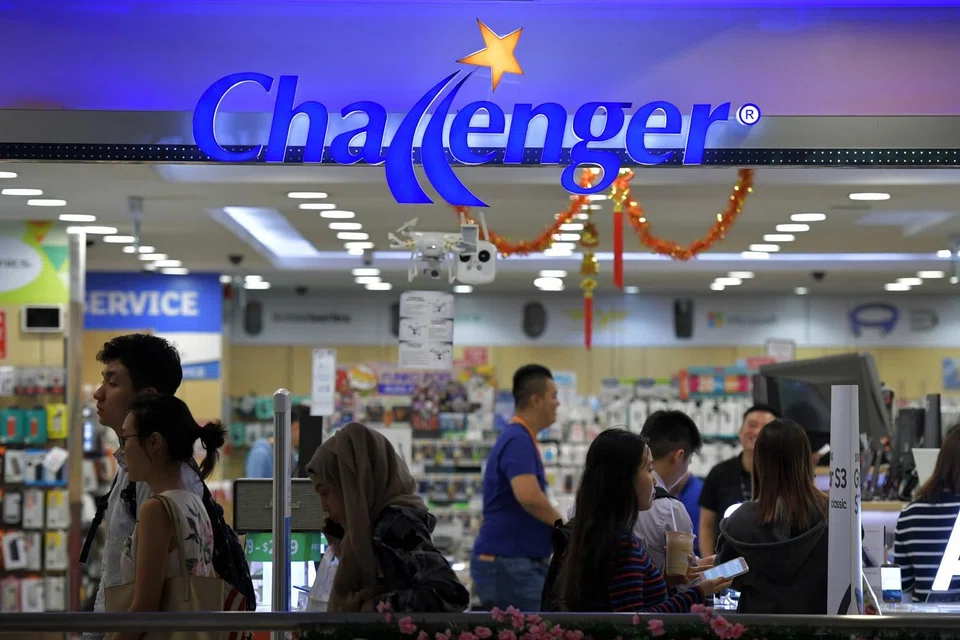
SHAREHOLDERS of Challenger Technologies are likely to have been pleasantly surprised by the consumer electronics retailer's earnings report for FY2020, which was unveiled this past week.
Revenue declined nearly 18 per cent to S$270.8 million, because of the absence of a trade show and lower sales as a result of the restrictions on movement imposed by the government during the year to counter the Covid-19 pandemic.
Yet, Challenger reported blowout earnings of 6.73 cents per share - up 32 per cent versus the 5.11 cents per share it reported for FY2019. Profit before tax from continuing operations increased by almost S$5.6 million to more than S$26.8 million.
What accounted for the company's sharply increased profitability? In a nutshell, it was the result of the government's efforts last year to shield businesses and their employees from the fallout of the pandemic.
Challenger reported "sundry income" of nearly S$5.1 million for FY2020, which is some S$4.8 million more than S$0.2 million it reported for the previous year. The company said this was mainly attributable to "receipts of government grants".
In its half-year financial report, Challenger indicated that these grants related to the Job Support Scheme (JSS) as well as the Wage Credit Scheme.
Challenger also reported a more than S$4.7 million decline in "premises expenses" to slightly more than S$12.9 million in FY2020. The company said this was mainly the result of "rental waivers and rebates".
Shareholders of Challenger are directly benefiting from the Covid-19 subsidy and support windfall from the government. The company has said it will hike its dividend to 2.7 cents per share for FY2020, up from the 1.5 cents per share it paid out for FY2019.
In absolute terms, Challenger will be paying out over S$9.3 million in dividends with respect to FY2020. This is S$4.1 million more than the nearly S$5.2 million it paid with respect to FY2019.
Shares in Challenger have jumped 12.5 per cent since the company reported its full-year numbers and announced the higher dividend. The stock closed Friday at 54 cents.
Big government support
Challenger's strong FY2020 earnings report is a cautionary tale about the dangers of trying to shield every corner of the economy from the Covid-19 fallout.
It also underscores why the enormous fiscal measures the government rushed to introduce last year should not continue for much longer - besides being unsustainable, these measures may well be excessively benefiting some segments of the corporate sector.
Unlike most recessions, which tend to be preceded by a period of excessive consumption or over-investment, the economic slump last year was caused by curbs on movement and human interaction to prevent the spread of Covid-19.
So, rather than trying to jumpstart demand, the government focused on subsidising business costs. The idea was to help companies keep their doors open and their workers employed, so that business could restart quickly once Covid-19 was under control.
The Ministry of Finance said in a report last week that grants received by firms in 2020 topped S$27.4 billion, up from S$1.5 billion in 2019. The biggest driver of this increase was the JSS, where the government co-funds 25 per cent to 75 per cent of the first S$4,600 of each local employee's gross monthly pay.
From April to December 2020, a total of S$22.6 billion was disbursed under the JSS, the report said.
Attempted privatisation
Challenger deserved the help it received from the government as much as any other consumer electronics retailer.
When the pandemic hit last year, it would have been unclear to the company as well as the government exactly how badly its revenues and earnings would be affected.
Moreover, the company was already struggling in the face of disruption in the retailing sector.
In 2019, the controlling Loo family and a private equity fund run by Dymon Asia Capital attempted to take Challenger private at 56 cents per share, stating that the company needed to make changes to its business that might affect its dividends.
The offer was rebuffed by minority shareholders who understood the value of the company.
Challenger is arguably one of the most successful homegrown retailing companies in Singapore, and it has an impressive track record of profitability. Despite the retailing sector facing technological disruption, the company is hardly in financial straits.
While the company has been struggling to grow its revenue, its return on equity (ROE) averaged 19 per cent during the five years to FY2019. For FY2020, with the Covid-19 support measures, its ROE came in at nearly 21 per cent.
The healthy ROEs are all the more impressive given the huge - and increasing - amount of cash on its books. At the end of FY2018, Challenger had a net cash position of S$63.2 million. This cash pile expanded to nearly S$77.9 million at the end of FY2019, and to almost S$85.8 million at the end of FY2020.
Challenger's net cash holdings are now equivalent to more than 46 per cent of its market capitalisation.
Fiscal pullback
With governments around the world gradually learning to manage Covid-19 infection rates, many investors appear to be positioning themselves to ride a strong recovery in economic activity in 2021.
Against that backdrop, analysts are expecting the Singapore government to adjust its Covid-19 measures in the Budget this week, narrowing direct fiscal support to only the most hard-hit segments of the economy - such as tourism and travel.
Some analysts also see the government augmenting the social safety net for Singaporeans struggling to find work, as well as reinforcing efforts to drive industry transformation and staking out promising new fields for future economic growth.
UOB Global Economics & Markets Research estimates that Budget 2021 will see an overall deficit of S$12.5 billion (or 2.5 per cent of GDP), versus a deficit of S$74.2 billion (or 15.3 per cent of GDP) last year.
What will this fiscal pullback mean for the local corporate sector? Logically, as life gets back to normal in 2021, corporate revenues should rebound. The big question is whether these revenues will rise sufficiently to offset the negative impact of the expiry of enormous subsidies like the JSS on corporate earnings.
For Challenger, ironically, its earnings, even in the event of a very strong economic recovery ahead, might well not match what it achieved with the Covid-19 support measures last year.
- For more analysis and insight on market trends and corporate issues, listen to the Mark To Market podcast bt.sg/mark2mkt
READ MORE: