

Chase for yields sends S-Reits on a bull ride this year
SGX head of listings says new asset classes such as self-storage, student accommodation, and multi-family homes could join the S-Reit universe in 2020
Singapore
IT has been such a good year for Singapore real estate investment trusts (S-Reits) that some are wondering if their upside will last much longer.
Several brokerages have shifted from their "buy" calls earlier this year. CGS-CIMB downgraded the sector to "neutral" in its Nov 19 report, citing diminishing prospects after the US Federal Reserve signalled a potential end to further rate cuts; UBS in its 2020 outlook described S-Reits as "rather pricey".
Indeed, the sector is now trading at a 5.5 per cent yield - a 370 basis-point spread against the 10-year bond yield of 1.8 per cent.
It is also about 1.15 times net asset value, which is at +1 standard deviation of the five-year historical average, and close to the last peak of 1.2 times in 2013.
Sat Duhra, co-portfolio manager of Asian dividend income at Janus Henderson, noted that global macro uncertainty has driven investors to defensive yield instruments such as Reits for most of this year.
"If you had asked me at the start of this year, I would have said 'Defensives all the way', but there has been some compression on the yield, so they are less attractive now."
He added that investors were probably not ready for the about-turn when the US Federal Reserve reversed direction to cut interest rates in July this year for the first time in more than a decade.
"Suddenly in the space of a couple of months, we had gone from a whole market believing that rates were definitely going to increase, to the idea that rates were going to fall. That's a huge shift in sentiment and created a lot of turbulence in markets."
This, coupled with persistent geopolitical risks such as Brexit, the weaker European economy and the lack of a resolution for the Sino-US trade war, gave that extra boost to S-Reit prices, stirring up a second wave of interest in the asset class.
The FTSE ST Reit Index rose 7 per cent in June ahead of the rate cut.
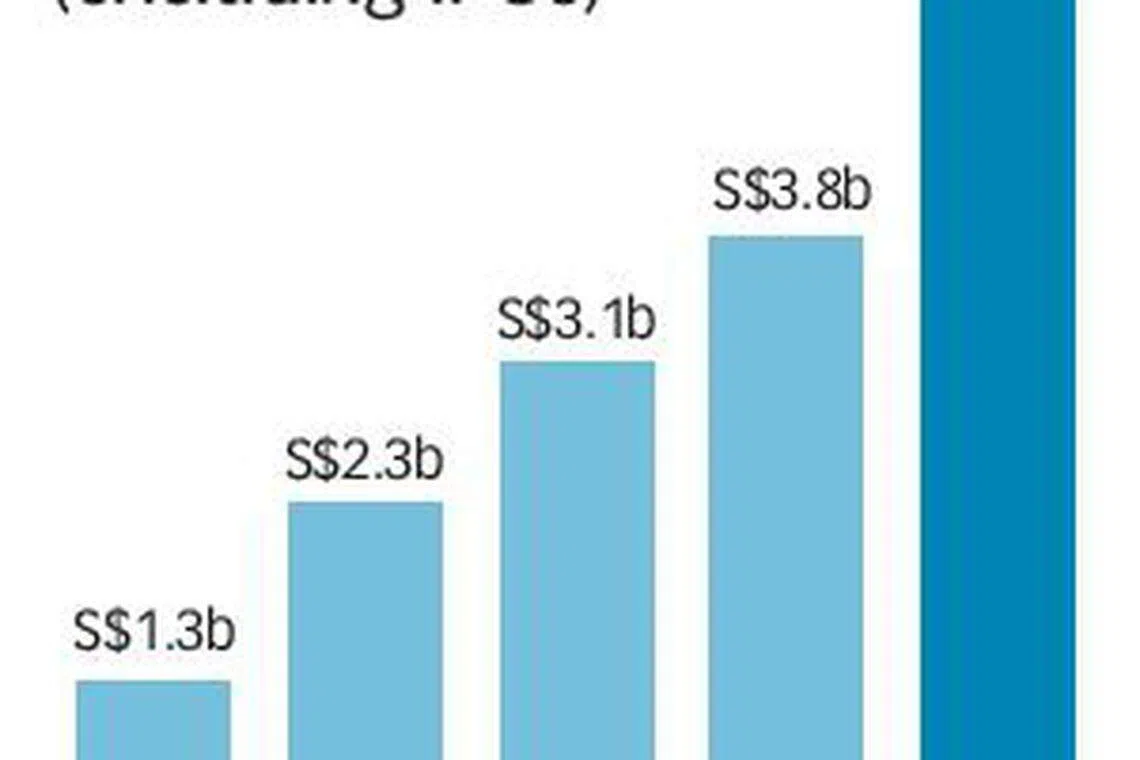
There were other signs of bullishness in the S-Reit sector, such as the whopping S$6.1 billion in equity offerings - including private placements, rights issues and preferential offerings - that the sector raised in the secondary market this year, compared to S$3.8 billion a year ago.
S-Reits have also taken advantage of the low prevailing interest rates and their compressed yields to take on about S$6.5 billion in acquisitions that are accretive to their distribution per unit and net asset values, even despite the use of equity, Maybank Kim Eng said in a Nov 20 note.
Its analyst Chua Su Tye noted that S-Reits went on an "acquisition spree" especially in the third quarter, and chose equity funding despite their ample debt headroom.
DPU accretion for their acquisitions ranged from 0.6 per cent to 12.4 per cent. Industrial Reits were the most active as they pushed further in overseas diversification, it said.
Indeed, last month, a joint venture between Mapletree Industrial Trust and Mapletree Investments completed the acquisition of an 80 per cent stake in three hyperscale data centres in North America for US$810.6 million.
The biggest equity fund-raising this year was Ascendas Reit's S$1.3 billion rights issue, for the purchase of 30 business parks in the United States and Singapore for about S$1.66 billion from its controlling unit holder CapitaLand.
Ample liquidity in the markets also caused the recent private placement exercises to generate very strong demand - at about four to 13 times subscribed, OCBC Investment Research said.
But CGS-CIMB seems to think that luck will run out for S-Reits soon, with the sector having generated 26 per cent returns year to date. The brokerage believes that with rate cuts expected to end and upside catalysts already reflected in the compressed yield spread, the sector will likely perform in line with the broader market going forward.
"Furthermore, with most of the anticipated deals (and equity offerings) already done, we think forward deal flow momentum could slow," it said. That said, an imminent raising of leverage limit for S-Reits due to be announced by the Singapore central bank may change things, as it will raise their debt room to buy more assets.
On the organic front, CGS-CIMB said that the latest round of third-quarter results showed the rental growth outlook remaining tepid amid a cloudy macro environment, with retail and office still experiencing positive rental reversion and the industrial segment still seeing a slight negative bias.
Maybank Kim Eng noted that for industrial Reits, tenants seem to be holding back their expansion plans given the uncertain macro environment and a slower recovery in rents. Industrial demand remains tilted towards newer business parks and high-spec properties, while for smaller industrial Reits, contributions from their growing pool of overseas assets are expected to aid their distribution recovery going forward.
In the retail subsector, the brokerage prefers large destination and suburban malls, which are more resilient to online competition and weaker tourist spending. Overseas Reits such as CapitaLand Retail China Trust and Mapletree North Asia Commercial Trust have also seen higher rental reversions for their assets, compared to domestically-focused Reits.
While hospitality Reits have displayed slow earnings growth this year, they are expected to benefit from more biennale corporate events next year, given that it is an "even" year. An easing supply of hotel rooms will also likely strengthen revenue per available room, Maybank Kim Eng said.
As for office Reits, OCBC noted that they have continued to achieve healthy rental reversions in the third quarter of this year, with Keppel Reit seeing rents increase 14 per cent, while Suntec Reit's offices saw rent raises of more than 20 per cent. Leases signed at One Raffles Quay and the Marina Bay Financial Centre Towers 1 and 2 have also seen "positive double-digit" improvements.
OCBC is among those who are optimistic about prospects for the S-Reit sector, projecting stable distribution per unit (DPU) growth of 1.2 per cent for the current financial year, and 4 per cent for the next financial year, underpinned largely by full-year contributions from acquisitions, asset redevelopments and bienniale hospitality events.
In addition, the momentum of initial public offerings (IPOs), which have made up the bulk of listings in Singapore in 2019, is expected to continue in the new year, offering a diverse range of asset classes.
According to Bloomberg data, S-Reit IPOs made up over half of the global Reit IPOs totalling US$4.2 billion year to date.
As at Dec 9, of the four listings, Lendlease Global Reit and Prime US Reit were in the black, while ARA US Hospitality Trust was down 2.4 per cent and Eagle Hospitality Trust lost 34 per cent of its value following negative news flow on one of its assets, the Queen Mary.
DBS analysts Derek Tan and Rachel Tan are slightly more moderate than OCBC in their outlook, saying: "In 2020, we think we will not see a repeat of 2019 where we saw an almost 20 per cent rise in the Reit index. Next year will see a more modest rise, and more divergent performances in our view, with a focus on Reits which can grow dividends faster on a relative basis and have the ability to still acquire accretively."
Stefanie Yuen Thio, joint managing partner at TSMP Law, notes that there are a few Reits in the pipeline, which are likely to launch in the first half of next year. The Business Times reported in October that the sponsors of United Hampshire US Reit, which owns grocery-led malls and self-storage assets, are looking to raise up to US$400 million from the Singapore market.
With the global economic uncertainty growing, Ms Yuen Thio also believes that secondary equity fund-raising and placements will keep coming onto the market, as S-Reits seek to bolster their balance sheets.
Ronald Tan, director of listings at Singapore Exchange (SGX), says investors can expect new asset classes to join the S-Reit universe next year, including self-storage facilities, student accommodation, and multi-family residential, a common type of accommodation for the renting population in the US and Europe.
"We will also continue to see more Asian sponsors, both existing and new, inject their overseas assets in US and Europe into S-Reits, as well as more acquisition of European assets by existing Reits."
Meanwhile, consolidation activity is expected to continue. 2019 saw three intra-sponsor mergers engineered by OUE, CapitaLand and Frasers Property amid a pursuit of scale.
Market watchers continue to believe that the "flight to safety" theme remains, and as long as the world remains an unsafe place to invest, investors will continue to flock to and seek refuge in yield stocks such as Reits.






