China narrows AI gap with US as open-source shift could hit valuations: George Yeo
As more Chinese firms make LLMs publicly available, big developers’ proprietary ‘moats’ and pricing power may shrink

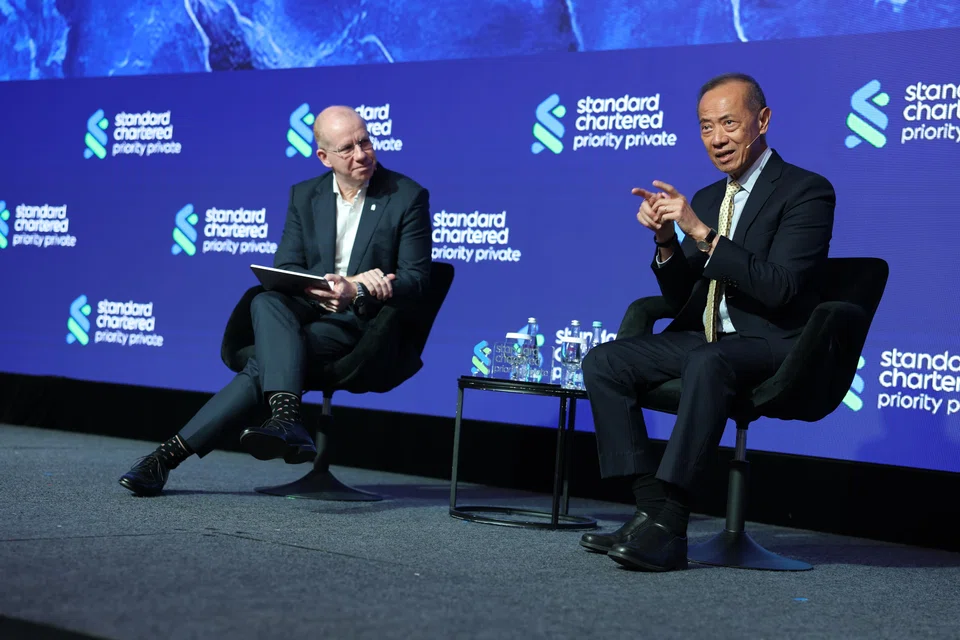
[SINGAPORE] With more companies in China opening up their large language models (LLMs), other big firms – especially American ones – are following suit, which could affect their valuations, warned Singapore’s former foreign minister George Yeo.
Speaking at a Standard Chartered (StanChart) H2 Global Market Outlook event on Thursday (Jul 9), he noted that this is something that should be “monitored very closely” by investors.
The rapid rise of open-source models threatens to commoditise artificial intelligence software, potentially eroding the proprietary “moats” and premium pricing power currently enjoyed by major LLM developers that supported their valuations.
“For a period of time, the masters of the universe (were in) the US, the Magnificent Seven… it felt that the US was so far ahead,” Yeo said during a fireside chat with StanChart’s global chief investment officer (CIO) Steve Brice.
The strength in information and technology gave the US the ability to control information and therefore manage and manipulate global power, he added.
However, the rapid advancement of China technology has disrupted this dynamic.
“China came up with DeepSeek, and, ever since then, China appeared to be six (to) nine months behind the US and then it is now three months… and then people wonder when China will overtake the US,” said Yeo.
He noted that China is a key driver in the global AI landscape, supported by cheaper energy infrastructure and rapidly advancing chip technologies. Domestic giants such as Huawei are quickly catching up in manufacturing and architecture.
Quoting Nvidia CEO Jensen Huang, Yeo pointed out that China is producing around half of the world’s experts in LLMs.

He cited the latest model from the country, Zhipu AI’s GLM-5.2, which is led by a Tsinghua University professor, as a prime example of this fast-shrinking capabilities gap between China and the US.
“AI is a new phase in the story of man,” said Yeo. “It is as fundamental as the arrival of agriculture; everything in human society will change because of AI.”
He added that every country will strive for sovereign autonomy in AI, with national security remaining a core driver.
The former minister’s latest comments build on statements made earlier in May at a CIO workshop organised by Accenture and IT Management Association. Then, he noted that the AI sector needs more power centres beyond the US and China for the world to remain stable.
India, he suggested, could emerge as a critical country to bring geopolitical balance to AI development.
Geopolitical transitions and fragilities
Yeo, who served as Singapore’s minister for foreign affairs from 2004 to 2011, also observed that the world is transitioning to a multipolar reality.
“While the geopolitical environment we have seen over the past decade has been very efficient, it has been quite fragile and has been based on US leadership,” he said.
This geographical friction extends directly to the physical supply chains underpinning technology.
Yeo highlighted rare earths as a critical resource that both the US and China are racing to control, given their vital importance to military defence and AI hardware infrastructure.
Turning to Europe, Yeo still views the region as strategically relevant, though he has expressed concern over its structural inability to secure cheap energy in an AI economy reliant on electricity.
When asked about his outlook, Yeo noted that he remains hopeful about long term US-China relations, but remains worried about the situation in the Middle East, which he warned could quickly spiral out of control.
AI not a bubble
Providing a market perspective, Sundeep Gantori, CIO of equities at StanChart, agreed that while the US currently holds the AI leadership mantle, China is narrowing the gap.
Advancements in AI require data and continuous capital expenditure, he noted.
This ongoing corporate spending race is why the team does not view AI as a bubble, and expects absolute capex spending growth to persist for the next three to four years.
In terms of sector plays, the bank’s CIO team previously held a bullish stance on semiconductors until May, when they tactically closed the overweight position.
However, following the market sell-off over the last two weeks, the team is now actively reconsidering a re-entry point into the sector.
Conversely, the team remains highly cautious on physical AI: the integration of the tech into physical systems such as robotics and hardware, drawing parallels to the hype cycle seen in the electric vehicle industry half a decade ago.
“It looked like a multitrillion-dollar opportunity, every company would make money, but… there are still hundreds of companies in China still struggling to make profits,” Gantori said, referring to the EV industry.
“At this stage, it is a binary outcome.”
Despite AI dominating current market narratives, the StanChart CIO team expects the next leg of the global equity rally to broaden well beyond the mega-cap technology names.
They currently favour defensive, yield-generating themes, such as global high-dividends equities for stable returns in times of market volatility, US communications services and Japan banks.
On navigating the current market turbulence, the team stressed: “Time in the market is more important than timing the market, so staying invested is the key.”
Decoding Asia newsletter: your guide to navigating Asia in a new global order. Sign up here to get Decoding Asia newsletter. Delivered to your inbox. Free.
Copyright SPH Media. All rights reserved.