

China woes drag STI 4.5% lower in 1st week of 2016
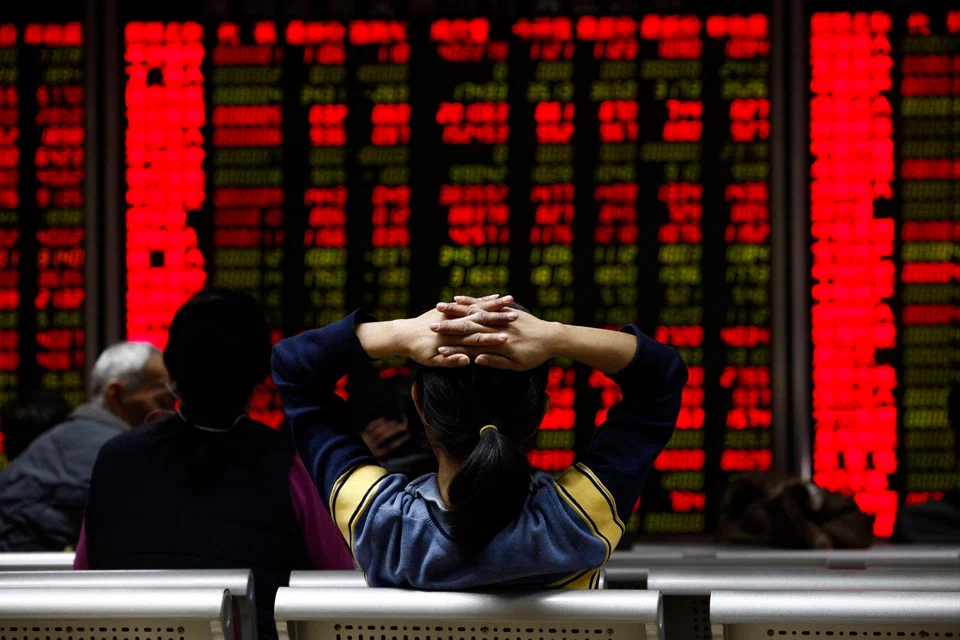
TO SAY it hasn't been a good start to 2016 might be an understatement, given the plunges that global equities suffered this past week. China has been blamed for the losses, perhaps a convenient scapegoat for overvaluation of risk assets rooted in the easy money policies that have been pursued by major central banks for several years now, starting with the US Federal Reserve and then the European Central Bank and the Bank of Japan.
Even so, the Chinese authorities' inept attempts to stem the bleeding in their stock markets has undoubtedly contributed to the contagion-selling everywhere. On Thursday, for example, China's regulators removed ill-conceived circuit breakers that had just been installed on Monday.
Regulatory ineptitude aside, one consolation - if it can be called that - available to players in the Singapore market is that volume spiked up mid-week to S$1.6 billion, the highest since window-dressing boosted turnover to S$1.7 billion on Nov 30 last year.
On Friday, some stability returned, reportedly because China, after lowering the yuan rate eight consecutive times, raised it.
Short-covering all around the region as well as in the Dow futures thus helped the Straits Times Index avoid a fifth straight fall when it rebounded 21.32 points to 2,751.23, though the loss for the week - and the year so far - still amounted to a considerable 131 points or 4.5 per cent. Turnover on Friday amounted to 1.4 billion units worth S$1.2 billion, and excluding warrants there were 235 rises versus 150 falls.
Among the stocks worst hit this week was commodities firm Noble Group. One week after ratings agency Moody's downgraded Noble's credit rating to "junk" status, a second ratings agency, Standard and Poor's, lowered Noble's rating to BB+ because the firm lacked a strong liquidity position, despite the sale of its agricultural unit. S&P also retained a negative outlook on Noble, citing the downturn in the commodities sector.
The company responded by saying that the change in its investment grade status is not expected to have a material impact on its operations and that once the sale of its unit Noble Agri is completed, its "ratings metrics will substantially exceed those required of an investment grade credit". Over the five days, Noble's shares fell S$0.06 or 15 per cent to end at S$0.34.
SingPost was also in focus this week, its shares on Wednesday plunging S$0.10 or 6.2 per cent to S$1.51, drawing a query from the Singapore Exchange. The company replied that there was no material information not announced which could account for the sudden drop. On Friday, the stock added S$0.015 to S$1.525 on volume of 10.1 million.
Bank of Singapore's chief economist Richard Jerram on Friday said in an Economics Research report that the volatility in China is not driven by fundamentals but seems to reflect the policymakers' discomfort with market-driven outcomes. "Global markets appear to have over-reacted," said Mr Jerram. "For many years, swings in the Chinese equity market have had little connection with the real economy, and the equity market crash in 2H 2015 has had limited economic impact."
TRENDING NOW

Nvidia reinstates Jensen Huang as CEO; Trump says move poses no national security risk

Beyond the greenback, Vietnam’s big borrowers turn to Asian-currency bonds

Indonesia’s coal tycoon Low Tuck Kwong replaced as Bayan Resources president-director

Six workers file employment claims against Crystal Jade Food Manufacturing

