

China's crash sends local stocks reeling
Greece crisis also plays a part; ST Index tumbles 1.7 per cent as market volume surges to S$1.6 billion
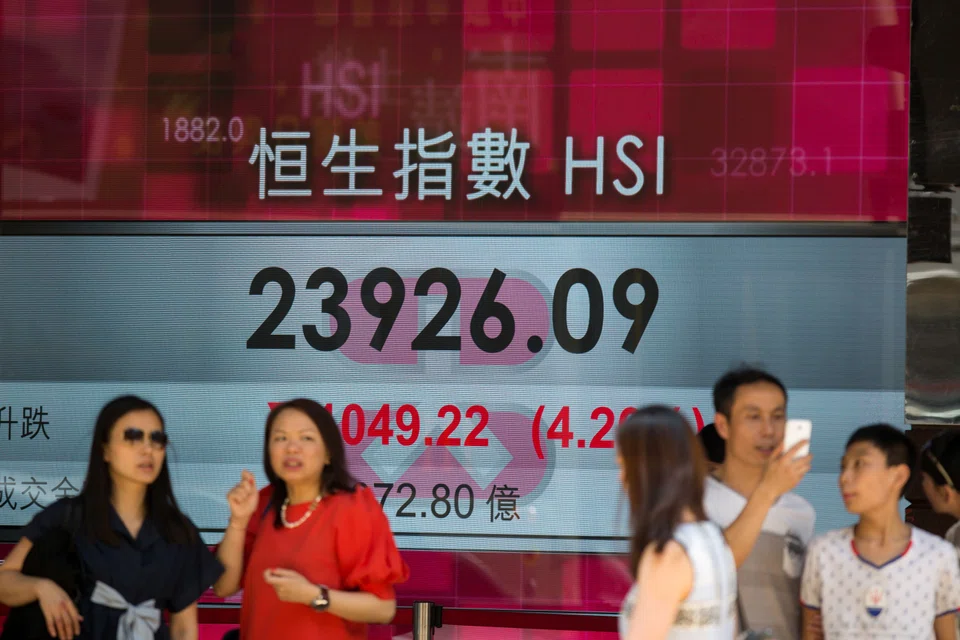
W HEN the China and Hong Kong stocks were surging earlier this year, there was no sympathetic movement in local stocks. This caused much frustration among observers here who had grown accustomed to trading here following Hong Kong's lead.
As if that wasn't bad enough, even more frustrating was Wednesday's 55.94-point or 1.7 per cent drop to 3,284.99 that the Straits Times Index suffered which came as a direct consequence of the Hang Seng Index's crash by nearly 1,500 points or almost 6 per cent.
The spillover selling here was widespread, leading to an advance-decline score of 73 to 426 excluding warrants. Volume was the highest in several days at 1.8 billion units worth S$1.6 billion.
Brokers were despairing when asked to describe the day's trading, their responses punctuated by the usual expletives best left unprinted. All pointed to China as the culprit, although many acknowledged that the as-yet-unresolved Greek situation also played a part.
The massive selling in China was described as a direct consequence of an unwinding of widespread margin positions taken by millions of retail punters eager to latch on to the rally of earlier months.
Over the weekend, China regulators introduced measures to shore up the country's plunging market, measures which observers said may have added to the problem.
Whatever the case, the extreme volatility in China was said to be keeping investors away. However, not all was doom and gloom - among the stocks which held firm in the face of the selling was IHC, which ended unchanged at S$0.30 with 37 million traded.
In contrast, China Fibretech, which underwent a 50-into-1 share consolidation at the end of May that took its price to S$1.60, did not enjoy such support - it crashed S$0.11 or 16 per cent on Wednesday to S$0.59 on volume of 94,900.
The consolidation was to satisfy the new minimum trading price (MTP) of S$0.20. The alarming collapse suffered by China Fibretech after the consolidation prompted many brokers to question the wisdom of MTP.
In the commodities sector, Noble Group's shares fell S$0.02 to S$0.695 on turnover of 48.6 million, a day after the company announced it has called for an independent review of its accounting practices.
On the situation in China, Bank of America-Merrill Lynch (BoA-ML), in its July 7 report titled "The A-share correction: the damage could spread far beyond the stock market", said the biggest damage caused by the A-share market's roller-coaster ride since the middle of last year has been to investors' faith in the government's ability to manage asset prices reasonably smoothly.
"The difficulty the government has faced to stabilize the stock market has demonstrated the downside of that faith," said BoA-ML. "As a result, we expect many of these assets to be re-priced lower going forward. Also, the ripple effect from the market correction has yet to show up - we expect slower growth, poorer corporate earnings, and a higher risk of a financial crisis."
On the outlook for China, Citi Research in its July 7 report "China Road Ahead 2H15" said it believes the country is in the late stage of policy easing and the early stage of economic stabilisation, which should be incrementally more supportive for H-shares than for A-shares.
"Valuations look rich for A-shares but not for H-shares, based on eight measures. We forecast 2015E/2016E EPS growth of 5/10 per cent, expecting liquidity upside in HK but less so in A-shares," said Citi.
"Sector-wise, we upgrade banks to 'overweight', and stay overweight on insurance, property, transportation, IT and healthcare. We downgrade staples to 'underweight', and stay underweight on telecoms, energy, and materials."
For full listings of SGX prices, go to http://btd.sg/BTmkts
TRENDING NOW

He built the Vingroup empire. Now South-east Asia’s richest man is handing some key roles to his sons
Despite the de-dollarisation debate, demand for dollar liquidity in Asia is growing
Can a first-time homebuyer couple earning S$18,000 a month afford a new EC unit?

Asia needs new energy security architecture

