China's Poly-GCL in talks with SembMarine for FLNG project
Sembcorp Marine's proprietary Gravifloat FLNG concept puts it in pole position, beating proposals from S Korea and China
Singapore
THE oil and gas business partnership between Chinese conglomerates Poly Group and GCL Group is in final talks with Sembcorp Marine (SMM) for the supply of a newbuild floating liquefaction plant (FLNG) towards the development of what may be Ethiopia's first liquefied natural gas (LNG) export project.
The president of Poly-GCL Petroleum Holdings told The Business Times recently that after spending more than a year reviewing proposals from South Korea, China and Singapore, SMM has emerged as the front runner with its proprietary Gravifloat FLNG concept.
A project award from Poly-GCL would spell a breakthrough for the commercialisation of SMM's Gravifloat FLNG concept. It would also represent the first newbuild FLNG commissioned to a Singapore yard group.
Poly-GCL Petroleum's chairman and president Barton Yu said the project tapping the vast reserves of Ethiopia's Ogaden basin will be developed across three phases, scaling up from a startup capacity of 3 million tonnes per annum (mtpa) from early 2020 to 10 mtpa once the full field development kicks in. While negotiation is ongoing on the contract value, analysts estimate a 3 mtpa FLNG easily costs over US$1 billion to design and build.
Poly-GCL aims to start production at its Ogaden basin project by early 2020. Working backwards, Mr Yu said that a final investment decision on the project is expected this September or October and construction on the FLNG may begin before the end of 2017.
So far, newbuild FLNGs have been constructed only in South Korea and such projects typically take more than three years to deliver. IHS principal researcher, Ang Dingli said that FLNG projects stand a better chance of raising financing if they are executed in Singapore over China, because yards here have demonstrated over their Chinese rivals better capabilities relevant to FLNG construction. And while South Korea had a head start over Singapore, Mr Ang noted that the difference between the two countries narrows when it comes to constructing smaller FLNGs.
Additionally, to fast-track the construction, Poly-GCL has purchased a secondhand LNG carrier that is expected to be commissioned to SembMarine to store output processed from the FLNG.
By cutting out LNG storage tank fabrication, construction on the Gravifloat FLNG can be completed within 28 months.
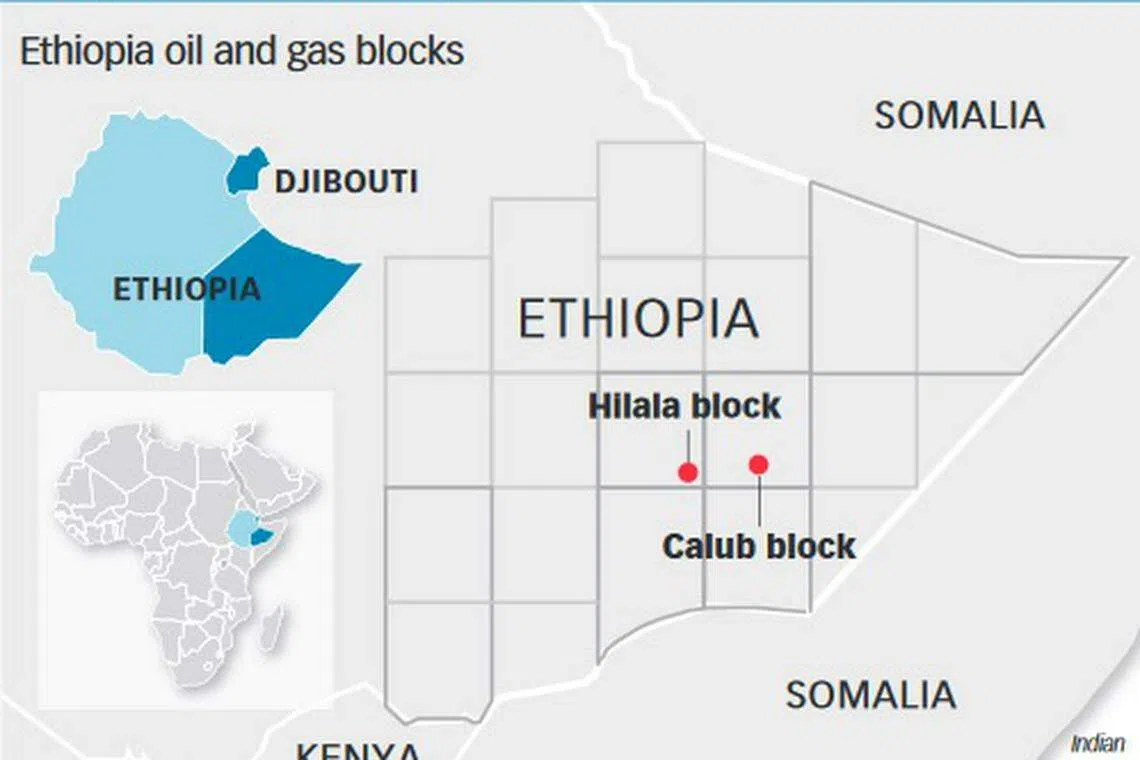
The Ogaden basin project also involves building a 700-kilometre pipeline that will transport gas from two blocks earmarked for development, Calub and Hilala, to the Port of Djibouti, where the FLNG will be moored.
The project ranks among the top three infrastructure developments in Ethiopia along with the Addis Ababa-Dijbouti Railway and Grand Ethiopian Renaissance Dam.
It is expected to facilitate the first LNG exports from Ethiopia, a country which although long touted for its hydrocarbon potential, has failed to attract or retain the required foreign direct investment.
Poly-GCL entered into Ethiopia after private- and state-owned oil companies from Russia and Malaysia, either commercially or politically motivated, exited the country.
The tide could turn in favour of Ethiopia's oil and gas industry with Poly-GCL taking over in Ogaden basin and China earmarking the country's first LNG export under its One Belt One Road (OBOR) initiative.
Coming under the OBOR umbrella may open up project financing options for Poly-GCL's Ogaden project, with Mr Yu hinting at Poly-GCL's interest to engage strategic investors from Singapore.
Last September, the Singapore Business Federation and the Industrial and Commercial Bank of China (ICBC) announced a tie-up of 50 billion yuan (S$10.37 billion) in funding for OBOR projects. Without speculating on the OBOR project funding possibility, SBF's chairman, SS Teo said that the Ogaden FLNG project will help deepen bilateral collaboration between Singapore and China. "More job opportunities will be created through this project and since the FLNG will help lower costs for oil companies, it is a win-win collaboration for both sides," he said.
Poly-GCL plans to set aside 70 per cent of output from Ogaden Phase 1 for long-term gas sales. Between 20-30 per cent will be traded on the spot market, Mr Yu said.
Private sector energy players such as Poly-GCL have been eyeing opportunities from a liberalisation of the domestic gas market now dominated by the three national oil companies, PetroChina, China National Offshore Oil Corporation and Sinopec.
Poly-GCL is seeking regulatory approval to operate a terminal in China for the purpose of importing gas from Ethiopia but Mr Yu also stressed that the company is concurrently reaching out to gas buyers in Europe, Japan and the larger Asia.
The project FID is expected to be conditional on Poly-GCL securing the long-term gas offtake. A supply glut coupled with the 2014 oil price collapse had swung the market in favour of gas buyers, but oil-linked LNG prices have been creeping back up and this may help Poly-GCL's gas offtake negotiations in the coming months.