China’s underlying strength, growth sectors can trump weak sentiment: OCBC head of wholesale banking

Tan Nai Lun
Published Fri, Jul 14, 2023 · 05:50 AM
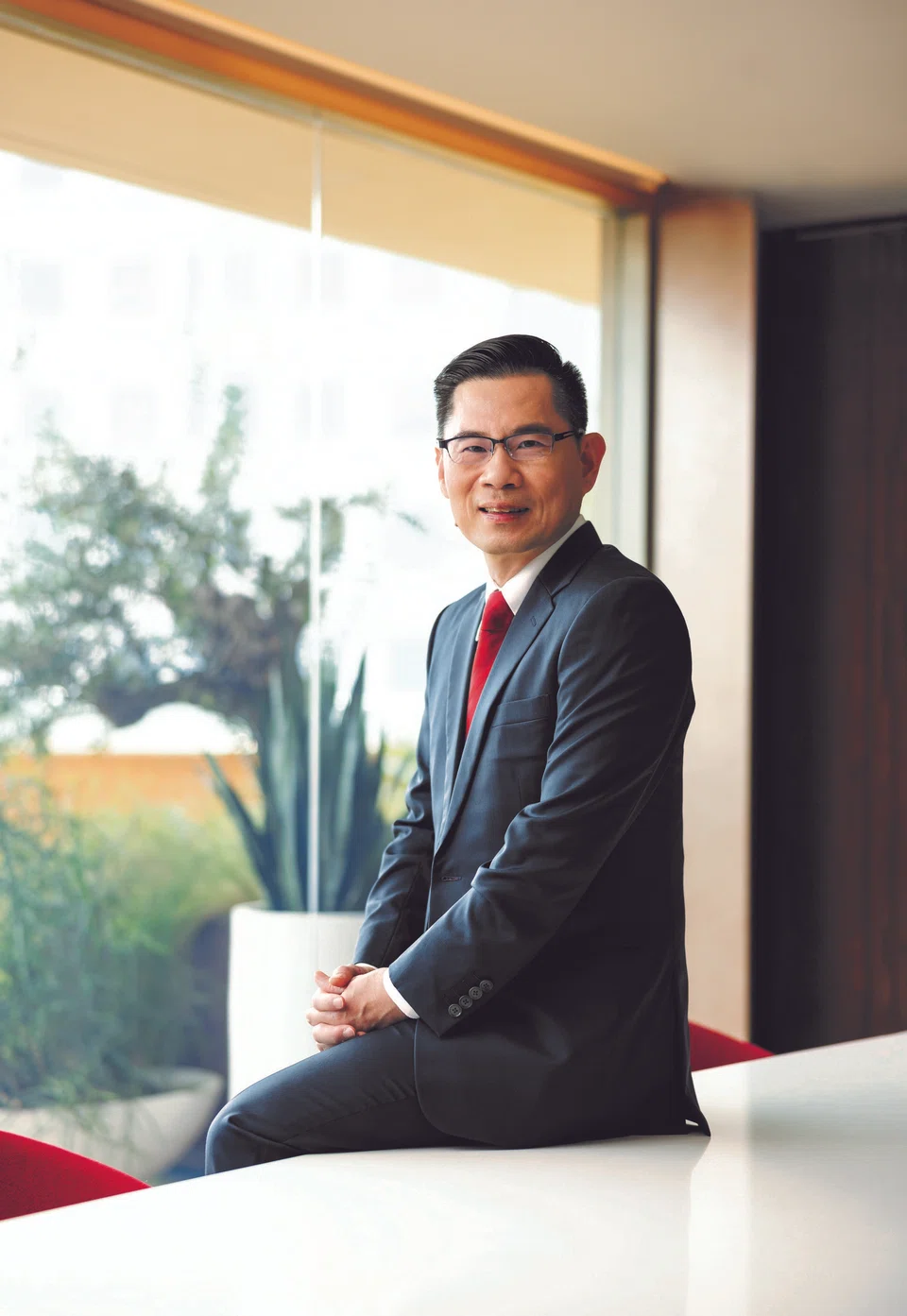
    • As long as the bank knows to pick the right growth sectors, OCBC should be able to meet its growth goals by 2025, said Tan Teck Long, head of global wholesale banking at OCBC.
    • As long as the bank knows to pick the right growth sectors, OCBC should be able to meet its growth goals by 2025, said Tan Teck Long, head of global wholesale banking at OCBC. PHOTO: OCBC

    CHINA’S recovery from the pandemic may be slower than expected, but the underlying strength of its economy and the ability of specific growth sectors to trump weak sentiment should not be underestimated, OCBC’s head of global wholesale banking Tan Teck Long has said.

    Optimistic about China’s ability to bounce back, he intends to increase the bank’s revenue from Greater China corporates operating in Asean by more than 50 per cent by 2025; he also aims to gain more than 26,000 new small and medium-sized enterprise (SME) customers in Hong Kong over three years.

    OCBC will also grow its transactional banking capabilities in Greater China to achieve more than 500 regional mandates for cash management over the next five years. It will also double its investment banking revenue in three years.

    Tan was speaking earlier this month after OCBC’s Asean-Greater China showcase in Hong Kong, where the bank said it would add S$3 billion in revenue from its Asean-Greater China strategy by 2025.

    The slower Chinese recovery was not out of Tan’s expectations. China, as a major exporter, was an obvious victim of a slowdown in the electronics sector.

    Recovery has also been hindered by its property market – weak throughout the pandemic – and consumers becoming more cautious in their spending.

    Furthermore, China reopened to the rest of the world post-pandemic only around half a year ago. Travel in and out of the mainland is still restricted by visa requirements. In Hong Kong, business sentiment is also soft; it is one of the last few regions to reopen from the pandemic, prior to which it faced a period of social unrest for almost two years.

    Nevertheless, interest among Singaporean companies wanting to invest in the logistics assets in China is “still very much alive”, Tan said.

    He noted that China still holds a large proportion of the world’s manufacturing capacity and owns leading manufacturing technology. Manufacturers in China also have a strong ability to restructure and adapt to changes in processes after years of experience, he added.

    Meanwhile, the China-plus-one diversification strategy – under which companies with factories in China diversify their operations to markets such as those in Asean – also applies to Chinese companies that are looking to expand globally.

    Tan said many Chinese companies are looking to diversify their operations outside China, given that land and labour costs have been going up on the mainland.

    OCBC should be able to meet its 2025 growth goals as long as it picks the right growth sectors, he said. He identified bright spots in the sectors of transition and renewable energy, technology, electric vehicles (EVs), infrastructure and natural resources.

    For example, Chinese investors are looking at Indonesia for EV projects, Malaysia for transition energy projects and Vietnam for a low-cost production alternative.

    This also holds true for the bank’s investment banking segment, for which Tan projects growth in related sectors, despite a global slowdown in deals.

    “Even though there’s a slowdown, it doesn’t mean that there are no deals,” he said; he added that the bank is shoring up its investment banking capabilities in Hong Kong to step up its presence in the region.

    Tan expects the general slowdown in investment momentum also comes out of people being generally more cautious in a high-interest-rate environment: “It’s not really just because of China. Overall, the world is facing a slowdown.”

    Even as he warned that a worsening in US-China tensions or a worse-than-expected economic slowdown may derail the bank’s growth plans, he said he is “quite comfortable with the progress being made”.

    Tan said only the more sensitive sectors such as the semiconductor industry may make deliberate shifts in their supply chains amid current US-China tensions.

    But companies in the rest of the economy are mainly rebalancing the location of their investments and making decisions based on good business sense.

    For example, precision-engineering company Akribis Systems is separating its manufacturing operations in China from its operations in the Asean region.

    Akribis CEO Leow Yong Peng said the company would have its China factories serve the Chinese market, while its Singapore and Malaysia manufacturers serve the rest of the world.

    Leow said private companies are simply trying to find a balance amid political tensions.

    It is too expensive for US companies to give up the Chinese market, while the Chinese also want to address the market outside China.

    The Singapore-based company, which first expanded to China in 2010, is now looking to expand its operations in the Asean region to lower manufacturing costs.

    A report by the OCBC Treasury Research team noted that the near-term outlook “looks bumpy”, but expects China’s outlook in the medium term to pick up after the announcement of stimulus measures.

    The team also expects Asean-China connections to deepen in the medium term, amid greater foreign direct investment from China into the Asean region and as the China-plus-one strategy gains traction amid heightened geopolitical tensions.