

China's yuan ends domestic session at lowest since 2007
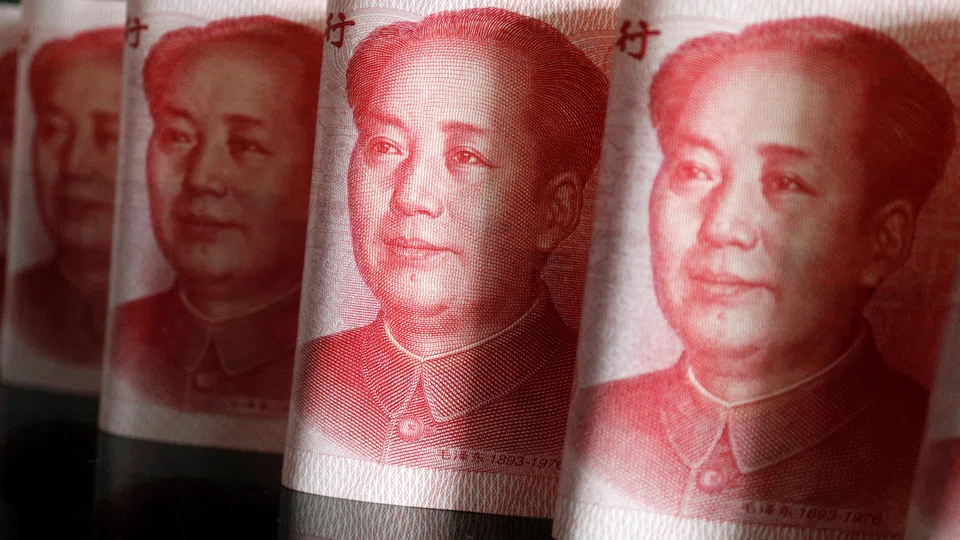
CHINA’S yuan finished the domestic session on Thursday (Sep 7) at its weakest since the global financial crisis, with soft trade data pointed to tough economic headwinds.
The onshore yuan ended domestic trading session a 7.3279 per US dollar, the weakest close since Dec 12, 2007.
Widening yield differentials and a faltering domestic economy have dragged the yuan down nearly 6 per cent this year to become one of the worst performing Asian currencies.
The yuan was already languishing amid a resilient US dollar ahead of China’s trade figures, which showed exports and imports contracting at a slower pace and slightly beating expectations.
The offshore yuan followed the weakening trend despite state banks’ recent actions to tighten offshore yuan liquidity to raise the cost of shorting the Chinese currency.
It weakened to a low of 7.3369 per US dollar, the softest level since Aug 17, and was trading at 7.3330 around 0830 GMT.
Prior to the market opening, the People’s Bank of China (PBOC) set the midpoint rate, around which the yuan is allowed to trade in a 2 per cent band, at 7.1986 per US dollar, 17 pips weaker than the previous fix of 7.1969.
“Recent yuan weakness was largely due to a strong US dollar,” said Ming Ming, chief economist at Citic Securities.
“In addition to the elevated US dollar index, there are two factors – loosening domestic monetary policy and a slowdown in economic recovery in the second and third quarter.”


Thursday’s fixing, which was set at a fresh two-week low, was again much stronger than market projections, a situation that has persisted for months and is seen by investors as a sign that authorities are uncomfortable with the yuan’s weakness.
The midpoint was 1,135 pips firmer than Reuters’ estimate of 7.3121.
The official guidance rate also capped the yuan’s daily downside limit at 7.3426 per US dollar, with several currency traders speculating that the 7.35 level could be the downside edge of the range authorities are comfortable with.
“We think yuan depreciation is not aligned with policy intentions, given its limited support for growth and second order impact on Asian currencies, risking competitive depreciation dynamics and an acceleration of capital outflows from the region,” Chang Wei Liang, FX & credit strategist at DBS, said in a note.
“Policymakers could thus continue to lean against RMB depreciation pressure.”
China remains an outlier among global central banks, having loosened monetary policy to shore up a stalling recovery while others have raised interest rates to combat inflation.
The widening yield differentials with major economies, particularly the US, have pressured the yuan and raised the risk of capital outflows.
“With such a wide interest rate gap and low volatility in the yuan, carry trade has been profitable,” a trader at a foreign bank said. REUTERS
Decoding Asia newsletter: your guide to navigating Asia in a new global order. Sign up here to get Decoding Asia newsletter. Delivered to your inbox. Free.
Share with us your feedback on BT's products and services
TRENDING NOW

Singapore identifies 7 firms responsible for haze fires, notices issued urging action: Grace Fu
DBS remains analysts’ pick ahead of Q3 earnings after Singapore banks’ share slump

High Court rules against Julius Baer’s Singapore trust arm in US$50 million family trust dispute

Could stablecoins be the future of money?

