

CICT posts 1.7% rise in H2 DPU to S$0.0545


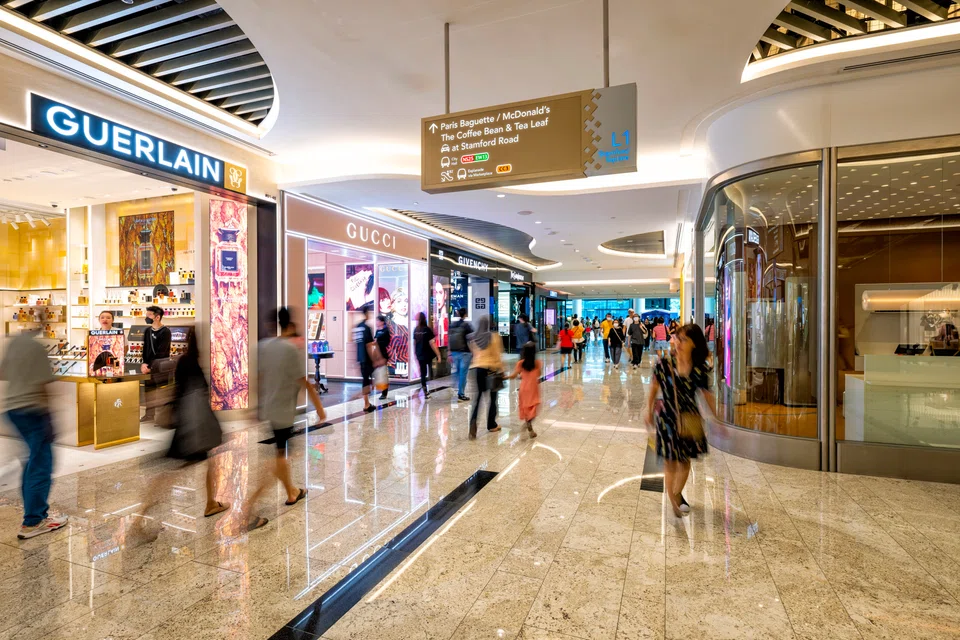
CAPITALAND Integrated Commercial Trust (CICT) on Tuesday (Feb 6) posted a distribution per unit (DPU) of S$0.0545 for the second half ended December, up 1.7 per cent from S$0.0536 in the previous corresponding period.
This came as gross revenue rose, helped by higher rental and occupancy rates, which supported a rise in net property income (NPI).
Gross revenue was up 4.1 per cent to S$785.2 million for the half-year period, from S$754.1 million in the year-ago period.
Property operating expenses for CICT’s assets grew 4.3 per cent to S$221.6 million, from S$212.5 million previously, on higher utilities, maintenance and marketing expenses.
NPI, meanwhile, grew 4 per cent on the year to S$563.6 million for the half-year period, from S$541.7 million.
Distributable income (DI) was up 2.1 per cent to S$362.5 million from S$355.1 million in the same period the year before.
The real estate investment trust (Reit) will pay the distribution on Mar 28, after the record date on Feb 15.
Teo Swee Lian, chairman of CICT’s manager, said the Reit adopted a conservative approach in 2023 in response to challenging market conditions and a high-cost environment.
“We focused on driving organic growth through proactive portfolio management, prudent cost management and discipline in capital management. This strategy has yielded positive results.”
For the full year ended Dec 31, 2023, DPU was 1.6 per cent higher at S$0.1075. Distributable income climbed 1.9 per cent to S$715.7 million. Gross revenue was 8.2 per cent higher at S$1.6 billion, while NPI rose 7 per cent to S$1.1 billion for the full year.
The improvement in performance came mainly from higher contributions from Raffles City Singapore, coupled with full-year contributions from the Reit’s 2022 acquisitions, the manager said.
The gains were offset by higher finance costs from the full-year impact of borrowings taken to fund the acquisitions in 2022 and higher interest rates.
Speaking at an earnings briefing on Tuesday, Tony Tan, chief executive of the manager, noted that there is more investor interest for transactions returning to the market.
He noted that one of the challenges in global real estate has been private equity players going through some rationalisation; not many transactions were made in the past 12 months, but there is starting to be some interest from such players.
In response to questions that CICT is reportedly looking to divest some assets, Tan said the manager does not comment on rumours.
“It’s actually not unusual for us to engage the market… sometimes it leads to some kind of commercial deal, sometimes it doesn’t,” he said.
“If we do have to monetise some assets, naturally next on our mind is how we are going to deploy it,” he added.
The manager observed that retail assets are still yielding more than office assets and more accretive. “Having said that, we will look at it closely when the time comes,” Tan said.
CICT has a call option that allows it to increase its stake in CapitaSpring within five years of the asset’s temporary occupation permit (TOP) date in November 2021. Tan noted that CapitaSpring has not completed one lease cycle yet.
“It’s important we witness that, because for new developments, the expense and post-stabilisation expense would be different,” he said. The manager would also consider the size of the asset in making its decision.
“It’s a very chunky asset. We don’t necessarily have to own 100 per cent. We own 45 per cent today, the question is whether we should own more,” he said. “So that’s something we’ll take back and think about it.”
CICT is also undertaking asset enhancement initiatives (AEI) this year to optimise its portfolio.
This includes a S$48 million AEI at IMM Building, and up to a 215-million-euro AEI at the Gallileo office building in Frankfurt, Germany.
Tan noted that the Reit has to fix some fundamental issues at the Gallileo asset to make it more relevant. While the asset would have 18 months of downtime, he noted that the asset’s contribution to DI was “not huge”, and that managing interest costs would have a bigger impact.
“Interest expense is the single largest subtraction from the distribution,” he noted.
CICT’s average cost of debt rose to 3.4 per cent as at Dec 31, up from 3.3 per cent in September. Based on current interest rate levels, the manager said it expects the average cost of debt to rise to around the mid-3 per cent range this year.
Tan said the manager is looking to pare down its gearing, and that aggregate leverage at around the 37- to 38-per-cent level would give sufficient flexibility. CICT’s aggregate leverage as at Dec 31 stood at 39.9 per cent, down from 40.8 per cent three months earlier.
DBS analysts said in a note that CICT’s FY2023 performance was in line with estimates, and maintained a “buy” call with a target price of S$2.30.
“We expect Singapore assets will likely remain stable with upside from retail and office, riding on the strong positive reversions over the past year. However, overall growth could moderate with the AEI plans at Gallileo,” they said.
CICT’s committed portfolio occupancy was 97.3 per cent for the 12 months ended December 2023, up 1.5 percentage points from the same period the previous year.
CICT’s units were trading at S$1.98 as at 4.02pm on Tuesday, up 1 per cent from the previous close.
TRENDING NOW
Far East Organization’s The Serra Residences sells less than a quarter of units released at average S$3,460 psf

MAS, SGX must address our IPO problem

A bumpy road ahead for some of Singapore’s fresh graduates in their job search

Once staunchly pro-China, Malaysian Chinese businesses are now distancing themselves from Beijing

