CICT sets sights on scaling global ranks
The CEO of Singapore’s oldest and largest Reit, which celebrates its 20th anniversary this month, says larger asset base necessary to be an international name.

Jude Chan
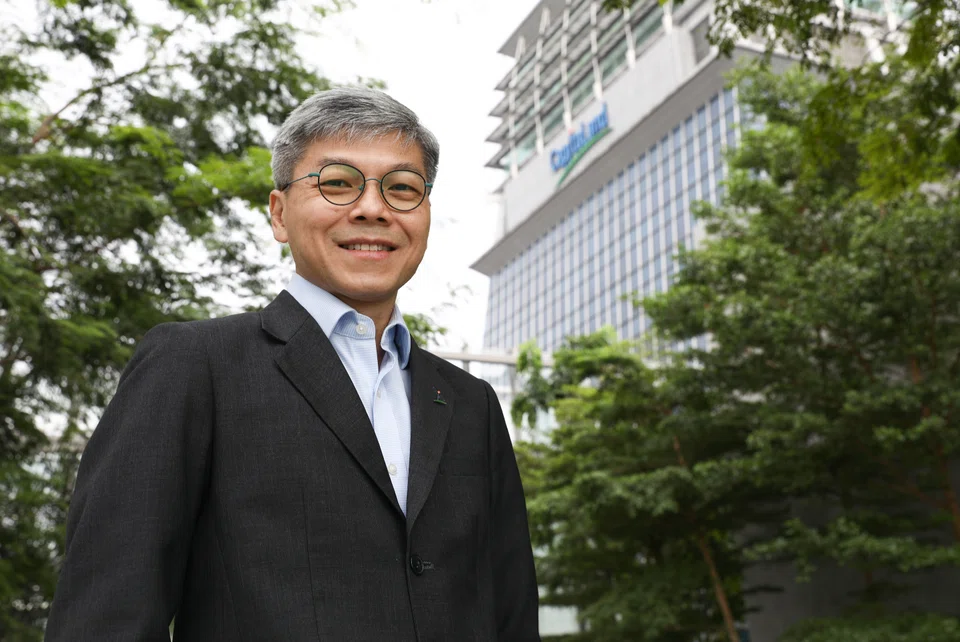
TONY Tan, chief executive officer of CapitaLand Integrated Commercial Trust (CICT), has big ambitions for the Singapore-listed real estate investment trust (S-Reit).
CICT’s S$14.3 billion market capitalisation as at Jul 1 ranks it as the biggest S-Reit, and one of the 15 biggest counters listed on the Singapore Exchange (SGX).
CICT also sits among the 30 constituents of the benchmark Straits Times Index (STI).
Yet, as Tan explains, in the global market, CICT is considered one of the smallest among the large-cap stocks – defined as companies with market caps of more than US$10 billion.
“There's still a long way because we are still not exactly in the spotlight of the big global funds,” Tan said. “Once we enter into the big league, it is a different ballgame.”
“Liquidity will beget liquidity,” he added. “We hope we get more funds invested in us, but we need to make sure that we bulk up the right portfolio.”
Considered a proxy for Singapore commercial property, CICT has grown significantly through the years.
It made its debut on the Singapore Exchange (SGX) as CapitaLand Mall Trust (CMT) in July 2002, in what was the first Reit listing in Singapore.
CMT started with just 3 malls under its belt – Tampines Mall, Junction 8 and Funan The IT Mall – with total assets worth some S$895 million and a market cap of S$730.6 million at the end of its maiden day of trading.
The Reit then went on an acquisition spree. Over the next 16 years, it would go on to acquire 15 assets; including Plaza Singapura, Bugis Junction and Raffles City Singapore.
The Reit also embarked on several development projects. Among them: the greenfield development of Westgate in a joint venture with sponsor CapitaLand, as well as the redevelopment of Funan.
On the asset enhancement front, CMT also led the way for the S-Reits. It was the first Reit here to pilot a unique asset enhancement initiative it calls “decantation”.
“In short, it is taking out a certain space of low or no value and replacing that into a new space which has leasable value,” Tan said.
For example, in 2004, the Reit transferred 70,000 sq ft of gross floor area from the office tower at Junction 8 to the retail space of the mall.
“Part of the process was to negotiate with the authorities and agree that this building will be leased out to non-profit organisations. Hence, this net lettable area (NLA) will be taken away from our value and we replace it somewhere else. That's where we created new NLA that will be able to command higher rent,” Tan said.
According to the Reit manager, this contributed to a 50 per cent increase in Junction 8’s average rent between July 2002 and December 2004.
The next lap
The Reit was renamed CICT in 2020 following a merger with CapitaLand Commercial Trust (CCT), which held a portfolio of 10 office and integrated development properties.
The merger between then Singapore’s second- and third-largest Reits would see the combined CICT own a total of 24 properties with an asset value of S$22.9 billion.
CICT would also leapfrog its way to becoming the third largest Reit in Asia-Pacific – behind Hong Kong’s Link Reit and Australia’s Scentre Group – with a theoretical market cap of S$16.8 billion.
The merger had come at an awkward time – in the thick of the Covid-19 pandemic. But the Reit manager believes this may have helped CICT weather the storm better than its peers.
“In retrospect, (the merger) probably helped us ride through the cycle a lot more smoothly,” Tan explained. “Without that, we would probably have seen the 2 (separate) Reits going through significant volatility.”
When the pandemic hit, the Reit’s properties in the retail space suffered the immediate brunt of changing regulations and behaviours. “Some businesses literally stopped, for some of our retail tenants especially,” he said.
The impact on the commercial or office sector, however, came only later – by which time the retail sector had managed to see some recovery.
This, Tan said, resulted in a smoothening of the impact of the pandemic on the combined Reit, with the enlarged portfolio providing greater stability and resilience.
Post-merger, CICT has continued to keep up the pace of its growth.
In December 2021, it announced the acquisition of 3 assets – 2 office buildings and a 50 per cent interest in an integrated development – in Sydney, Australia, for around S$740 million.
In March this year, it also joined hands with CapitaLand Open End Real Estate Fund (Coref) to acquire a Grade-A office building at 79 Robinson Road for S$1.3 billion.
As at end-December 2021, CICT’s total assets under management (AUM) stood at S$23.8 billion – over 26 times the AUM of CMT when it was initially listed.
Some 93 per cent of its portfolio by property value is based in Singapore, with another 4 per cent in Germany and the remaining 3 per cent in Australia.
The Reit manager has guided that it intends for the portfolio to maintain a heavy concentration in Singapore, with not more than 20 per cent of its portfolio by value outside of Singapore.
“(There are) opportunities that still exist within Singapore,” Tan said. “We are trying to seize a lot of opportunities with portfolio upscaling. Now that things have stabilised, we can start doing a bit more in-depth study into some of the assets and see whether it makes sense for us to scale up.”
“Some of (these potential assets) are operating at suboptimal levels. Is it the best use case? Do we have room to look at redevelopment? (That) will give us another anchor for growth in the medium term,” he added.
In addition, Tan said there are still assets in the sponsor’s pipeline that give CICT “enough room to look at potential future growth opportunities, even within Singapore.”
The Reit manager’s growth strategy over the years – combining acquisitions, redevelopment and asset enhancement initiatives – seems to have paid off.
CICT’s net asset value (NAV) per unit has doubled to S$2.06 as at April, from S$1.03 at the end of 2002.
Some value creation has come from Funan, which saw its NLA more than double to 531,634 sq ft post-redevelopment, compared with 248,376 sq ft at the initial public offering (IPO).
Funan’s property value has also soared to S$785 million as at end-December 2021, from S$191 million when the Reit was listed in 2002.
Another example is Junction 8, which underwent the decantation exercise. Property value of the asset has jumped to S$796 million as at end December, from S$295 million at listing.
Junction 8’s net property income has also doubled to S$40.6 million as at Dec 31, from S$20.3 million 2 decades ago.
For FY2021 ended December, CICT posted distribution per unit (DPU) of S$0.104, up from S$0.0869 in the year-ago period, with distributable income increasing 82.7 per cent to S$674.7 million.
Gross revenue grew 75.1 per cent year on year to S$1.3 billion from S$745.2 million, while net property income (NPI) rose 85.5 per cent to S$951.1 million from S$512.7 million.
For Q1 FY2022 ended March, CICT reported a 1.5 per cent increase in gross revenue to S$339.7 million. NPI inched up 0.5 per cent year on year to S$248.3 million.
Recovery to come
Despite potential near-term headwinds – including from continued Covid-19 and geopolitical uncertainties – DBS analysts Rachel Tan and Derek Tan believe CICT has potential for growth on the back of its portfolio optimisation and asset recycling efforts.
“As the largest commercial S-Reit, CICT is poised to ride on the Singapore office upcycle and retail recovery,” they said in a report following CICT’s Q1 FY2022 business update.
“(As) a key proxy and beneficiary of the reopening play… We estimate CICT could deliver a 6 per cent 2-year compound annual growth rate – one of the stronger growth rates among its peers,” the analysts added.
DBS has a “buy” recommendation on CICT, with a target price of S$2.70.
“Easing negative retail reversions, together with tailwinds from office sector recovery, and then traction from improving NPI, suggest stronger fundamentals in FY2022,” said Maybank analyst Chua Su Tye.
“Its balance sheet remains strong, and we see upside from acquisitions, as management escalates its capital recycling efforts, backed by its sponsor’s Singapore AUM,” he added.
Maybank also has a “buy” call on CICT, with a target price of S$2.60.
Units of CICT last closed at S$2.15 on Jul 1, up 5.4 per cent in the year to date.
TRENDING NOW
He built the Vingroup empire. Now South-east Asia’s richest man is handing some key roles to his sons
Quarter of Singtel special discounted shares sold ahead of CPF Board transfer
Why Tan Aik Keong of digital solutions specialist Agmo wants to make himself less indispensable
Asia needs new energy security architecture