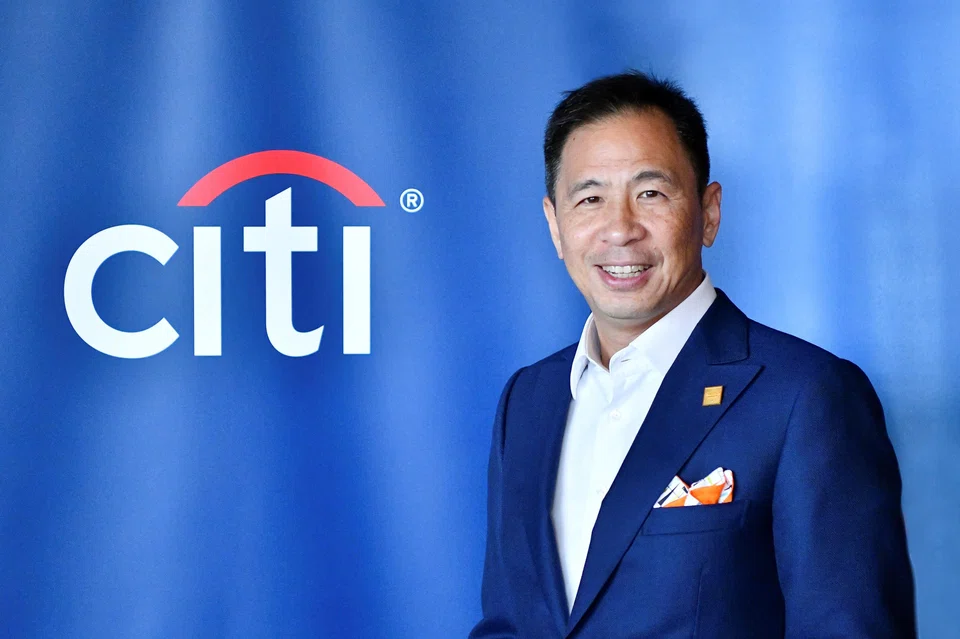
Citi’s new Singapore chief Lee Lung-Nien on legacy and leading at home

‘I want to be remembered as a good mentor,’ says the 35-year Citi veteran

Summarise
Tan Nai Lun
Published Tue, Dec 30, 2025 · 07:00 AM
    • "If you have processes that don’t work well, but you’ve got good people, they’ll know how to fix it and get things done right," said Lee Lung-Nien, Citi country officer and banking head for Singapore.
    • "If you have processes that don’t work well, but you’ve got good people, they’ll know how to fix it and get things done right," said Lee Lung-Nien, Citi country officer and banking head for Singapore. PHOTO: CITI

    [SINGAPORE] Markets, anti-money laundering, private banking, corporate sales, operations – there is little that Lee Lung-Nien has not done in his 35-year career at Citi.

    The 61-year-old has also taken on the role of country chief twice – first in 2015 for Malaysia, and now in 2025, for his home country, Singapore.

    In fact, he is the first Singaporean in half a century to be Citi country officer and banking head for the Republic. He took on the role from October.

    A career Citibanker, Lee is a product of the bank’s global talent programme, with experience in London, New York and Malaysia.

    And being a local comes with great advantages – he knows the country well, and has built natural connections over the years.

    “When I meet clients, they can skip the ‘Where are you from? How long have you been here?’ pleasantries,” he said in an exclusive interview with The Business Times.

    “It’s easy to connect with clients, having covered them through the years. They are now captains of industries.”

    No doubt, Lee’s people skills have helped get him to where he is today. Beyond his personable demeanour, the banking veteran speaks with the confidence gained from decades of experience.

    But if you were to ask him what it would take to run things successfully, he would pin it down to one thing – the people who work at Citi.

    “Our people are the lifeblood of this organisation: they are the ones that keep the lights on and drive the business.

    “If you have processes that don’t work well, but you’ve got good people, they’ll know how to fix it and get things done right.”

    Citibankers, clients, controls, celebration

    Lee segments his priorities into the “four Cs”, with his staff, the “Citibankers”, being one of them.

    It is no surprise that people development is one of his areas of focus in his new role. Banking is a people’s business, he said.

    Being a Citibanker carries the cachet of working for a top global bank, he added. The bank has deep roots in Singapore, having opened a branch in the Republic in 1902.

    It has also produced some of Singapore’s best-known bankers. Alumni include the former DBS chief executive Piyush Gupta, and the current CEO, Tan Su Shan.

    What Lee looks for in bankers is the passion to look after clients, and their willingness to learn and grow.

    “I’m not looking for people to come in for a year, get the Citi name on their CV and go,” he said. “We’re looking for people who are here for the long term.”

    This is given that banking is an evolving industry where developments – in the form of regulations and approvals, for example, take time to play out.

    But the bank also has to do its part to develop its employees’ skills.

    Lee finds it important to give opportunities to staff to move within the franchise and overseas, to build their network and world view.

    This was partly what led him to remain at Citi for over three decades – the bank offered good mentors, guidance and opportunities to try different things.

    “Why would I want to go? You can do everything under one roof,” he said.

    Certainly, clients – another of his four Cs – are a key priority for Lee.

    When Citi embarked on one of its biggest restructuring exercises a few years ago, it exited consumer banking operations in several international markets under its push to refocus on its core business.

    But Singapore is one of the bank’s remaining consumer banking hubs in Asia; the Republic also houses a number of the bank’s regional and global client coverage and product teams.

    The third of Lee’s four Cs: controls. While expanding the business and serving clients is important, he believes in having in place strong guard rails and risk controls.

    This includes keeping technology up to date, boosting cybersecurity to prevent scams, and strengthening anti-money laundering and terrorist financing controls.

    “I like to use the analogy of a car: If you want to go fast and grow the business, you better have good brakes,” said Lee, who is also a prominent figure in the motorsport scene.

    He is vice-president of the Asia-Pacific for the Federation Internationale de l’Automobile, which is the governing body for many global motorsport series and a member of the World Motor Sport Council, which sets regulations for motorsport worldwide.

    As for the final C, Lee identifies an area that many might not consider a priority when steering a close-to-8,000-strong organisation – celebrating success.

    Whether it is in terms of celebrating employee milestones or company achievements, acknowledging success can help keep morale going, he said.

    “After all the restructuring (at Citi over the years), we’re trying to bring everything back,” he said.

    Citi’s global restructuring exercise involved simplifying its business, but also led to the cutting of some 20,000 jobs. Those in Singapore were not spared.

    “With the four Cs strategy and my team in place… we can achieve what we want and celebrate successes across clients, controls and Citibankers.”

    All in all, Lee wants to leave behind a legacy of being a good mentor.

    “The day I leave the organisation, (I hope) people will say: ‘Lung was a great mentor. He supported me in my career, helped develop me; he was a strong advocate, and he gave opportunities to so many people.’”

    But expectations remain high, even for a man who seems to have seen it all.

    He acknowledges the pressure of being the bank’s country officer in his homeland.

    Apart from the Citi brand name carrying a lot of weight, Singapore is a key market for the bank’s operations, as it is a global hub for banking services.

    In Asia, Singapore is also one of two consumer banking hubs, the other being Hong Kong. In the private banking space, the Republic is the centre for Citi’s Asia South cluster, which includes Indonesia, Malaysia, India and Australia.

    Citi’s chief executive Jane Fraser visits Singapore regularly in her capacity as a member of the Monetary Authority of Singapore’s International Advisory Panel.

    The bank is also a major wealth player, as the government continues to actively promote the Republic as a wealth hub.

    Given this backdrop, it is increasingly important for a leader to operate with empathy and passion, especially as the transformation journey of Citi requires teams to work even more closely together and across business functions, too.

    And this is exactly what Lee plans to do: “With a great team behind me, I’m more confident… because I think there’s so much potential here.

    “You get the right people in place, and things will just run.”