Clearbridge's 'build, borrow, buy' approach
Singapore
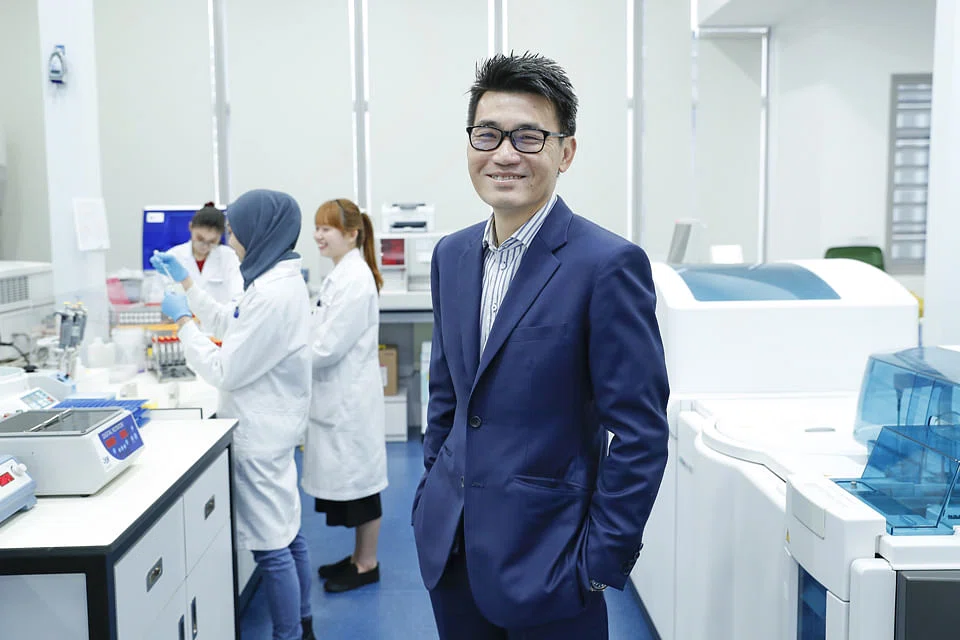
NURTURING talent and unlocking human potential are lifelong passions for healthcare entrepreneur Jeremy Yee. "What truly inspires me is the process of identifying and grooming the next generation of leaders and entrepreneurs, who can grow faster than the organisation," said the chief executive of SGX-listed precision medicine services firm Clearbridge Health.
"The joy comes from being a variable in the equation where people develop to their fullest potential. After all, products do not move by themselves - it is the human capital that makes things happen." That's why Mr Yee feels his journey in healthcare - spanning nearly two decades - has reaped multiple rewards despite myriad challenges along the way. "The key is having a learning mindset. In mentoring and coaching others, I find myself developing and growing as well - that's the most satisfying part of the process," he added.
A holder of Master's degrees in Arts, Commerce and Business Administration from universities in the US, Australia and Singapore, he was named executive director and chief executive of Clearbridge Health in May 2017.
Prior to this appointment, from 2011 to 2016, he helmed SGX-listed cord blood banking services company Cordlife Group. Between 2002 and 2011, he held chief financial officer and chief operating officer roles with ASX-listed Cordlife. The early part of his career was spent in the banking and finance industry.
Mr Yee's decision to focus on healthcare stems largely from a desire to cater to what he sees as a pressing and growing need in the region. "Healthcare is pretty much an under-served market here, given Asean's population base of more than 655 million. With a feasible business model, you can easily capture a multitude of opportunities."
In particular, precision medicine - which tailors drug treatments to individual patients based on their genes, lifestyle, and environment - has an increasing relevance today. "The best healthcare strategy is a patient-centric, customised approach, rather than a one-size-fits-all method of disease treatment and prevention," he said. "If we want to improve diagnoses and treatments for patients with critical or chronic illnesses like cancer and diabetes, it's important to understand their underlying conditions, so as to provide targeted therapy."
According to projections by Research and Markets, the global precision medicine market could be valued at US$216.8 billion by 2028, reflecting a compound annual growth rate (CAGR) of 10.6 per cent.
The Asia-Pacific market - the world's fastest-growing - was valued at US$11 billion in 2018, and is anticipated to hit US$20.9 billion by 2023, expanding at a CAGR of 16.6 per cent, data from Ken Research showed. Key drivers include a rapidly ageing population, longer life spans and technological advances.
This is where Clearbridge Health, with its precision medicine tools and technologies, can play an important and expanding role. "First, in terms of scope, we can provide relevant products and services using a pricing model that is affordable," Mr Yee said. "Second, in terms of scale, we can offer these services to doctors and patients, both in Singapore and across markets in South-east Asia."
Established in 2010 in Singapore and known then as Clearbridge Accelerator, the company invested in medical technology and incubated global deep-tech healthcare firms. In 2017, the business expanded to include medical clinics and strategic stakes in precision medical technology companies.
Listing on SGX's Catalist board in December 2017, Clearbridge Health now has a growing network of owned and operated primary healthcare touchpoints as well as healthcare systems across Asia. The group also has stakes in three medical technology firms - 23.1 per cent-owned associate Biolidics, which listed on Catalist in December 2018; Clearbridge Biophotonics; and the Singapore Institute of Advanced Medicine Holdings.
Last month, Biolidics announced the launch of a rapid test kit for Covid-19 that uses serum, plasma or whole blood samples to test for the novel coronavirus. The kit has obtained provisional authorisation from Singapore's Health Sciences Authority, relevant authorisation from the Food and Drug Administration of the Philippines, as well as the Conformitè Europëenne (CE) Marking for use in the European Union.
"Our vision is to bring high-quality healthcare and solutions to the masses through a distribution model that makes it readily available and affordable - such as a Public-Private Partnership model, in countries with national health insurance systems like the Philippines and Indonesia," Mr Yee said. "As a private player adding expertise and working with public hospitals on the ground, we want to change the way local patients receive and experience healthcare."
A case in point is Indonesia, where Clearbridge currently manages a total of 49 hospital joint operation contracts, serving close to four million patients a year, primarily in the area of renal care and pathology. Thanks to its Indonesian operations, the group's healthcare systems business unit was the major revenue contributor in 2019, with sales surging more than four-fold to S$15.6 million.
But even as demand for quality healthcare in the region continues to accelerate, challenges abound. The most obvious are operational issues - "especially when the healthcare sector in Asia is fragmented, with policies and regulations diverging across countries", he said.
To drive expansion, Clearbridge has adopted a three-pronged approach - building, borrowing and buying. The group aims to enlarge its network in existing countries, and expand into new, populous markets via the public-private-partnership model where relevant.
"We're not an earnings aggregator - we don't buy clinics to boost our profits," Mr Yee added. "Instead, we want to accumulate skills and expertise to expand, as well as improve the quality of treatments that patients receive, especially beyond Singapore, as South-east Asia is our hinterland."
The group is also deliberately prudent in its acquisitions. "We require every entity we buy to be Ebitda- (earnings before interest, tax, depreciation and amortisation) positive and contribute immediately to our financial performance."
Other hurdles include market volatility and valuation. "Clearbridge is moving towards profitability, but market volatility is such that it doesn't give entrepreneurs an opportunity to exploit capital markets for growth," Mr Yee said.
Clearbridge's market capitalisation - currently about S$117 million - has shrunk slightly from its initial public offer (IPO) market cap of S$135 million. For the year ended Dec 31, 2019, the group reported a revenue of S$21.5 million, up nearly four-fold.
"It's been a challenge to successfully convey our entrepreneurial vision to investors, and the market has limited tools with which to evaluate high-growth companies like us," Mr Yee said. As a result, Clearbridge Health remains largely unrecognised by the market, with Ebitda and revenues moving in opposite directions to its share price, he added.
"We own proprietary technologies, and an associate like Biolidics that's supporting us in novel diagnostic capabilities," he added. "We have an asset-light business model, and no direct competitor in Singapore - our closest peers are private hospital groups with more assets in real estate than medical products and services."
Maintaining a balance between growth and cashflows also keeps Mr Yee up late into the night. Sometimes, the epiphany comes during one of his daily 10-km runs. But more often than not, a decision is reached after brainstorming with the rest of his team.
And for the 50-year-old father of two girls and a boy aged 14 to 20, leading by example is paramount. Cultivating integrity, a razor-sharp focus and resilience are also at the top of his list. "The key defining characteristic of an entrepreneur centres on how he or she deals with problems. Entrepreneurs never give up - if they feel deep in their gut that this is the right thing to do, they will die trying."