CLI to rebalance portfolio, grow India and South-east Asia businesses
As the asset management group diversifies further, its funds under management in China will fall to 10% to 20% by 2028, from 27% currently


CAPITALAND Investment (CLI) will rebalance its portfolio to grow its India and South-east Asia business and optimise its China holdings, as it seeks further “geographical diversification” for growth.
The group also plans to “leverage M&A (mergers and acquisitions) to grow in our focus markets of Japan, Korea and Australia, and look to ex-Asia developed markets such as the US and Europe next”, CLI said on Nov 22.
The asset management group aims to double funds under management (FUM) from S$102 billion as at the third quarter of 2023, to S$200 billion in FY2028. This is expected to drive CLI’s overall return on equity towards the 10 to 12 per cent level on a sustainable basis, said DBS Research analysts in a note on Saturday.
They also expect CLI to tap into the Chinese or Indian real estate investment trust (Reit) markets.
It expects China’s contribution to CLI’s funds under management to moderate, it told investors.
As CLI ramps up in other markets, China contributions will be reduced to 10 to 20 per cent by the financial year 2028. This is down from 27 per cent of CLI’s FUM as at Nov 21, 2024.
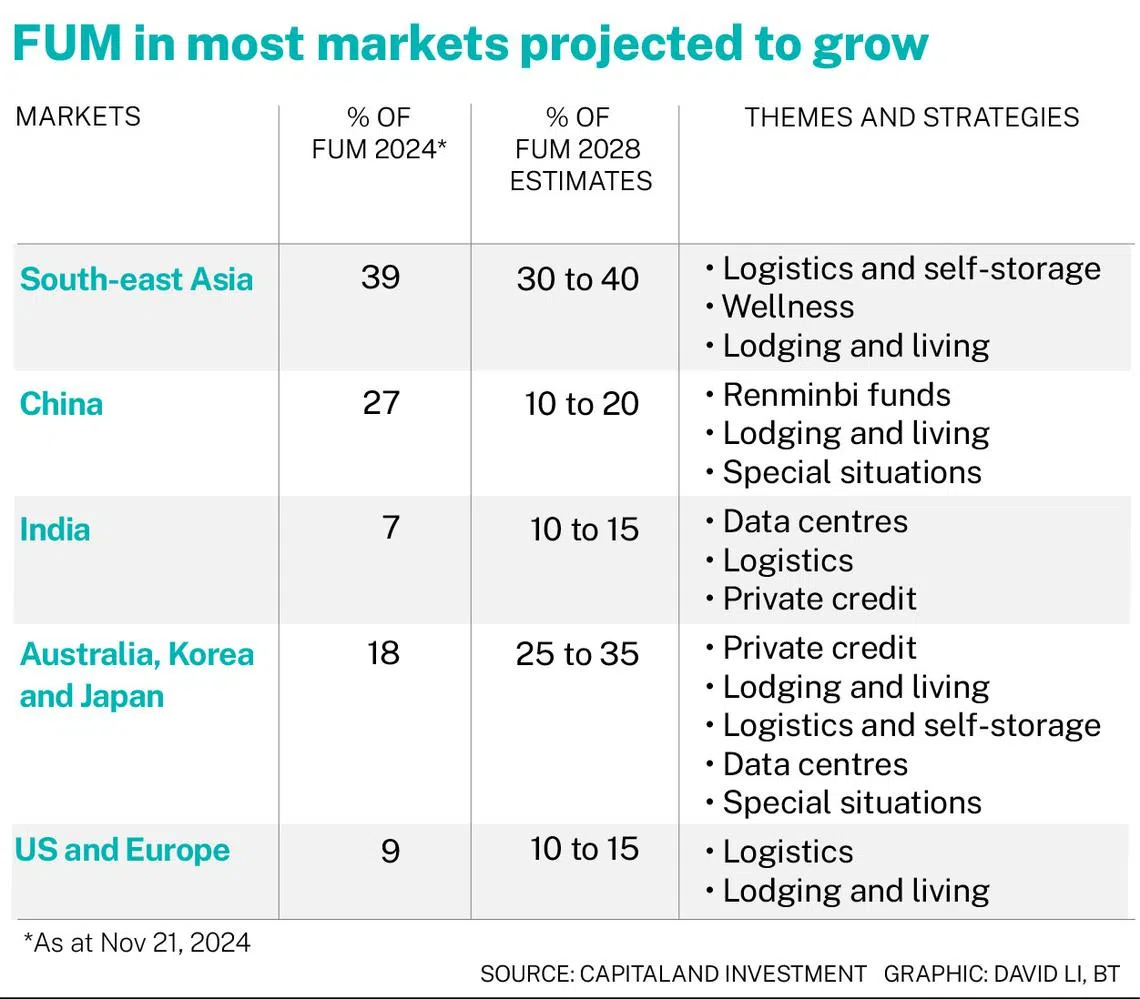
Growth in China will be driven by CLI’s renminbi funds, lodging and living businesses, as well as investment opportunities arising from special situations, said the group.
Lee Chee Koon, group chief executive officer at CLI, said: “As we pivot to become an asset-light global real asset manager, we are actively managing our balance sheet and have made creditable progress in our capital recycling efforts.”
He noted that since 2021, the group has recycled S$24 billion, out of which about S$11 billion came from China. The group’s China business has also raised nearly 50 billion yuan (S$9.2 billion) in domestic capital since 2021, said Lee.
But he cautioned that CLI is likely to “face challenges as we reconstitute our portfolio in China in the short term”.
While CLI’s real estate investment business (REIB) continues to contribute to its bottom line, the group said that earnings are “impacted by non-operating movements”.
It warned of potential fair-value or divestment losses, such as from China, which could affect non-operating earnings in the near to medium term.
In 2023, CLI China’s return on equity stood at negative 8 per cent, and this metric will continue to be under pressure, said the group.
For the nine months ended September, CLI’s REIB generated revenue of S$1.42 billion, down 2 per cent from S$1.44 billion in the previous corresponding period.
The decline was mainly due to divestments in India, Australia and France, which led to lower REIB revenue in their respective geographic segments.
The group expects REIB income to contribute 30 to 40 per cent of its earnings. This will be led by higher earnings from private funds and warehousing of products such as credit that generate double-digit returns, said CLI.
Total revenue for the nine-month period amounted to S$2.1 billion, representing a slight improvement from S$2.09 billion in the prior year. This comes as contributions from fee income-related business grew 6 per cent on the year to S$845 million.
This segment is also expected to contribute 60 to 70 per cent and improve overall quality of CLI earnings in the future, said the group.
In the DBS Research report, analysts also noted that CLI’s growth strategy enables the group to attract capital and make investments that are aligned with long-term trends. These include demographic shifts, digitalisation, as well as changes to supply chains.
The analysts pointed to CLI’s plans to grow its FUM by investing in lodging and living, data centres and logistics businesses. It will invest in its Reits as demand for income-focused financial products rises.
The analysts maintained their “buy” call on the counter with a target price of S$3.85.
Shares of CLI were trading 0.4 per cent or S$0.01 higher at S$2.80 as at 4.51 pm on Monday.